Ethereum vs Bitcoin: Key Differences Explained
Ethereum and Bitcoin are the two largest crypto networks, but they were built for different goals. Here is a clear comparison of how they differ and where each one shines.

By James Park, NFT & Web3 Gaming Analyst
NFTs, Web3 Gaming, GameFi, Digital Collectibles, Creator Economy
✓ Reviewed by Olivia Bennett· Blockchain Security Researcher
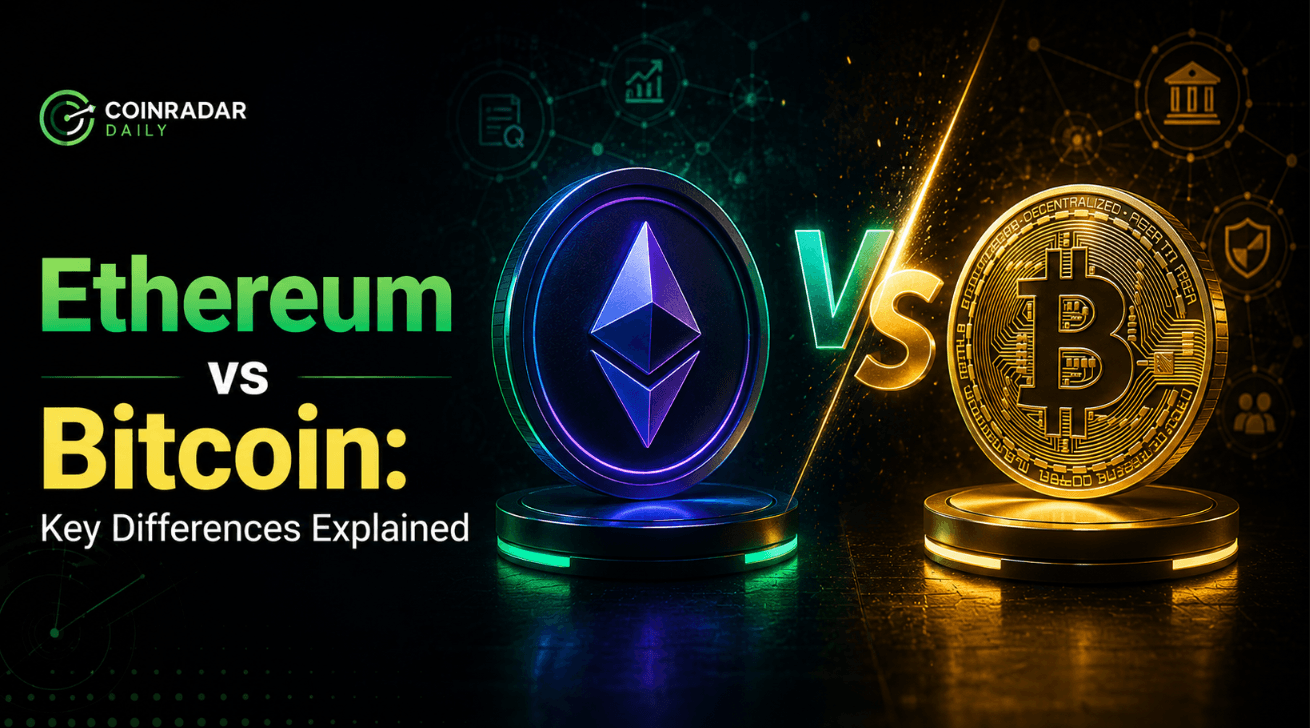
Ethereum and Bitcoin are the two largest cryptocurrencies, but they were designed for different purposes. Bitcoin is built primarily as digital money and a store of value, with a fixed supply and a simple, security-focused design. Ethereum is a programmable platform that runs smart contracts and applications, with ETH used to power that activity. In short, Bitcoin aims to be sound digital money, while Ethereum aims to be a global computer for decentralized apps.
Key takeaways
- Bitcoin focuses on being a store of value and a payment network.
- Ethereum is a programmable platform that runs smart contracts and apps.
- Bitcoin has a fixed supply cap, while ETH supply policy works differently.
- Bitcoin uses proof-of-work mining; Ethereum uses proof-of-stake validators.
- They are often complementary rather than direct competitors.
Different goals from the start
Bitcoin was created to be a decentralized form of money that no government or company controls. Its design deliberately keeps things simple and predictable to maximize security and reliability. Ethereum came later with a broader ambition: to let developers build any kind of application on a shared blockchain. That difference in purpose shapes almost every technical choice each network makes.
Supply and monetary policy
Bitcoin has a hard cap on its total supply, which underpins its reputation as digital scarcity and a hedge against inflation. Ethereum does not use the same fixed cap; its supply changes based on how much ETH is issued to validators and how much is removed through fees. This makes Bitcoin's monetary policy famously predictable and Ethereum's more dynamic and tied to network usage.
How they reach consensus
Bitcoin and proof of work
Bitcoin relies on miners who use computing power to secure the network and add new blocks. This proof-of-work system is highly secure and time-tested, but it is energy-intensive by design. The cost of mining is what makes attacking Bitcoin prohibitively expensive.
Ethereum and proof of stake
Ethereum uses proof of stake, where validators lock up ETH to secure the network instead of competing with computing power. This approach uses far less energy and ties security to economic stake rather than hardware. Each model has trade-offs, but both aim to keep their networks honest and resistant to attack.
Comparing Ethereum and Bitcoin is less about which one wins and more about understanding two different bets: one on digital scarcity, the other on programmable infrastructure. — CoinRadar Daily analysis
Use cases and ecosystems
Bitcoin is most often used as a long-term store of value and a way to move money across borders. Ethereum supports a sprawling ecosystem of finance, marketplaces, gaming, and tools, all built on its smart contract platform. Because of this, the two networks attract different kinds of users and developers, even though many people hold both.
Which one is right for you?
If you mainly want a simple, scarce digital asset to hold, Bitcoin's focus suits that goal. If you want to use applications, stake, or interact with on-chain finance, Ethereum's flexibility is the draw. Many investors treat them as complementary, holding Bitcoin for its monetary properties and Ethereum for its utility. Whatever you choose, understand the risks and never invest more than you can afford to lose.
Frequently asked questions
Is Ethereum better than Bitcoin?+
Neither is strictly better; they are built for different purposes. Bitcoin excels as a store of value and simple money, while Ethereum excels as a platform for applications and smart contracts. The right choice depends on your goals.
Do Ethereum and Bitcoin compete?+
They overlap somewhat but are often complementary. Bitcoin emphasizes being sound digital money, while Ethereum emphasizes programmability. Many people hold both for different reasons.
Why does Bitcoin use more energy than Ethereum?+
Bitcoin uses proof-of-work mining, which relies on computing power and consumes significant energy. Ethereum switched to proof of stake, which secures the network through staked ETH and uses far less energy.
Does Bitcoin have smart contracts like Ethereum?+
Bitcoin has limited scripting capabilities and is not designed primarily for complex smart contracts. Ethereum was built specifically to run smart contracts and applications, which is its main differentiator.
Should I buy Bitcoin or Ethereum?+
That depends on your goals and risk tolerance. Some prefer Bitcoin for its fixed supply and store-of-value role, others prefer Ethereum for its utility. This is not financial advice, so research carefully before deciding.
Written by
James ParkNFT & Web3 Gaming AnalystNFTs, Web3 Gaming, GameFi, Digital Collectibles, Creator Economy
James Park serves as the NFT & Web3 Gaming Analyst at CoinRadar Daily, where he covers the rapidly evolving worlds of blockchain gaming, digital collectibles, metaverse ecosystems, and creator-driven economies. Combining expertise in interactive media with blockchain technology, he analyzes how NFTs and decentralized gaming continue to reshape digital ownership and online communities. James earned a Master of Fine Arts in Digital Media from NYU Tisch School of the Arts, giving him a unique perspective that blends creative storytelling, digital culture, and emerging technology. Rather than viewing NFTs solely through an investment lens, he examines their broader impact on entertainment, gaming, intellectual property, and community engagement. Prior to joining CoinRadar Daily, James reported on the NFT industry and blockchain gaming for several leading digital media outlets, covering the explosive growth of the NFT market, the transition toward utility-focused collections, and the evolution of GameFi. His close relationships with independent developers, digital artists, and gaming communities allow him to identify important industry trends long before they reach mainstream attention. His reporting places particular emphasis on sustainable Web3 game design, token economies, and the long-term viability of blockchain-powered virtual worlds. James has published extensive research analyzing why certain gaming ecosystems thrive while others struggle with inflationary token models, weak player retention, or unsustainable reward structures. His market analysis is frequently referenced by blockchain startups, investors, and game studios evaluating new Web3 projects. Beyond journalism, James actively participates in NFT and decentralized creator communities while following developments in digital art, virtual economies, and next-generation gaming technologies. He also contributes educational content on blockchain gaming and regularly speaks about the future of digital ownership, helping CoinRadar Daily deliver balanced, research-driven coverage at the intersection of technology, gaming, and crypto innovation.

✓Reviewed & edited by
Olivia BennettBlockchain Security ResearcherSmart Contract Security, Audit Reports, Exploits, DeFi Hacks, White-Hat Research
Olivia Bennett is the Blockchain Security Researcher at CoinRadar Daily, where she specializes in smart contract security, DeFi risk analysis, blockchain infrastructure, and protocol vulnerabilities. Drawing on years of hands-on cybersecurity experience, she delivers in-depth reporting that explains both the technical details and the real-world implications of security incidents across the digital asset ecosystem. Before joining CoinRadar Daily, Olivia built her career in cybersecurity, working in penetration testing, blockchain security assessments, and smart contract auditing. She participated in numerous security reviews for decentralized applications and blockchain protocols, helping identify critical vulnerabilities before they could be exploited. Her responsible disclosure work has contributed to improving the security of several major DeFi projects and protecting millions of dollars in digital assets. Olivia earned a Bachelor of Science in Computer Science from the University of Edinburgh and later completed advanced professional training in offensive security and blockchain technologies. Her combination of software security expertise and blockchain knowledge enables her to provide readers with clear, evidence-based analysis of exploits, protocol upgrades, and emerging attack vectors. At CoinRadar Daily, Olivia publishes detailed investigations into blockchain exploits, smart contract audits, cross-chain security, wallet protection, and evolving cyber threats affecting the crypto industry. She is particularly committed to translating highly technical research into practical guidance that helps investors, developers, and blockchain users better understand protocol risk and security best practices. Alongside her editorial work, Olivia contributes educational resources covering secure wallet management, decentralized finance security, and blockchain infrastructure. She also participates in industry events and technical discussions focused on strengthening Web3 security standards, supporting CoinRadar Daily's mission to provide accurate, research-driven coverage of the rapidly evolving digital asset landscape.
CoinRadar Daily content is written by named analysts and checked against our editorial standards. Market data is indicative and informational only — nothing here is financial advice.
Ethereum services, rated
How we score →Independent, rubric-scored tables covering the services this ethereum coverage keeps running into.
Best Liquid Staking Protocols
Top rated: Rocket Pool 8.1
Staking that hands you a tradable receipt token.
4rated →
Best Crypto Staking Platforms
Top rated: Figment 8.1
Services that stake on your behalf.
5rated →
Best DeFi Protocols
Top rated: Uniswap Protocol 9.0
The base layer everything else is built on.
4rated →
Keep Reading
Ethereum Layer 2 Rollups Explained: Arbitrum, Optimism, Base
Layer 2 rollups make Ethereum faster and cheaper by moving activity off the main chain. Here is how rollups work, what Arbitrum, Optimism, and Base offer, and what to watch.
Emily Volker · May 26, 2026→
Ethereum Gas Fees Explained and How to Reduce Them
Gas fees are the cost of doing anything on Ethereum. Here is what gas is, why it gets expensive, and concrete tactics to pay less without taking shortcuts on security.
Olivia Bennett · June 4, 2026→
Ethereum Staking Explained: How to Earn ETH Rewards
Staking lets ETH holders earn rewards while helping secure Ethereum. Here is how staking works, the different ways to do it, and the trade-offs to weigh first.
James Park · June 14, 2026→