Restaking: Why Stacked Risks Are Not Independent
Restaking sells one idea: capital already securing a network can secure others at the same time and earn twice. The arithmetic on the reward side is straightforward. The arithmetic on the risk side is where the argument is, because the failures are not independent events.

By Olivia Bennett, Blockchain Security Researcher
Smart Contract Security, Audit Reports, Exploits, DeFi Hacks, White-Hat Research
✓ Reviewed by Emily Volker· Editor-in-Chief

Restaking lets staked capital be pledged as security to additional services beyond the network it originally secured. Each service can impose its own slashing conditions on that collateral. The pitch is that the capital works harder. The complication is that the conditions under which it can be destroyed multiply, and they do not fail independently.
The reward side is simple. The risk side is not.
Adding a second source of payment to the same capital is easy to reason about: two streams instead of one, minus fees. If the added yield is a few percentage points on capital you had already committed, the offer looks close to free.
The risk side resists that treatment because the natural intuition — small independent probabilities compound into a still-small probability — does not apply. If two services could each slash your collateral, and the events were genuinely independent, the combined exposure would be modest. They are not independent, and the reasons are structural rather than incidental.
Four ways the correlation arrives
Shared operators. The same professional operators run infrastructure for many services, because operating is a specialised business with few participants. An operator failure hits every service that operator runs, and your collateral may be pledged to several of them.
Shared software. Services built on a common framework inherit common bugs. A defect in a widely-used component is a single event that triggers penalties across every service using it.
Shared conditions. Slashing is usually triggered by liveness or correctness failures, and the things that cause those — network partitions, cloud region outages, a bad client release — are exactly the events that hit many services at once.
Shared incentive to exit. When one service has a problem, restakers reassess all of them. Withdrawal pressure appears across services simultaneously, which is when queues lengthen and receipt tokens trade at discounts.
Each of these means the same underlying event shows up as several penalties. The distribution of outcomes is not a gentle curve of small independent losses; it is mostly nothing, occasionally a lot.
The opacity problem
There is a second issue specific to how restaking is packaged for ordinary depositors. Protocols that make restaking accessible generally do so by abstracting away which services the collateral is pledged to and which operators run them. That is the product: you deposit, and someone else makes the allocation.
The consequence is that the depositor cannot enumerate their own slashing exposure. They know they are exposed to a set of conditions; they frequently cannot say which, how many, or how correlated. Assessing an exposure you cannot list is not risk management, and no yield figure resolves it.
The protocols that score best on this are the ones that publish the allocation and the operator set, and that let a depositor see what their collateral is actually securing. That disclosure is not a nicety; it is the difference between a priced risk and an accepted one.
Where the extra yield comes from
It is worth applying the same question here as to any yield: who is paying, and why.
Restaking rewards are paid by services that need economic security and would otherwise have to bootstrap their own. That is a genuine service with a genuine buyer, which puts it in a better category than a return funded by token emissions. But the size of the payment depends on those services having sustainable revenue of their own, and many are early enough that their payments are subsidised by their own token issuance rather than by customers.
So a restaking return can be real external revenue, or it can be a second layer of emissions dressed as revenue, and the composition changes as the services mature. The question of who is paying is answerable service by service and is worth answering.
How to assess a restaking position
- Can you enumerate every service your collateral secures. If not, you cannot assess the exposure.
- How concentrated is the operator set across those services. Shared operators are the main correlation channel.
- Do the services pay from revenue or from their own token issuance. The second is emissions with extra steps.
- Has the withdrawal path been exercised at size, or only in principle.
- Does the protocol retain your withdrawal credentials, or do you. That decides who can ultimately move the principal.
None of this makes restaking a bad instrument. It makes it a leveraged one: the same capital, more claims against it, and a loss distribution with a longer tail than the headline suggests. That is a legitimate position to take deliberately and a poor one to arrive at because the yield was a little higher.
Restaked and liquid restaking tokens are also accepted as collateral on lending markets, where a failure in one layer turns into bad debt in another. Lending protocols have taken losses along exactly this path, and our ledger of DeFi risk managers shows which firms held the parameters when they did.
Sources
2 references- 01Proof-of-stake rewards and penalties
ethereum.org · accessed August 22, 2026
- 02Attack and defense in proof-of-stake
ethereum.org · accessed August 22, 2026
Frequently asked questions
Is restaking just staking with more yield?+
It is staking with more yield and more ways to lose the principal. The same collateral is pledged to multiple services, each able to slash it, and those slashing events share operators, software and triggering conditions. The extra return is compensation for a risk most depositors have not enumerated.
Why are the risks correlated rather than independent?+
Because the services share infrastructure. The same small set of professional operators, the same frameworks and the same network-level events sit behind many of them, so one underlying failure surfaces as several penalties at once.
Is restaking yield real?+
Sometimes. It is paid by services buying economic security, which is a genuine transaction with a genuine buyer. But many such services fund those payments from their own token issuance rather than revenue, which makes the return a second layer of emissions. It is answerable service by service.
What should I check before restaking?+
Whether you can list every service your collateral secures, how concentrated the operator set is across them, whether the services pay from revenue or emissions, whether the withdrawal path has been tested at size, and who holds the withdrawal credentials.
Written by
Olivia BennettBlockchain Security ResearcherSmart Contract Security, Audit Reports, Exploits, DeFi Hacks, White-Hat Research
Olivia Bennett is the Blockchain Security Researcher at CoinRadar Daily, where she specializes in smart contract security, DeFi risk analysis, blockchain infrastructure, and protocol vulnerabilities. Drawing on years of hands-on cybersecurity experience, she delivers in-depth reporting that explains both the technical details and the real-world implications of security incidents across the digital asset ecosystem. Before joining CoinRadar Daily, Olivia built her career in cybersecurity, working in penetration testing, blockchain security assessments, and smart contract auditing. She participated in numerous security reviews for decentralized applications and blockchain protocols, helping identify critical vulnerabilities before they could be exploited. Her responsible disclosure work has contributed to improving the security of several major DeFi projects and protecting millions of dollars in digital assets. Olivia earned a Bachelor of Science in Computer Science from the University of Edinburgh and later completed advanced professional training in offensive security and blockchain technologies. Her combination of software security expertise and blockchain knowledge enables her to provide readers with clear, evidence-based analysis of exploits, protocol upgrades, and emerging attack vectors. At CoinRadar Daily, Olivia publishes detailed investigations into blockchain exploits, smart contract audits, cross-chain security, wallet protection, and evolving cyber threats affecting the crypto industry. She is particularly committed to translating highly technical research into practical guidance that helps investors, developers, and blockchain users better understand protocol risk and security best practices. Alongside her editorial work, Olivia contributes educational resources covering secure wallet management, decentralized finance security, and blockchain infrastructure. She also participates in industry events and technical discussions focused on strengthening Web3 security standards, supporting CoinRadar Daily's mission to provide accurate, research-driven coverage of the rapidly evolving digital asset landscape.

✓Reviewed & edited by
Emily VolkerEditor-in-ChiefEditorial Strategy, Investigative Journalism, Crypto Media, E-E-A-T Standards
Emily Volker is the Editor-in-Chief of CoinRadar Daily, where she leads a multilingual editorial team covering cryptocurrency markets, blockchain innovation, Web3, and global digital asset regulation across eight languages. With more than a decade of experience in financial and technology journalism, she has played a key role in developing high editorial standards and trusted reporting within the digital asset industry. Emily began her career as a financial journalist reporting on commodities, energy markets, and emerging technologies before discovering Bitcoin and decentralized finance in the early 2010s. She later moved to London to join one of Europe's early blockchain-focused media organizations, where she advanced into senior editorial leadership. Her experience reporting through both the rapid expansion of the 2017 ICO boom and the subsequent market correction reinforced her commitment to fact-based, research-driven journalism in an industry often influenced by speculation. She holds a Master's degree in International Journalism from City, University of London, and has completed executive studies in digital media strategy through the Reuters Institute at Oxford. Emily is a strong advocate for editorial transparency, rigorous verification, and responsible financial reporting. She also helped integrate Google's E-E-A-T principles—Experience, Expertise, Authoritativeness, and Trustworthiness—into the editorial standards followed by CoinRadar Daily. Under her leadership, CoinRadar Daily has expanded into a global cryptocurrency news platform publishing content in eight languages with a network of editors, analysts, and contributors across four continents. Emily oversees investigative reporting, editorial policy, content quality, and fact-checking processes to ensure every article meets the publication's standards for accuracy, credibility, and independence. Alongside her editorial responsibilities, Emily mentors aspiring journalists through digital media initiatives and regularly speaks at international conferences focused on journalism, fintech, blockchain technology, and digital assets, where she discusses responsible reporting, combating misinformation, and the evolving future of financial media.
CoinRadar Daily content is written by named analysts and checked against our editorial standards. Market data is indicative and informational only — nothing here is financial advice.
DeFi services, rated
How we score →Independent, rubric-scored tables covering the services this defi coverage keeps running into.
Best DeFi Protocols
Top rated: Uniswap Protocol 8.9
The base layer everything else is built on.
4rated →
Best Decentralised Exchanges
Top rated: Uniswap 8.7
Swap venues where you never hand over your keys.
5rated →
Best Crypto Lending Platforms
Top rated: Aave 8.0
Borrow against your holdings, or lend them out.
4rated →
Keep Reading
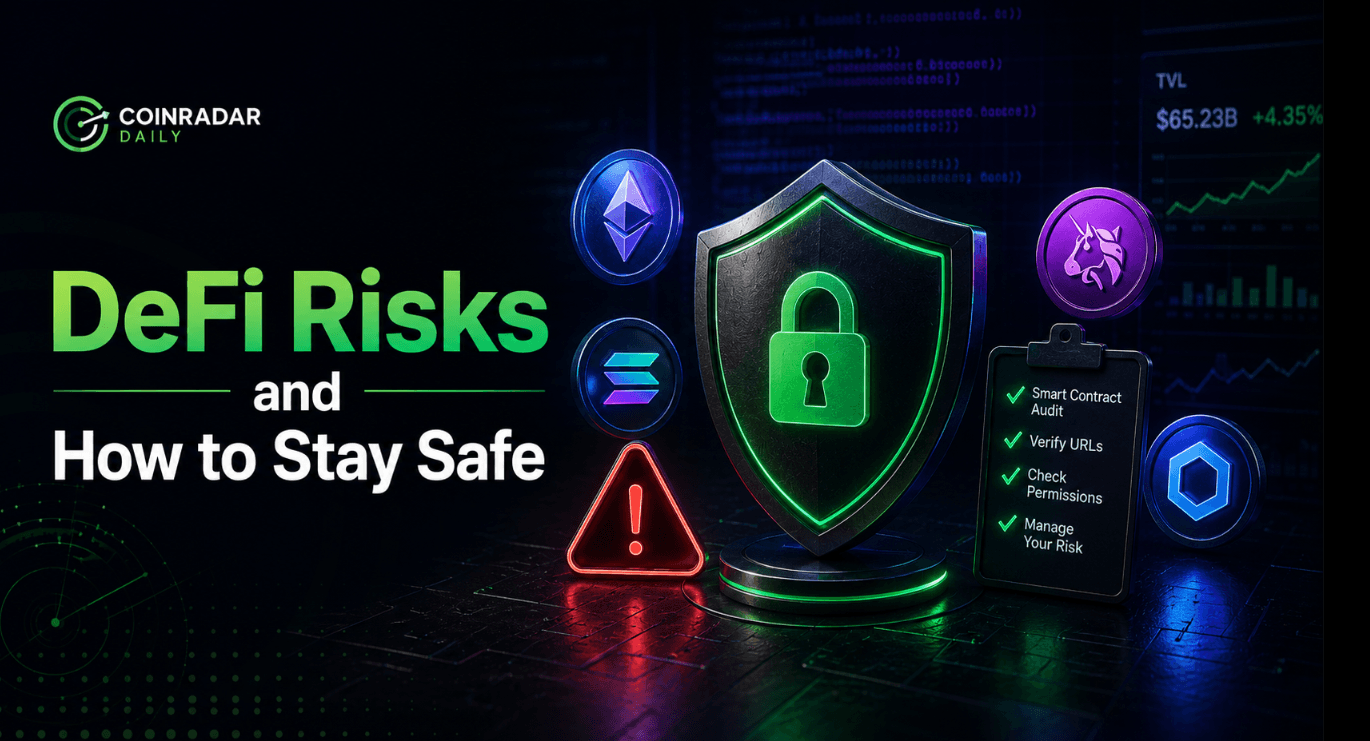
DeFi Risks and How to Stay Safe
DeFi opens powerful financial tools to anyone, but it also removes the safety nets of traditional finance. Here are the main risks and the habits that help you avoid them.
James Park · May 24, 2026→
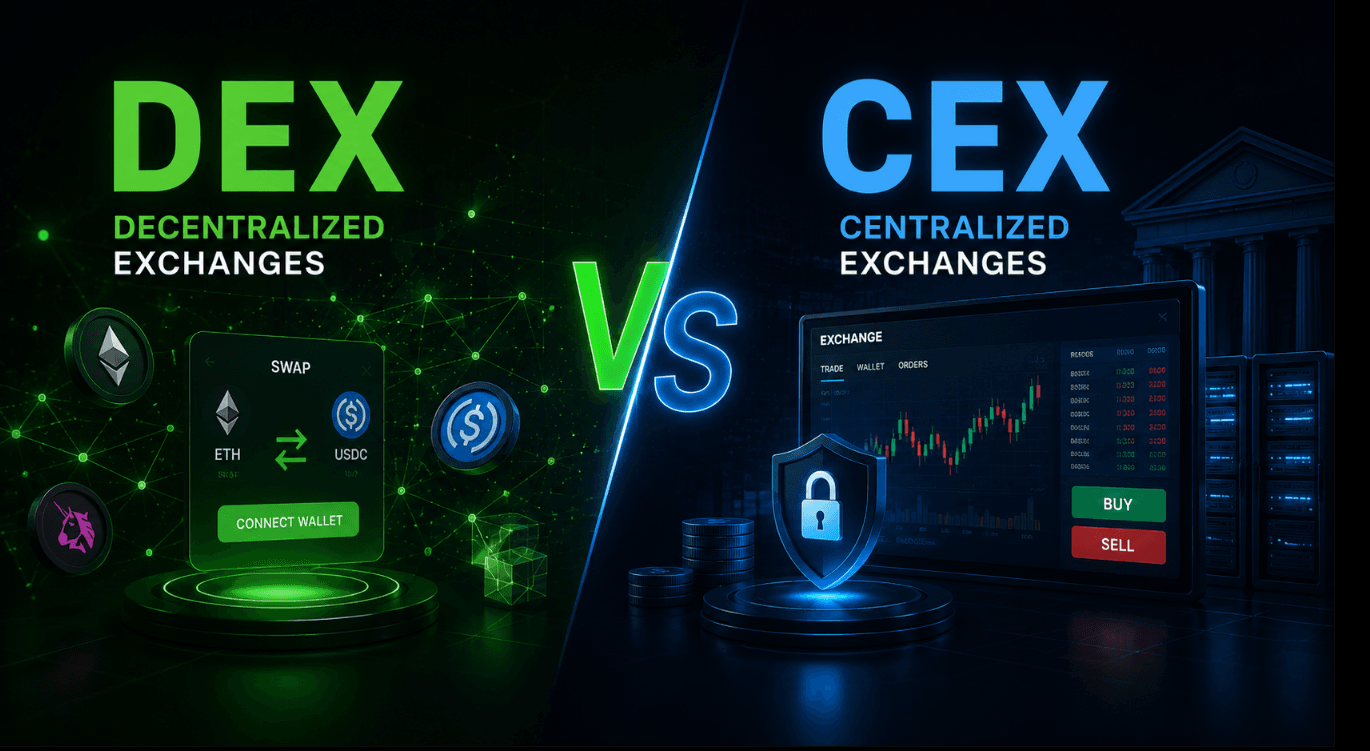
DEX vs CEX: Decentralized vs Centralized Exchanges
Centralized exchanges hold your funds and feel like apps; decentralized exchanges let you trade from your own wallet. Here is how the two compare and when to use each.
Emily Volker · May 26, 2026→
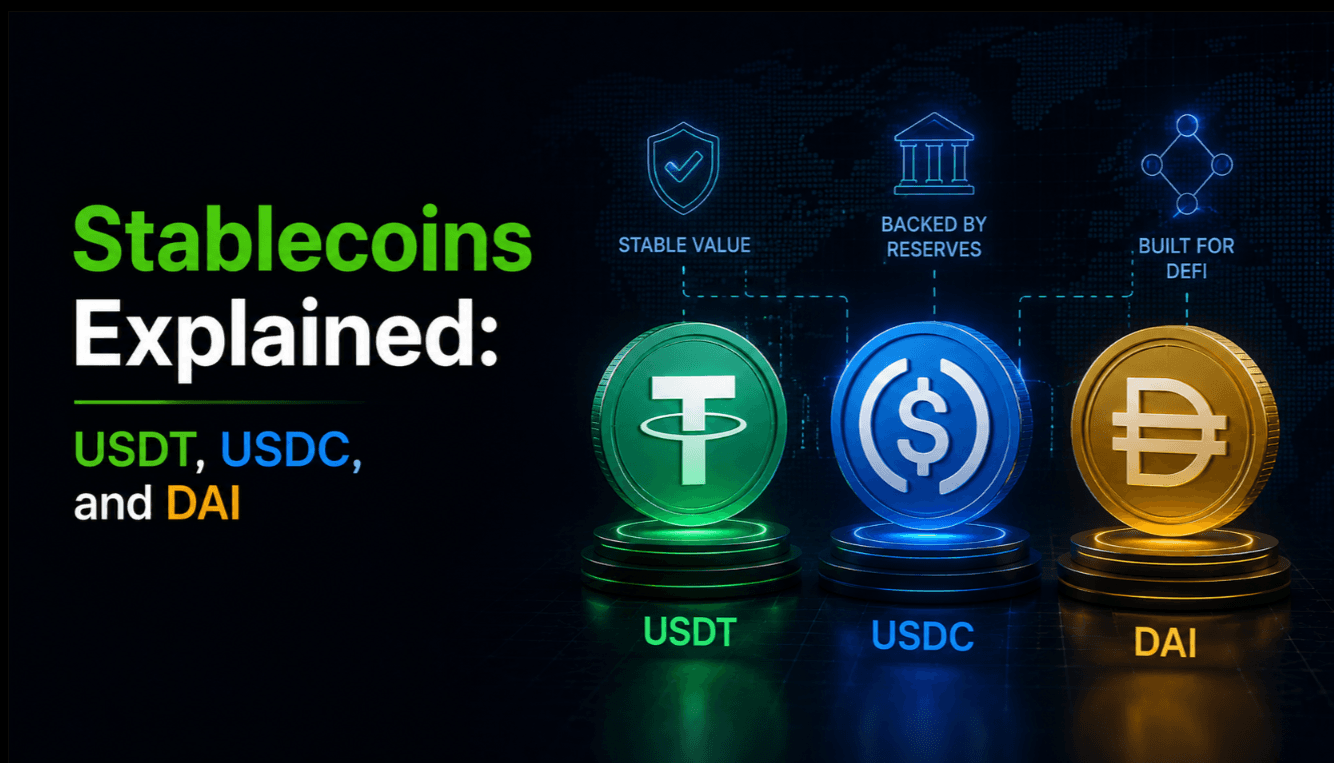
Stablecoins Explained: USDT, USDC, and DAI
Stablecoins aim to hold a steady value, usually one US dollar, so crypto users can move and store money without volatility. Here is how USDT, USDC, and DAI differ.
Olivia Bennett · June 4, 2026→