DeFi Risks and How to Stay Safe
DeFi opens powerful financial tools to anyone, but it also removes the safety nets of traditional finance. Here are the main risks and the habits that help you avoid them.

By James Park, NFT & Web3 Gaming Analyst
NFTs, Web3 Gaming, GameFi, Digital Collectibles, Creator Economy
✓ Reviewed by Emily Volker· Editor-in-Chief
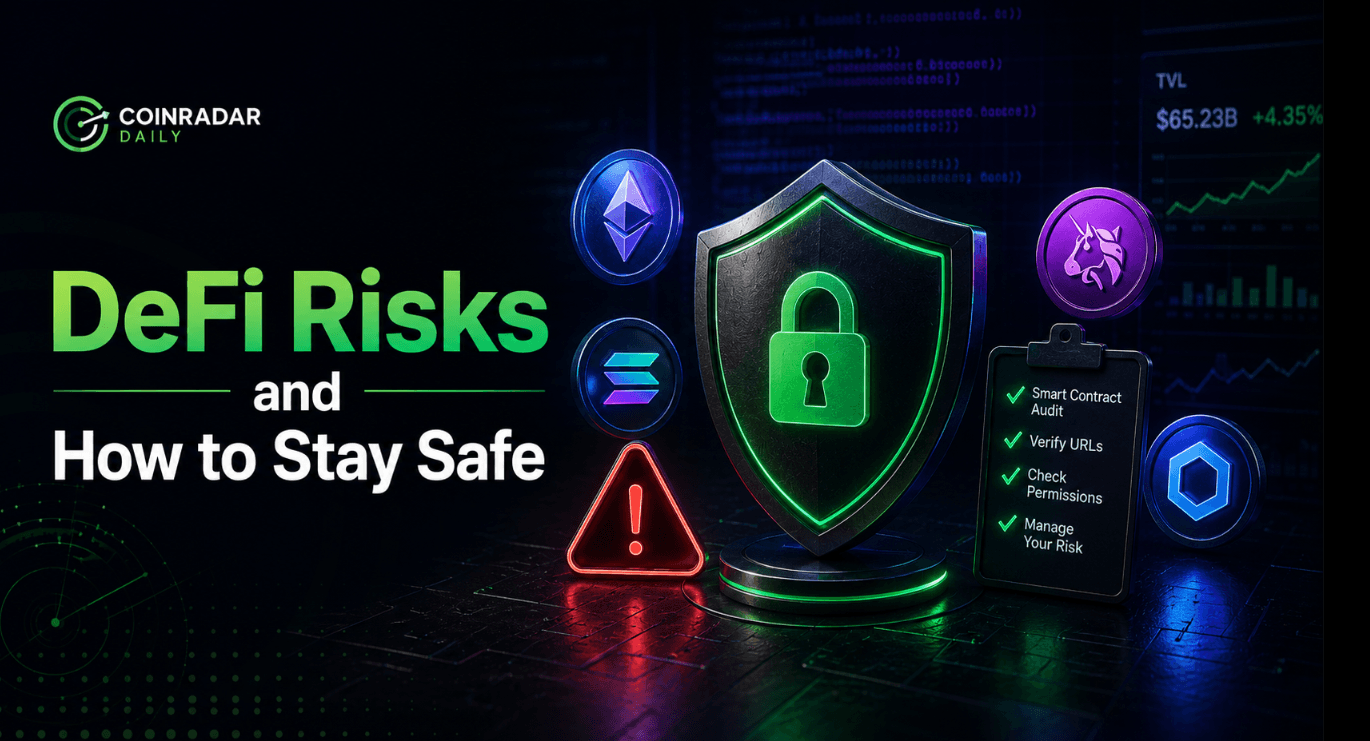
DeFi gives anyone access to lending, trading, and yield without intermediaries, but it also strips away the protections people expect from banks. There is no fraud department, no deposit insurance, and usually no way to reverse a mistaken or malicious transaction. The biggest risks fall into a few clear categories, and most losses can be reduced with a handful of disciplined habits rather than deep technical expertise.
Key takeaways
- DeFi has no safety net: most transactions are irreversible and uninsured.
- Smart-contract bugs can drain even well-intentioned protocols.
- Rug pulls and scams are designed to look legitimate until funds vanish.
- Wallet security and careful approvals prevent a large share of losses.
- Skepticism toward outsized yields is one of your best defenses.
Smart-contract risk
Every DeFi protocol runs on code, and code can contain flaws. A bug or logic error in a smart contract can let an attacker drain funds, often within a single transaction and with no warning. Audits by reputable firms reduce this risk but never eliminate it, because audits can miss issues and new code is always being added. The longer a protocol has operated at scale without an incident, the more it has been tested by real-world pressure.
How to limit smart-contract exposure
Favor established protocols with a long track record, multiple independent audits, and a transparent team. Avoid putting a large share of your funds into a single contract, and be cautious with brand-new projects that have not yet been battle-tested. Spreading exposure does not remove risk, but it limits how much a single failure can cost you.
Rug pulls and exit scams
A rug pull happens when the people behind a project drain its liquidity or value and disappear, leaving holders with worthless tokens. These schemes often arrive wrapped in hype: aggressive marketing, anonymous teams, and promises of returns that make no economic sense. Because anyone can launch a token, the barrier to creating a convincing fake is low.
- Anonymous teams with no verifiable history or accountability.
- Liquidity that is not locked, letting founders withdraw it at will.
- Token ownership concentrated in a few wallets controlled by insiders.
- Pressure tactics urging you to buy quickly before you can research.
- Yields far above anything sustainable, used as bait.
Most DeFi losses are not exotic hacks. They are ordinary people approving the wrong contract or chasing a yield that was never real. — CoinRadar Daily desk note
Wallet and approval risks
Many losses come not from broken protocols but from the wallet itself. Phishing sites trick users into signing malicious transactions, and token approvals can grant a contract ongoing permission to move your assets. A single careless signature can hand an attacker access to funds you never intended to expose.
Safer wallet habits
Use a hardware wallet for significant holdings, double-check every website address before connecting, and read what each transaction actually requests before signing. Periodically review and revoke token approvals you no longer need, and consider keeping a separate wallet for experimenting with new protocols so your main holdings stay isolated.
Market and economic risks
Even flawless code carries financial risk. Volatile collateral can trigger sudden liquidations, liquidity can dry up when you most want to exit, and stablecoins can temporarily lose their peg. Strategies that look profitable in calm markets can unravel quickly under stress, so understanding how a position behaves in a downturn matters as much as understanding its upside.
Building a personal safety routine
Staying safe in DeFi is mostly about consistent process. Research each protocol before depositing, start with small amounts, secure your recovery phrase offline, and treat any unusually high yield as a question rather than an opportunity. None of these steps requires advanced skills, but together they prevent the large majority of avoidable losses and let you explore DeFi with far more confidence.
Frequently asked questions
What is the most common way people lose money in DeFi?+
Many losses come from user-side mistakes such as signing malicious transactions, falling for phishing, or chasing scam tokens, rather than from sophisticated protocol hacks. Careful wallet habits prevent a large share of them.
How can I tell if a DeFi project is a rug pull?+
Watch for anonymous teams, unlocked liquidity, token supply concentrated in a few wallets, high-pressure marketing, and unsustainable yields. No single sign is proof, but several together are a serious warning.
Are audited protocols completely safe?+
No. Audits reduce risk by catching many issues, but they cannot guarantee safety. Bugs can be missed, and new code can introduce new vulnerabilities, so audits should be one factor among several.
What is a token approval and why does it matter?+
A token approval grants a smart contract permission to move specific tokens from your wallet. Overly broad or forgotten approvals can be exploited, so it is wise to review and revoke approvals you no longer use.
Should I use a hardware wallet for DeFi?+
For meaningful amounts, yes. A hardware wallet keeps your private keys offline and requires physical confirmation for transactions, which protects against many remote attacks and phishing attempts.
Written by
James ParkNFT & Web3 Gaming AnalystNFTs, Web3 Gaming, GameFi, Digital Collectibles, Creator Economy
James Park serves as the NFT & Web3 Gaming Analyst at CoinRadar Daily, where he covers the rapidly evolving worlds of blockchain gaming, digital collectibles, metaverse ecosystems, and creator-driven economies. Combining expertise in interactive media with blockchain technology, he analyzes how NFTs and decentralized gaming continue to reshape digital ownership and online communities. James earned a Master of Fine Arts in Digital Media from NYU Tisch School of the Arts, giving him a unique perspective that blends creative storytelling, digital culture, and emerging technology. Rather than viewing NFTs solely through an investment lens, he examines their broader impact on entertainment, gaming, intellectual property, and community engagement. Prior to joining CoinRadar Daily, James reported on the NFT industry and blockchain gaming for several leading digital media outlets, covering the explosive growth of the NFT market, the transition toward utility-focused collections, and the evolution of GameFi. His close relationships with independent developers, digital artists, and gaming communities allow him to identify important industry trends long before they reach mainstream attention. His reporting places particular emphasis on sustainable Web3 game design, token economies, and the long-term viability of blockchain-powered virtual worlds. James has published extensive research analyzing why certain gaming ecosystems thrive while others struggle with inflationary token models, weak player retention, or unsustainable reward structures. His market analysis is frequently referenced by blockchain startups, investors, and game studios evaluating new Web3 projects. Beyond journalism, James actively participates in NFT and decentralized creator communities while following developments in digital art, virtual economies, and next-generation gaming technologies. He also contributes educational content on blockchain gaming and regularly speaks about the future of digital ownership, helping CoinRadar Daily deliver balanced, research-driven coverage at the intersection of technology, gaming, and crypto innovation.

✓Reviewed & edited by
Emily VolkerEditor-in-ChiefEditorial Strategy, Investigative Journalism, Crypto Media, E-E-A-T Standards
Emily Volker is the Editor-in-Chief of CoinRadar Daily, where she leads a multilingual editorial team covering cryptocurrency markets, blockchain innovation, Web3, and global digital asset regulation across eight languages. With more than a decade of experience in financial and technology journalism, she has played a key role in developing high editorial standards and trusted reporting within the digital asset industry. Emily began her career as a financial journalist reporting on commodities, energy markets, and emerging technologies before discovering Bitcoin and decentralized finance in the early 2010s. She later moved to London to join one of Europe's early blockchain-focused media organizations, where she advanced into senior editorial leadership. Her experience reporting through both the rapid expansion of the 2017 ICO boom and the subsequent market correction reinforced her commitment to fact-based, research-driven journalism in an industry often influenced by speculation. She holds a Master's degree in International Journalism from City, University of London, and has completed executive studies in digital media strategy through the Reuters Institute at Oxford. Emily is a strong advocate for editorial transparency, rigorous verification, and responsible financial reporting. She also helped integrate Google's E-E-A-T principles—Experience, Expertise, Authoritativeness, and Trustworthiness—into the editorial standards followed by CoinRadar Daily. Under her leadership, CoinRadar Daily has expanded into a global cryptocurrency news platform publishing content in eight languages with a network of editors, analysts, and contributors across four continents. Emily oversees investigative reporting, editorial policy, content quality, and fact-checking processes to ensure every article meets the publication's standards for accuracy, credibility, and independence. Alongside her editorial responsibilities, Emily mentors aspiring journalists through digital media initiatives and regularly speaks at international conferences focused on journalism, fintech, blockchain technology, and digital assets, where she discusses responsible reporting, combating misinformation, and the evolving future of financial media.
CoinRadar Daily content is written by named analysts and checked against our editorial standards. Market data is indicative and informational only — nothing here is financial advice.
DeFi services, rated
How we score →Independent, rubric-scored tables covering the services this defi coverage keeps running into.
Best DeFi Protocols
Top rated: Uniswap Protocol 9.0
The base layer everything else is built on.
4rated →
Best Decentralised Exchanges
Top rated: Uniswap 8.7
Swap venues where you never hand over your keys.
5rated →
Best Crypto Lending Platforms
Top rated: Aave 8.3
Borrow against your holdings, or lend them out.
4rated →
Keep Reading
DEX vs CEX: Decentralized vs Centralized Exchanges
Centralized exchanges hold your funds and feel like apps; decentralized exchanges let you trade from your own wallet. Here is how the two compare and when to use each.
Emily Volker · May 26, 2026→
Stablecoins Explained: USDT, USDC, and DAI
Stablecoins aim to hold a steady value, usually one US dollar, so crypto users can move and store money without volatility. Here is how USDT, USDC, and DAI differ.
Olivia Bennett · June 4, 2026→
Yield Farming and Liquidity Pools Explained
Yield farming lets you earn returns by supplying assets to DeFi protocols, often through liquidity pools. Here is where those returns come from and what can go wrong.
James Park · June 12, 2026→