Yield Farming and Liquidity Pools Explained
Yield farming lets you earn returns by supplying assets to DeFi protocols, often through liquidity pools. Here is where those returns come from and what can go wrong.

By James Park, NFT & Web3 Gaming Analyst
NFTs, Web3 Gaming, GameFi, Digital Collectibles, Creator Economy
✓ Reviewed by Olivia Bennett· Blockchain Security Researcher
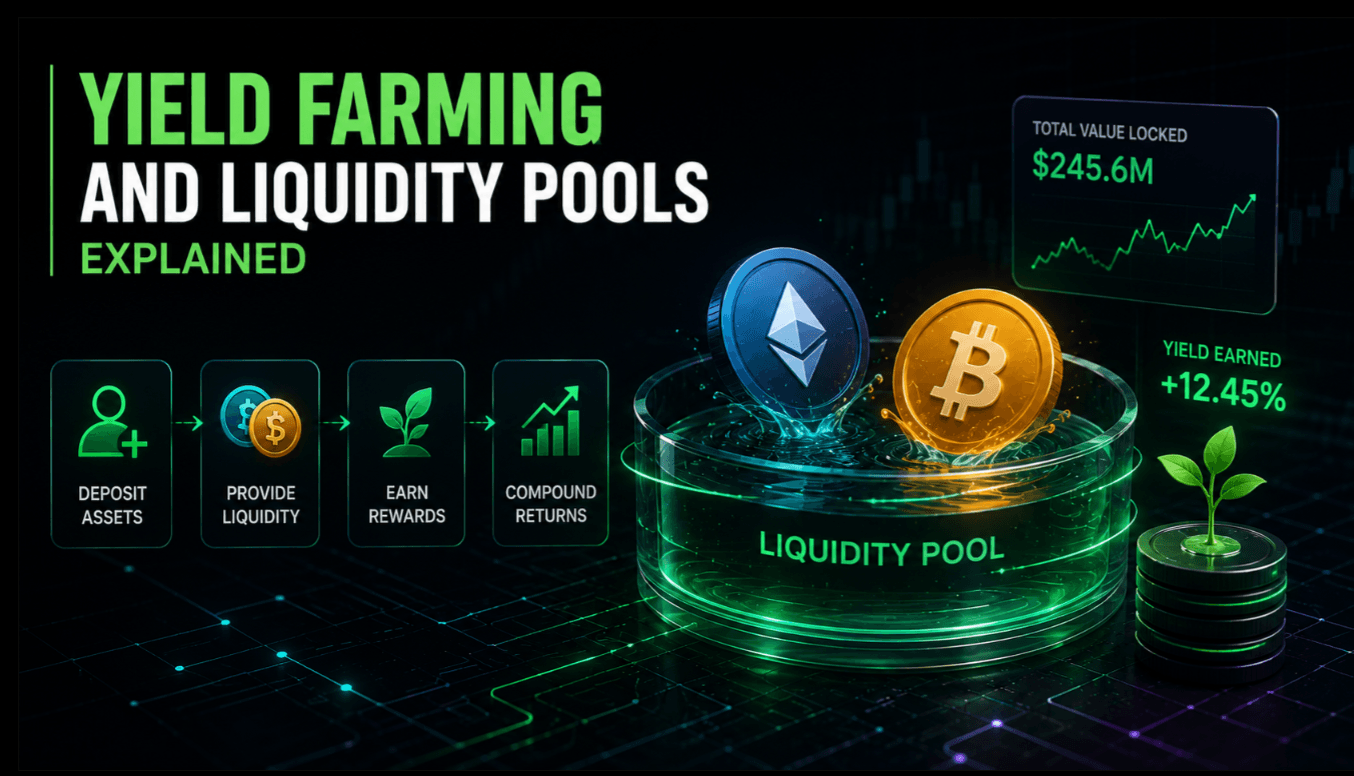
Yield farming is the practice of putting crypto assets to work in DeFi protocols to earn returns, most often by depositing them into liquidity pools. A liquidity pool is a smart contract holding two or more tokens that traders swap against, and the fees those trades generate are shared with the people who supplied the tokens. Layered on top are extra incentives, paid in protocol tokens, that boost the headline yield in exchange for taking on more risk.
Key takeaways
- Liquidity pools let users trade tokens against a shared pot instead of an order book.
- Liquidity providers earn a share of trading fees plus, sometimes, extra token rewards.
- Yield farming chains these rewards together to maximize returns on deposited assets.
- Impermanent loss can erode gains when the pooled tokens move apart in price.
- High advertised yields usually signal high risk, not free money.
How liquidity pools work
Most decentralized exchanges use automated market makers, where a formula sets prices based on the ratio of tokens in a pool. When someone swaps token A for token B, they add A and remove B, and the price adjusts automatically. Anyone can become a liquidity provider by depositing a balanced pair of tokens, and in return they receive LP tokens that represent their share of the pool.
Every swap charges a small fee that flows back to the pool, increasing the value of each LP token over time. The more trading volume a pool sees, the more fees its providers collect. This is the base layer of yield: it exists even without any extra incentive program.
Where the extra yield comes from
Trading fees alone are often modest, so protocols add incentives to attract liquidity. A protocol may distribute its own governance token to people who stake their LP tokens, effectively paying users to provide capital. Yield farmers then move between opportunities, compounding rewards and sometimes restaking reward tokens to earn yet more.
It is important to understand what backs each layer. Fee income comes from real economic activity. Token incentives, by contrast, come from new token issuance, and their value depends on whether the market keeps demanding that token. A high yield driven mostly by inflationary rewards can shrink quickly if the token price falls.
Impermanent loss, explained
Impermanent loss is the most misunderstood risk in liquidity provision. When the two tokens in a pool change price relative to each other, the automated rebalancing leaves a provider with a different mix than they deposited, and that mix can be worth less than simply holding the tokens would have been. The loss is called impermanent because it can shrink if prices return to their original ratio, but it becomes permanent the moment you withdraw.
Yield is a payment for risk. If you cannot explain why a pool pays what it pays, you have not finished your research. — CoinRadar Daily desk note
When impermanent loss matters most
Pools made of two volatile, unrelated tokens carry the highest impermanent-loss risk, because their prices can diverge sharply. Pools of two assets that track the same value, such as two dollar stablecoins, carry far less, since they tend to stay close to each other. Choosing the right kind of pool for your risk tolerance is half the battle.
Other risks worth weighing
- Smart-contract risk: a bug in the pool or farm contract can drain deposits.
- Reward-token volatility: incentives can lose value faster than they accrue.
- Liquidity risk: thin pools can be hard to exit without heavy slippage.
- Gas costs: frequent compounding can cost more than it earns on small balances.
- Protocol risk: governance changes can alter fees and reward schedules.
A measured approach to yield farming
Treat advertised annual percentage yields as a starting question rather than a promise. Separate the fee-based portion from the incentive-based portion, consider whether the pool exposes you to impermanent loss, and check how long the protocol has operated without incident. Starting with stablecoin pairs or established protocols lets you learn the mechanics before taking on the more aggressive strategies that produce the eye-catching numbers.
Frequently asked questions
What is the difference between staking and yield farming?+
Staking usually means locking a single asset to help secure a network or protocol in exchange for rewards. Yield farming typically involves supplying assets to liquidity pools or lending markets and often chaining several reward layers together for higher, but riskier, returns.
Can I lose money providing liquidity even if prices go up?+
Yes. Through impermanent loss, you can end up worse off than simply holding the tokens if their prices diverge, even when both rise. Trading fees and rewards may offset this, but they do not always fully cover it.
Are high APY farms a scam?+
Not always, but extremely high yields usually reflect high risk, heavy token inflation, or both. Some are outright scams. Always investigate where the yield comes from and how long the protocol has run safely.
Do I need to actively manage a yield farm?+
Often yes. Reward rates change, token prices move, and compounding may require periodic transactions. Some platforms automate this, but passive strategies still need monitoring for protocol or market changes.
What are LP tokens?+
LP tokens are receipts that represent your share of a liquidity pool. They track your claim on the pooled assets and accrued fees, and you redeem them to withdraw your portion of the pool.
Written by
James ParkNFT & Web3 Gaming AnalystNFTs, Web3 Gaming, GameFi, Digital Collectibles, Creator Economy
James Park serves as the NFT & Web3 Gaming Analyst at CoinRadar Daily, where he covers the rapidly evolving worlds of blockchain gaming, digital collectibles, metaverse ecosystems, and creator-driven economies. Combining expertise in interactive media with blockchain technology, he analyzes how NFTs and decentralized gaming continue to reshape digital ownership and online communities. James earned a Master of Fine Arts in Digital Media from NYU Tisch School of the Arts, giving him a unique perspective that blends creative storytelling, digital culture, and emerging technology. Rather than viewing NFTs solely through an investment lens, he examines their broader impact on entertainment, gaming, intellectual property, and community engagement. Prior to joining CoinRadar Daily, James reported on the NFT industry and blockchain gaming for several leading digital media outlets, covering the explosive growth of the NFT market, the transition toward utility-focused collections, and the evolution of GameFi. His close relationships with independent developers, digital artists, and gaming communities allow him to identify important industry trends long before they reach mainstream attention. His reporting places particular emphasis on sustainable Web3 game design, token economies, and the long-term viability of blockchain-powered virtual worlds. James has published extensive research analyzing why certain gaming ecosystems thrive while others struggle with inflationary token models, weak player retention, or unsustainable reward structures. His market analysis is frequently referenced by blockchain startups, investors, and game studios evaluating new Web3 projects. Beyond journalism, James actively participates in NFT and decentralized creator communities while following developments in digital art, virtual economies, and next-generation gaming technologies. He also contributes educational content on blockchain gaming and regularly speaks about the future of digital ownership, helping CoinRadar Daily deliver balanced, research-driven coverage at the intersection of technology, gaming, and crypto innovation.

✓Reviewed & edited by
Olivia BennettBlockchain Security ResearcherSmart Contract Security, Audit Reports, Exploits, DeFi Hacks, White-Hat Research
Olivia Bennett is the Blockchain Security Researcher at CoinRadar Daily, where she specializes in smart contract security, DeFi risk analysis, blockchain infrastructure, and protocol vulnerabilities. Drawing on years of hands-on cybersecurity experience, she delivers in-depth reporting that explains both the technical details and the real-world implications of security incidents across the digital asset ecosystem. Before joining CoinRadar Daily, Olivia built her career in cybersecurity, working in penetration testing, blockchain security assessments, and smart contract auditing. She participated in numerous security reviews for decentralized applications and blockchain protocols, helping identify critical vulnerabilities before they could be exploited. Her responsible disclosure work has contributed to improving the security of several major DeFi projects and protecting millions of dollars in digital assets. Olivia earned a Bachelor of Science in Computer Science from the University of Edinburgh and later completed advanced professional training in offensive security and blockchain technologies. Her combination of software security expertise and blockchain knowledge enables her to provide readers with clear, evidence-based analysis of exploits, protocol upgrades, and emerging attack vectors. At CoinRadar Daily, Olivia publishes detailed investigations into blockchain exploits, smart contract audits, cross-chain security, wallet protection, and evolving cyber threats affecting the crypto industry. She is particularly committed to translating highly technical research into practical guidance that helps investors, developers, and blockchain users better understand protocol risk and security best practices. Alongside her editorial work, Olivia contributes educational resources covering secure wallet management, decentralized finance security, and blockchain infrastructure. She also participates in industry events and technical discussions focused on strengthening Web3 security standards, supporting CoinRadar Daily's mission to provide accurate, research-driven coverage of the rapidly evolving digital asset landscape.
CoinRadar Daily content is written by named analysts and checked against our editorial standards. Market data is indicative and informational only — nothing here is financial advice.
DeFi services, rated
How we score →Independent, rubric-scored tables covering the services this defi coverage keeps running into.
Best DeFi Protocols
Top rated: Uniswap Protocol 9.0
The base layer everything else is built on.
4rated →
Best Decentralised Exchanges
Top rated: Uniswap 8.7
Swap venues where you never hand over your keys.
5rated →
Best Crypto Lending Platforms
Top rated: Aave 8.3
Borrow against your holdings, or lend them out.
4rated →
Keep Reading
DeFi Risks and How to Stay Safe
DeFi opens powerful financial tools to anyone, but it also removes the safety nets of traditional finance. Here are the main risks and the habits that help you avoid them.
James Park · May 24, 2026→
DEX vs CEX: Decentralized vs Centralized Exchanges
Centralized exchanges hold your funds and feel like apps; decentralized exchanges let you trade from your own wallet. Here is how the two compare and when to use each.
Emily Volker · May 26, 2026→
Stablecoins Explained: USDT, USDC, and DAI
Stablecoins aim to hold a steady value, usually one US dollar, so crypto users can move and store money without volatility. Here is how USDT, USDC, and DAI differ.
Olivia Bennett · June 4, 2026→