Slashing: What Actually Triggers It, and Who Pays
Slashing is treated as a vague background risk in most staking marketing. It is not vague: it punishes a specific, provable class of behaviour, it is separate from the penalty for simply being offline, and the question of who absorbs it is answered in a document almost nobody reads.

By Olivia Bennett, Blockchain Security Researcher
Smart Contract Security, Audit Reports, Exploits, DeFi Hacks, White-Hat Research
✓ Reviewed by Emily Volker· Editor-in-Chief
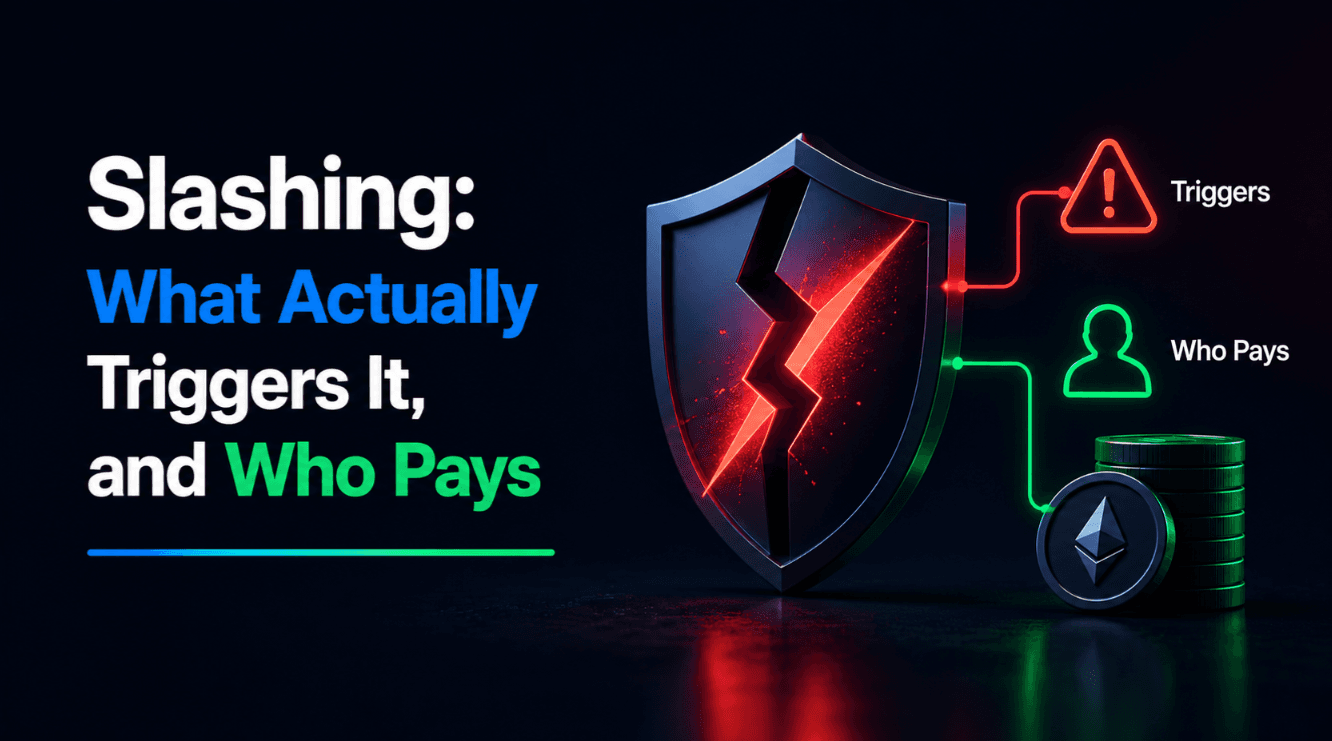
Slashing is a protocol-level penalty that destroys part of a validator's stake for behaviour the network can prove is dishonest. It is deliberately narrow: it targets actions that are only explicable as an attack on consensus, and it is distinct from the much milder penalties applied for being offline. Understanding which category a given failure falls into is the difference between a rounding error and a permanent loss.
The two offences that actually trigger it
Almost every slashable offence reduces to signing two conflicting things when honest participation would have produced one.
The first is double signing: proposing two different blocks for the same slot. An honest validator has no reason to do this — there is one correct block to propose, and producing two is either an attempt to split the network's view or the result of running the same key on two machines that cannot see each other.
The second is contradictory attestation: voting for two incompatible versions of history, or casting a vote that surrounds an earlier one in a way that would let the validator support two conflicting chains. Again, honest behaviour produces one vote. The protocol does not need to know intent; the contradiction itself is the proof.
That narrowness is the design. A penalty that destroyed capital for ambiguous behaviour would make validation uninsurable, so networks restrict it to actions where the evidence is self-contained and undeniable.
Why running a backup is the classic way to get slashed
The most common cause of slashing is not an attack. It is an operator trying to be careful.
The instinct when you have a validator that must stay online is to run a second instance for redundancy. If both instances hold the same key and both are active, they will eventually sign conflicting messages, and the network will punish exactly the behaviour the redundancy was meant to prevent. The failure mode is worse than the outage it was designed to avoid.
This is why competent operators run failover as an explicitly manual or strongly interlocked process, and why a provider's answer to the question of how they handle failover tells you more about their competence than their marketing does. An operator who describes an automatic hot standby holding the same key is describing a slashing incident that has not happened yet.
Downtime is a different thing, and much smaller
Being offline is penalised, but through a separate mechanism. A validator that fails to attest simply does not earn the rewards it would have earned, and on some networks loses a small amount in addition. The design intent is symmetry: over a given period, a validator offline half the time ends up roughly where it would have been having not staked at all.
This matters because downtime and slashing are routinely bundled together in discussions of staking risk, and they are different in scale by orders of magnitude. Downtime is an opportunity cost. Slashing is destruction of principal.
There is one exception worth knowing: several networks apply a correlation penalty, where the severity of a slashing scales with how many other validators were slashed around the same time. An isolated mistake is treated as a mistake. A large group of validators failing together looks like a coordinated attack, and is punished as one. The practical consequence is that using the same client software, the same hosting provider or the same operator as a large share of the network raises your penalty in precisely the scenario where a penalty is most likely.
Who absorbs the loss
This is the question that decides whether slashing is your problem, and it is answered by the arrangement rather than by the protocol.
In non-custodial delegation, the protocol slashes the stake, which is yours. Unless the operator has undertaken to make you whole, the loss stops with you. Most have not undertaken anything.
In custodial staking, the platform holds the asset, and whether it passes the loss through depends entirely on its terms. Some platforms have absorbed slashing events without passing them on; that is a commercial decision, not an obligation, and a decision made once is not a commitment.
A small number of operators publish an indemnity with terms — what is covered, what is excluded, what the cap is. That document is the product. An assurance that slashing is unlikely is not an indemnity, and neither is a page describing an operator's excellent record.
Reading a provider's real exposure
- Ask how failover works. If the answer involves two live instances sharing a key, the risk is structural rather than hypothetical.
- Check the operator's slashing history on-chain. It is public, and an empty record over a long period is meaningful evidence.
- Find out what share of the network runs the same client software as your operator. Client diversity is the main defence against a correlated penalty.
- Read the indemnity if one exists, and note its exclusions. Read the terms of service if one does not.
- Distinguish downtime guarantees from slashing cover. Providers frequently offer the first and imply the second.
The realistic assessment is that slashing is rare with competent operators and catastrophic when it happens. That combination is exactly the profile that makes people underprice it, because the base rate is low enough to feel like zero right up until it is not.
Sources
3 references- 01Attack and defense in proof-of-stake
ethereum.org · accessed August 22, 2026
- 02Slashing
Upgrading Ethereum (eth2book) · accessed August 22, 2026
- 03Consensus specifications
Ethereum Foundation · accessed August 22, 2026
Frequently asked questions
How likely is slashing?+
Rare with a competent operator — the offences are narrow and honest validation does not produce them. The risk is concentrated in operational mistakes, particularly running the same validator key on two live machines, and in correlated events where a widely-used client or host fails at once.
Is being offline the same as being slashed?+
No, and the difference is large. Downtime means forgoing rewards and sometimes a small additional penalty, designed so an intermittently offline validator ends up roughly where it would have been not staking. Slashing destroys a portion of the stake itself.
Does my provider cover slashing losses?+
Usually not. In non-custodial delegation the stake is yours and so is the penalty unless an indemnity says otherwise. A few operators publish real indemnity terms; most publish a good track record instead, which is not the same thing.
What is a correlation penalty?+
A mechanism that scales the severity of a slashing with how many validators were slashed at the same time, on the reasoning that mass simultaneous failure looks like coordination. It means sharing client software, hosting or operator with a large share of the network increases your loss in exactly the scenario where loss is likeliest.
Written by
Olivia BennettBlockchain Security ResearcherSmart Contract Security, Audit Reports, Exploits, DeFi Hacks, White-Hat Research
Olivia Bennett is the Blockchain Security Researcher at CoinRadar Daily, where she specializes in smart contract security, DeFi risk analysis, blockchain infrastructure, and protocol vulnerabilities. Drawing on years of hands-on cybersecurity experience, she delivers in-depth reporting that explains both the technical details and the real-world implications of security incidents across the digital asset ecosystem. Before joining CoinRadar Daily, Olivia built her career in cybersecurity, working in penetration testing, blockchain security assessments, and smart contract auditing. She participated in numerous security reviews for decentralized applications and blockchain protocols, helping identify critical vulnerabilities before they could be exploited. Her responsible disclosure work has contributed to improving the security of several major DeFi projects and protecting millions of dollars in digital assets. Olivia earned a Bachelor of Science in Computer Science from the University of Edinburgh and later completed advanced professional training in offensive security and blockchain technologies. Her combination of software security expertise and blockchain knowledge enables her to provide readers with clear, evidence-based analysis of exploits, protocol upgrades, and emerging attack vectors. At CoinRadar Daily, Olivia publishes detailed investigations into blockchain exploits, smart contract audits, cross-chain security, wallet protection, and evolving cyber threats affecting the crypto industry. She is particularly committed to translating highly technical research into practical guidance that helps investors, developers, and blockchain users better understand protocol risk and security best practices. Alongside her editorial work, Olivia contributes educational resources covering secure wallet management, decentralized finance security, and blockchain infrastructure. She also participates in industry events and technical discussions focused on strengthening Web3 security standards, supporting CoinRadar Daily's mission to provide accurate, research-driven coverage of the rapidly evolving digital asset landscape.

✓Reviewed & edited by
Emily VolkerEditor-in-ChiefEditorial Strategy, Investigative Journalism, Crypto Media, E-E-A-T Standards
Emily Volker is the Editor-in-Chief of CoinRadar Daily, where she leads a multilingual editorial team covering cryptocurrency markets, blockchain innovation, Web3, and global digital asset regulation across eight languages. With more than a decade of experience in financial and technology journalism, she has played a key role in developing high editorial standards and trusted reporting within the digital asset industry. Emily began her career as a financial journalist reporting on commodities, energy markets, and emerging technologies before discovering Bitcoin and decentralized finance in the early 2010s. She later moved to London to join one of Europe's early blockchain-focused media organizations, where she advanced into senior editorial leadership. Her experience reporting through both the rapid expansion of the 2017 ICO boom and the subsequent market correction reinforced her commitment to fact-based, research-driven journalism in an industry often influenced by speculation. She holds a Master's degree in International Journalism from City, University of London, and has completed executive studies in digital media strategy through the Reuters Institute at Oxford. Emily is a strong advocate for editorial transparency, rigorous verification, and responsible financial reporting. She also helped integrate Google's E-E-A-T principles—Experience, Expertise, Authoritativeness, and Trustworthiness—into the editorial standards followed by CoinRadar Daily. Under her leadership, CoinRadar Daily has expanded into a global cryptocurrency news platform publishing content in eight languages with a network of editors, analysts, and contributors across four continents. Emily oversees investigative reporting, editorial policy, content quality, and fact-checking processes to ensure every article meets the publication's standards for accuracy, credibility, and independence. Alongside her editorial responsibilities, Emily mentors aspiring journalists through digital media initiatives and regularly speaks at international conferences focused on journalism, fintech, blockchain technology, and digital assets, where she discusses responsible reporting, combating misinformation, and the evolving future of financial media.
CoinRadar Daily content is written by named analysts and checked against our editorial standards. Market data is indicative and informational only — nothing here is financial advice.
DeFi services, rated
How we score →Independent, rubric-scored tables covering the services this defi coverage keeps running into.
Best DeFi Protocols
Top rated: Uniswap Protocol 8.9
The base layer everything else is built on.
4rated →
Best Decentralised Exchanges
Top rated: Uniswap 8.7
Swap venues where you never hand over your keys.
5rated →
Best Crypto Lending Platforms
Top rated: Aave 8.0
Borrow against your holdings, or lend them out.
4rated →
Keep Reading
DeFi Risks and How to Stay Safe
DeFi opens powerful financial tools to anyone, but it also removes the safety nets of traditional finance. Here are the main risks and the habits that help you avoid them.
James Park · May 24, 2026→
DEX vs CEX: Decentralized vs Centralized Exchanges
Centralized exchanges hold your funds and feel like apps; decentralized exchanges let you trade from your own wallet. Here is how the two compare and when to use each.
Emily Volker · May 26, 2026→
Stablecoins Explained: USDT, USDC, and DAI
Stablecoins aim to hold a steady value, usually one US dollar, so crypto users can move and store money without volatility. Here is how USDT, USDC, and DAI differ.
Olivia Bennett · June 4, 2026→