Best Crypto Exchanges
Top rated: Kraken 8.6
Centralised venues that hold your funds while you trade.
6rated →
Bitcoin shook off the Federal Reserve's first rate hike in three years to reclaim $76,000, even as Washington sent mixed signals on crypto policy — one bill advancing through House committees days after the CLARITY Act stalled in the Senate.

By Olivia Bennett, Blockchain Security Researcher
Smart Contract Security, Audit Reports, Exploits, DeFi Hacks, White-Hat Research
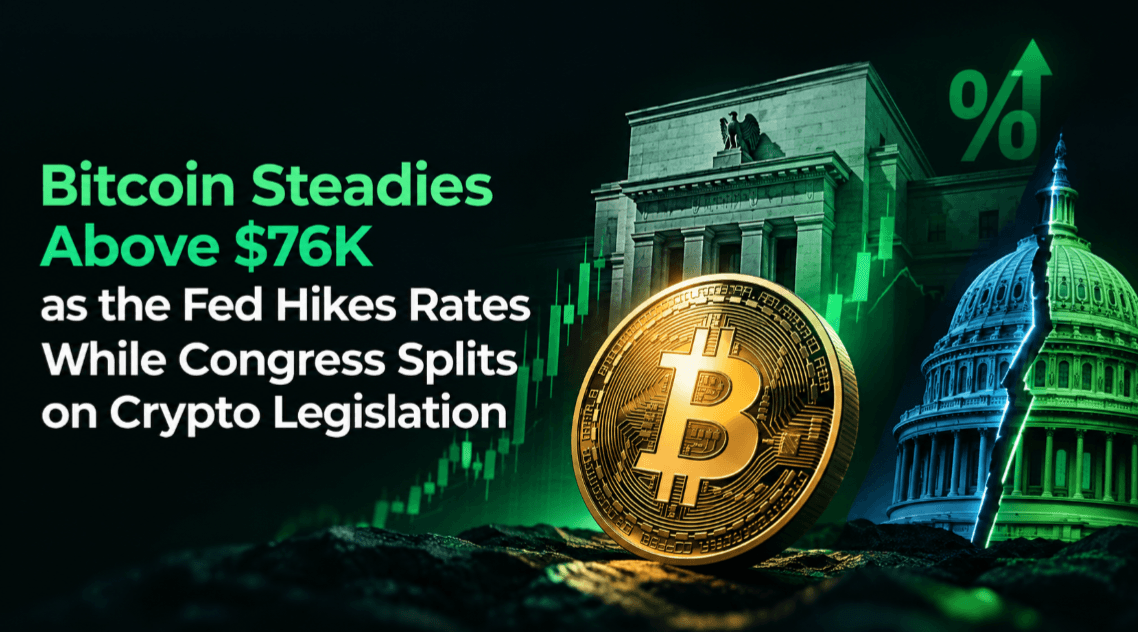
Crypto markets spent the past two days absorbing two very different kinds of news out of Washington: a long-awaited Federal Reserve rate decision, and a fresh reminder that comprehensive crypto legislation is still far from settled. The result has been a volatile but ultimately resilient market, with Bitcoin swinging through a multi-thousand-dollar range before steadying near $76,500.
On September 17, the Federal Reserve raised its target rate by 25 basis points, lifting the range to 3.75%–4.00% in its first increase since 2023. The vote was unanimous, 12-0, though the tone stayed hawkish — the majority of officials on the committee signaled they expect at least one more hike before year-end, keeping traders on edge through the announcement.
Bitcoin briefly dipped toward $75,000 ahead of the decision before rebounding past $76,000 once it landed, while Ether recovered to roughly $2,400. By the end of the session, Bitcoin was changing hands near $76,460, up more than 1% on the day, with the total crypto market capitalization sitting around $2.71 trillion.
The rally came despite continued institutional selling: spot Bitcoin ETFs saw outflows of roughly $296 million, while Ethereum ETFs logged their largest single-day redemptions of the month at about $224 million, with BlackRock leading withdrawals in both. Attention now shifts to the Bank of Japan's own rate decision as the next likely catalyst for global risk assets.
While the Fed dominated headlines, two House committees quietly advanced crypto-related legislation over the same 48 hours. The House Ways and Means Committee approved the Digital Asset Tax Certainty Act by a 38-5 vote, a measure aimed at simplifying tax treatment for stablecoin payments; industry groups continue lobbying for changes to how staking rewards are taxed at the point they're received.
A day earlier, the House Financial Services Committee voted 28-21 to advance the American Reserve Modernization Act, which would create a US Strategic Bitcoin Reserve. The amended version consolidates what was originally a 20-year lockup into a single enactment date and swaps quarterly attestations for annual public reporting. The bill still needs a full House vote, Senate passage and a presidential signature — and with lawmakers set to leave Washington until after the November election, a floor vote this month looks unlikely.
That incremental progress stands in contrast to what happened just a day earlier to the CLARITY Act, the broader crypto market-structure bill that had been the industry's top legislative priority. The bill failed to clear a Senate cloture vote after falling short of the 60 votes needed, with the breakdown centered on ethics provisions governing crypto-related conduct by officials and their families — Democrats pushed for tighter restrictions, Republicans argued the proposed language went too far.
The market reaction was immediate: Bitcoin fell more than 5% during that session, while shares of Coinbase and Circle dropped as much as 10%. Bitcoin traded around $75,926 that day, with the broader market capitalization down 4.7% over 24 hours and Bitcoin's dominance climbing to roughly 58.5% as capital rotated away from altcoins. Liquidations across the crypto derivatives market reached close to $250 million in a 12-hour window, with the majority coming from short positions being forced closed.
Even so, not everyone in the industry is writing the bill off, and some lawmakers have suggested it could return in a revised form later this year. Institutional demand also held up through the volatility: spot Bitcoin ETFs had pulled in nearly $987 million in the week before the vote, suggesting large buyers stayed positioned despite the price swings.
Together, the two storylines describe a market that is absorbing tighter monetary policy at the same time regulatory clarity is arriving unevenly. Analysts note that a Strategic Bitcoin Reserve with a long lockup, if ultimately signed into law, would remove the federal government as a scheduled seller of forfeited coins — ending a recurring source of supply without introducing a new buyer. With near-term support widely seen in the $75,000–$77,000 zone and resistance building around $79,000–$82,000, traders are likely to keep watching both incoming economic data and the pace of legislative movement in Washington in the weeks ahead.
Written by
Olivia BennettBlockchain Security ResearcherOlivia Bennett is the Blockchain Security Researcher at CoinRadar Daily, where she specializes in smart contract security, DeFi risk analysis, blockchain infrastructure, and protocol vulnerabilities. Drawing on years of hands-on cybersecurity experience, she delivers in-depth reporting that explains both the technical details and the real-world implications of security incidents across the digital asset ecosystem. Before joining CoinRadar Daily, Olivia built her career in cybersecurity, working in penetration testing, blockchain security assessments, and smart contract auditing. She participated in numerous security reviews for decentralized applications and blockchain protocols, helping identify critical vulnerabilities before they could be exploited. Her responsible disclosure work has contributed to improving the security of several major DeFi projects and protecting millions of dollars in digital assets. Olivia earned a Bachelor of Science in Computer Science from the University of Edinburgh and later completed advanced professional training in offensive security and blockchain technologies. Her combination of software security expertise and blockchain knowledge enables her to provide readers with clear, evidence-based analysis of exploits, protocol upgrades, and emerging attack vectors. At CoinRadar Daily, Olivia publishes detailed investigations into blockchain exploits, smart contract audits, cross-chain security, wallet protection, and evolving cyber threats affecting the crypto industry. She is particularly committed to translating highly technical research into practical guidance that helps investors, developers, and blockchain users better understand protocol risk and security best practices. Alongside her editorial work, Olivia contributes educational resources covering secure wallet management, decentralized finance security, and blockchain infrastructure. She also participates in industry events and technical discussions focused on strengthening Web3 security standards, supporting CoinRadar Daily's mission to provide accurate, research-driven coverage of the rapidly evolving digital asset landscape.
CoinRadar Daily Newsroom · Published September 17, 2026 · Informational, not financial advice.
Independent, rubric-scored tables covering the services this markets coverage keeps running into.
Top rated: Kraken 8.6
Centralised venues that hold your funds while you trade.
6rated →
Top rated: Hyperliquid 8.3
On-chain leverage.
5rated →
Top rated: DefiLlama 8.7
Terminals, bots, screeners and portfolio trackers.
4rated →