Best Stablecoins
Top rated: USDC 8.4
A stablecoin is a promise about redemption.
4rated →
Washington drew a hard line on Iran-linked crypto infrastructure this week, while Coinbase moved to put digital assets inside thousands of community bank apps. Together, the two stories show how the US crypto perimeter is being redrawn.

By Olivia Bennett, Blockchain Security Researcher
Smart Contract Security, Audit Reports, Exploits, DeFi Hacks, White-Hat Research
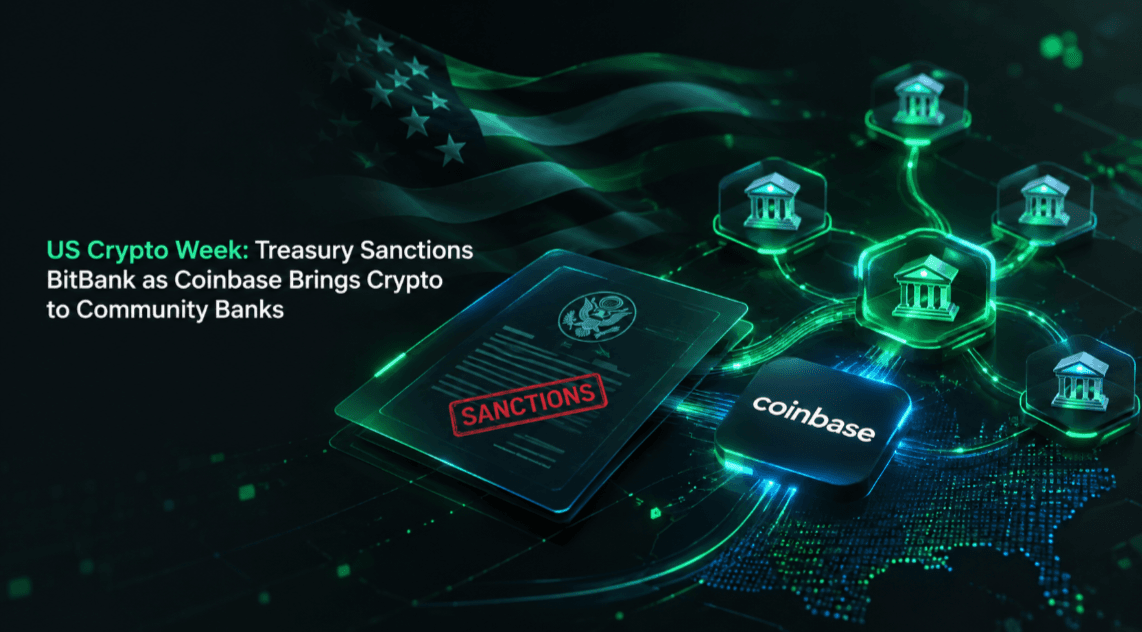
Two developments from the past few days show where the US crypto market is heading. Enforcement is reaching deeper into offshore infrastructure, and regulated banks are reaching into crypto. Both are steps toward the same outcome: a digital-asset market that operates inside the compliance perimeter.
On Thursday, September 17, the US Treasury's Office of Foreign Assets Control (OFAC) sanctioned the Iranian crypto exchange BitBank. It also designated the exchange's software developer, Pishtaz Simorgh Electronic Trade Company, and three associates of the financier Babak Zanjani.
Treasury alleges that between June and July, Zanjani used BitBank to move hundreds of millions of dollars' worth of Bitcoin to Iran's Islamic Revolutionary Guard Corps. It also says the previously sanctioned Hormuz Safe platform has used the exchange since June to route payments to the Iranian government. The designations fall under Executive Order 13902 and are part of Operation Economic Outcast. Treasury Secretary Scott Bessent said that funding the Iranian regime through crypto is not beyond OFAC's reach.
Some context matters here. These are administrative sanctions, not criminal convictions. Treasury's announcement did not publish wallet addresses, transaction hashes or a precise total, so the "hundreds of millions" figure remains the government's own claim. For US persons, the practical effect is that any BitBank-linked property must be blocked. Foreign firms that deal with the designated parties may face secondary sanctions exposure.
On September 16, Coinbase announced a partnership with the banking technology provider Stablecore. The goal is to let community banks and credit unions offer crypto trading, custody, staking and stablecoin payments inside their existing digital banking platforms.
The division of labor is simple. Coinbase supplies the custody and exchange infrastructure, and Stablecore connects it to each institution's core banking, digital banking and compliance systems. The model is white-label, so banks keep their own branding and customer experience. Amarillo National Bank is among the early institutions involved.
The headline figure needs a careful reading. Stablecore's existing integrations reach systems used by more than 3,000 US banks and credit unions, but that is the size of its technology footprint, not the number of banks that have signed up. The deal also follows a separate Coinbase partnership with Moov, announced on September 10, which covers stablecoin settlement for more than 1,000 community institutions.
At first glance, a sanctions action and a banking partnership have little in common. Read together, they describe the same shift. Regulators are tightening the rules for platforms outside the US financial system. Meanwhile, regulated firms are building compliant on-ramps for the platforms and customers inside it.
For banks, the appeal is straightforward. Smaller institutions can offer digital-asset services without building custody and trading systems from scratch. For the broader market, the enforcement side is a reminder that compliance is becoming a condition of access rather than an optional extra.
Institutional demand remains visible. US spot Bitcoin ETFs recorded about $159 million in net inflows on Thursday, led by BlackRock's IBIT. On the policy side, the CLARITY Act stalled in the Senate this week, and the CFTC has sent its crypto market rules to the White House for review. Readers should watch how many banks actually go live with Coinbase services, and whether Treasury extends its Iran-focused campaign to more digital-asset platforms.
Written by
Olivia BennettBlockchain Security ResearcherOlivia Bennett is the Blockchain Security Researcher at CoinRadar Daily, where she specializes in smart contract security, DeFi risk analysis, blockchain infrastructure, and protocol vulnerabilities. Drawing on years of hands-on cybersecurity experience, she delivers in-depth reporting that explains both the technical details and the real-world implications of security incidents across the digital asset ecosystem. Before joining CoinRadar Daily, Olivia built her career in cybersecurity, working in penetration testing, blockchain security assessments, and smart contract auditing. She participated in numerous security reviews for decentralized applications and blockchain protocols, helping identify critical vulnerabilities before they could be exploited. Her responsible disclosure work has contributed to improving the security of several major DeFi projects and protecting millions of dollars in digital assets. Olivia earned a Bachelor of Science in Computer Science from the University of Edinburgh and later completed advanced professional training in offensive security and blockchain technologies. Her combination of software security expertise and blockchain knowledge enables her to provide readers with clear, evidence-based analysis of exploits, protocol upgrades, and emerging attack vectors. At CoinRadar Daily, Olivia publishes detailed investigations into blockchain exploits, smart contract audits, cross-chain security, wallet protection, and evolving cyber threats affecting the crypto industry. She is particularly committed to translating highly technical research into practical guidance that helps investors, developers, and blockchain users better understand protocol risk and security best practices. Alongside her editorial work, Olivia contributes educational resources covering secure wallet management, decentralized finance security, and blockchain infrastructure. She also participates in industry events and technical discussions focused on strengthening Web3 security standards, supporting CoinRadar Daily's mission to provide accurate, research-driven coverage of the rapidly evolving digital asset landscape.
CoinRadar Daily Newsroom · Published September 19, 2026 · Informational, not financial advice.
Independent, rubric-scored tables covering the services this regulation coverage keeps running into.
Top rated: USDC 8.4
A stablecoin is a promise about redemption.
4rated →
Top rated: Gnosis Pay 7.8
Spend crypto at the till.
4rated →
Top rated: Kraken 8.6
Centralised venues that hold your funds while you trade.
6rated →