BIP-32, BIP-39 and BIP-44: The Layers Behind a Seed Phrase
People say seed phrase as though it were one thing. It is three separate standards doing three separate jobs, and almost every case of a correct phrase restoring an empty wallet is a mismatch at one specific seam between them.

By Olivia Bennett, Blockchain Security Researcher
Smart Contract Security, Audit Reports, Exploits, DeFi Hacks, White-Hat Research
✓ Reviewed by Emily Volker· Editor-in-Chief
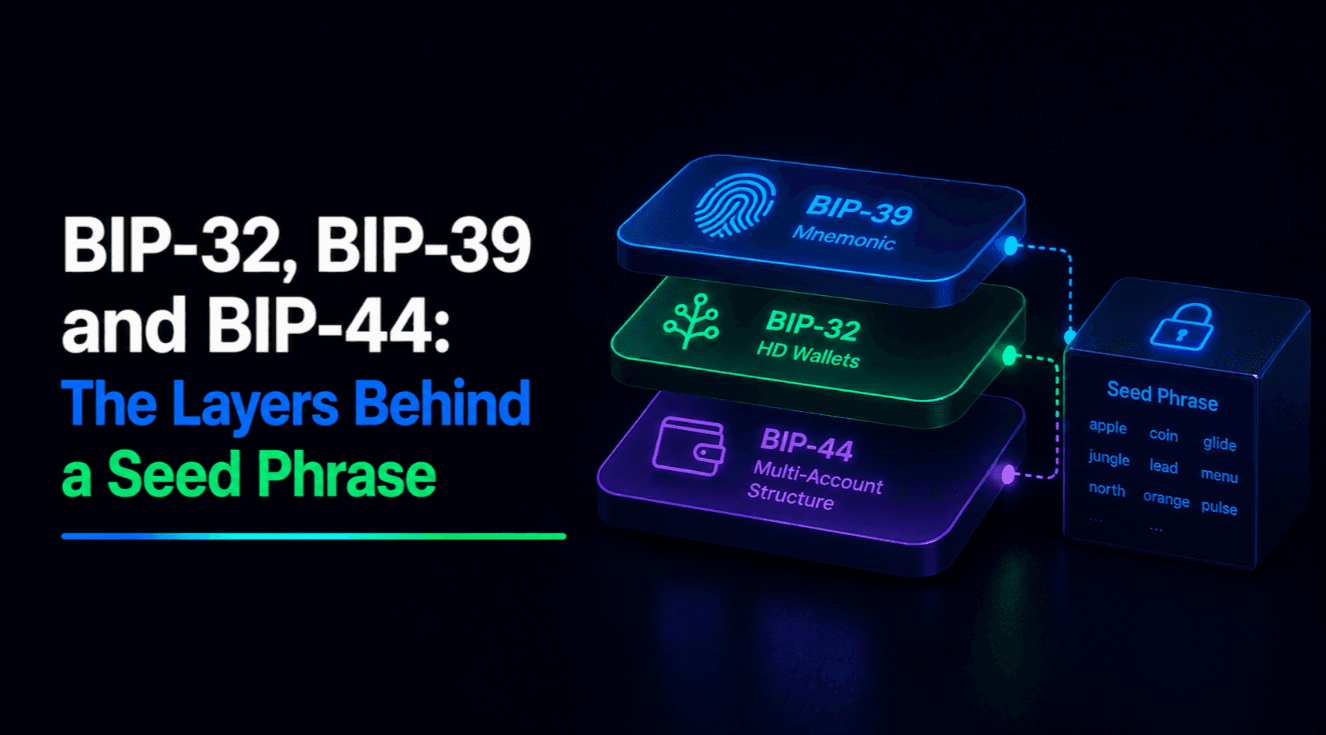
Write down twelve or twenty-four words, keep them safe, and any compatible wallet can restore your funds. That is the promise, and it mostly holds. When it does not, the cause is nearly always a mismatch between the layers the phrase actually depends on — because the words alone do not fully determine which addresses a wallet will look at.
BIP-39: words to a seed
BIP-39 defines how a mnemonic phrase encodes entropy and converts to a binary seed. The wordlist is fixed at 2048 words chosen so the first four letters are unambiguous, which is why some wallets accept truncated input.
The phrase includes a checksum, which is why a single mistyped word is usually caught rather than silently producing a valid-but-different wallet. It is a safety net rather than a guarantee: a small fraction of wrong phrases pass the checksum, and those restore a real, empty wallet with no error.
The conversion from words to seed also takes an optional passphrase. With no passphrase, an empty string is used. Any passphrase produces a completely different seed — that is the mechanism behind so-called hidden wallets, and the reason a forgotten passphrase is unrecoverable.
BIP-32: one seed, unlimited keys
BIP-32 turns that single seed into a tree of keys. From one master key, any number of child keys can be derived deterministically, so a wallet can generate a fresh address for every transaction while only ever backing up one secret.
Two properties are worth knowing. Extended public keys allow a watch-only wallet to derive all your receiving addresses without any ability to spend — the basis of monitoring a cold wallet from a phone.
And hardened derivation exists because non-hardened child keys have an unfortunate property: an extended public key combined with any one child private key reveals the parent private key. Hardened derivation blocks that, which is why account-level paths use it.
BIP-44: where in the tree to look
A tree with unlimited branches is only useful if wallets agree where to look. BIP-44 defines a standard path structure — purpose, coin type, account, change, index — so that any conforming wallet derives the same addresses from the same seed.
This is the layer where compatibility actually breaks, because BIP-44 was followed by further standards for newer address types, each with its own purpose value. A wallet that derives one type from your seed will not show balances held under another, even though the seed is identical and everything is working correctly.
That is the mechanism behind the most common self-custody scare: a correct phrase, a correct wallet, and an empty balance. Nothing is lost. The wallet is looking in a different part of the tree, and pointing it at the right derivation path restores the view.
Where compatibility actually breaks
- Different derivation path — the wallet defaults to a different address type from the one your funds sit under. Most common, entirely recoverable.
- A passphrase you forgot you set, including one entered by accident. Produces a valid but different wallet with no error message.
- A non-standard wordlist or a wallet that never used BIP-39 at all. Older and bespoke wallets exist that do not.
- Account gaps — funds on an account index beyond where the wallet stops scanning, so the balance is real and invisible.
- Address gap limits, where a long run of unused addresses causes the wallet to stop looking before it reaches funds.
What to record alongside the words
The practical conclusion is that a seed phrase alone is an incomplete backup. Recording a few extra facts costs nothing and removes almost every recovery failure that is not simple loss.
Note the wallet software and device the phrase was created on, the derivation path if the wallet displays it, whether a passphrase is in use and where it is stored separately, and the first receiving address. That last item is the cheapest verification available: if a restore produces a different first address, you know immediately that something is wrong, before you conclude the funds are gone.
Testing a restore on a spare device before funding a wallet is the other habit worth building, and it is the one that converts all of this from theory into something you have actually done.
Sources
3 references- 01BIP-39: Mnemonic code for generating deterministic keys
Bitcoin Improvement Proposals · accessed August 22, 2026
- 02BIP-32: Hierarchical Deterministic Wallets
Bitcoin Improvement Proposals · accessed August 22, 2026
- 03BIP-44: Multi-Account Hierarchy for Deterministic Wallets
Bitcoin Improvement Proposals · accessed August 22, 2026
Frequently asked questions
Why does my seed phrase restore an empty wallet?+
Almost always a derivation path mismatch: the wallet is deriving a different address type from the one your funds sit under, so it is looking at the correct seed and the wrong branch of the tree. The other common causes are a passphrase you forgot was set, and funds on an account index beyond where the wallet scans.
What does the BIP-39 passphrase do?+
It is mixed into the conversion from words to seed, so any passphrase produces an entirely different wallet. That is what makes hidden wallets possible, and it is why a forgotten passphrase is unrecoverable — there is no way to search for it and no error to tell you one was used.
Are all seed phrases interchangeable between wallets?+
The phrase-to-seed step is standardised, so mostly yes. Where wallets differ is the derivation path they use to decide which addresses to show, which is a separate standard. A phrase can be perfectly valid in a new wallet that simply looks in a different place.
What should I write down besides the words?+
The wallet and device it was created on, the derivation path if shown, whether a passphrase is used and where it is stored separately, and the first receiving address. The last one lets you confirm a restore worked correctly rather than guessing.
Written by
Olivia BennettBlockchain Security ResearcherSmart Contract Security, Audit Reports, Exploits, DeFi Hacks, White-Hat Research
Olivia Bennett is the Blockchain Security Researcher at CoinRadar Daily, where she specializes in smart contract security, DeFi risk analysis, blockchain infrastructure, and protocol vulnerabilities. Drawing on years of hands-on cybersecurity experience, she delivers in-depth reporting that explains both the technical details and the real-world implications of security incidents across the digital asset ecosystem. Before joining CoinRadar Daily, Olivia built her career in cybersecurity, working in penetration testing, blockchain security assessments, and smart contract auditing. She participated in numerous security reviews for decentralized applications and blockchain protocols, helping identify critical vulnerabilities before they could be exploited. Her responsible disclosure work has contributed to improving the security of several major DeFi projects and protecting millions of dollars in digital assets. Olivia earned a Bachelor of Science in Computer Science from the University of Edinburgh and later completed advanced professional training in offensive security and blockchain technologies. Her combination of software security expertise and blockchain knowledge enables her to provide readers with clear, evidence-based analysis of exploits, protocol upgrades, and emerging attack vectors. At CoinRadar Daily, Olivia publishes detailed investigations into blockchain exploits, smart contract audits, cross-chain security, wallet protection, and evolving cyber threats affecting the crypto industry. She is particularly committed to translating highly technical research into practical guidance that helps investors, developers, and blockchain users better understand protocol risk and security best practices. Alongside her editorial work, Olivia contributes educational resources covering secure wallet management, decentralized finance security, and blockchain infrastructure. She also participates in industry events and technical discussions focused on strengthening Web3 security standards, supporting CoinRadar Daily's mission to provide accurate, research-driven coverage of the rapidly evolving digital asset landscape.

✓Reviewed & edited by
Emily VolkerEditor-in-ChiefEditorial Strategy, Investigative Journalism, Crypto Media, E-E-A-T Standards
Emily Volker is the Editor-in-Chief of CoinRadar Daily, where she leads a multilingual editorial team covering cryptocurrency markets, blockchain innovation, Web3, and global digital asset regulation across eight languages. With more than a decade of experience in financial and technology journalism, she has played a key role in developing high editorial standards and trusted reporting within the digital asset industry. Emily began her career as a financial journalist reporting on commodities, energy markets, and emerging technologies before discovering Bitcoin and decentralized finance in the early 2010s. She later moved to London to join one of Europe's early blockchain-focused media organizations, where she advanced into senior editorial leadership. Her experience reporting through both the rapid expansion of the 2017 ICO boom and the subsequent market correction reinforced her commitment to fact-based, research-driven journalism in an industry often influenced by speculation. She holds a Master's degree in International Journalism from City, University of London, and has completed executive studies in digital media strategy through the Reuters Institute at Oxford. Emily is a strong advocate for editorial transparency, rigorous verification, and responsible financial reporting. She also helped integrate Google's E-E-A-T principles—Experience, Expertise, Authoritativeness, and Trustworthiness—into the editorial standards followed by CoinRadar Daily. Under her leadership, CoinRadar Daily has expanded into a global cryptocurrency news platform publishing content in eight languages with a network of editors, analysts, and contributors across four continents. Emily oversees investigative reporting, editorial policy, content quality, and fact-checking processes to ensure every article meets the publication's standards for accuracy, credibility, and independence. Alongside her editorial responsibilities, Emily mentors aspiring journalists through digital media initiatives and regularly speaks at international conferences focused on journalism, fintech, blockchain technology, and digital assets, where she discusses responsible reporting, combating misinformation, and the evolving future of financial media.
CoinRadar Daily content is written by named analysts and checked against our editorial standards. Market data is indicative and informational only — nothing here is financial advice.
Bitcoin services, rated
How we score →Independent, rubric-scored tables covering the services this bitcoin coverage keeps running into.
Best Hardware Wallets
Top rated: Trezor Safe 5 8.6
Devices whose only job is to keep a key away from the internet.
5rated →
Best Crypto Wallets
Top rated: Rabby 8.3
Software wallets for everyday use.
5rated →
Best Crypto Exchanges
Top rated: Kraken 8.4
Centralised venues that hold your funds while you trade.
6rated →
Keep Reading
Bitcoin Self-Custody: Hardware Wallets, Seed Phrases & Security
Self-custody means holding your own keys. Here is how hardware wallets and seed phrases protect Bitcoin, and the security habits that prevent loss.
James Park · May 25, 2026→

What Is a Spot Bitcoin ETF and How Does It Work?
A spot Bitcoin ETF holds actual bitcoin and lets investors gain exposure through a brokerage account. Here is how it works and what you give up.
Emily Volker · June 1, 2026→

Bitcoin vs Gold: Which Is the Better Store of Value?
Bitcoin is often called digital gold, but the two assets store value very differently. Here is how they compare on scarcity, volatility, and risk.
Olivia Bennett · June 5, 2026→