What Is a Spot Bitcoin ETF and How Does It Work?
A spot Bitcoin ETF holds actual bitcoin and lets investors gain exposure through a brokerage account. Here is how it works and what you give up.

By Emily Volker, Editor-in-Chief
Editorial Strategy, Investigative Journalism, Crypto Media, E-E-A-T Standards
✓ Reviewed by Olivia Bennett· Blockchain Security Researcher
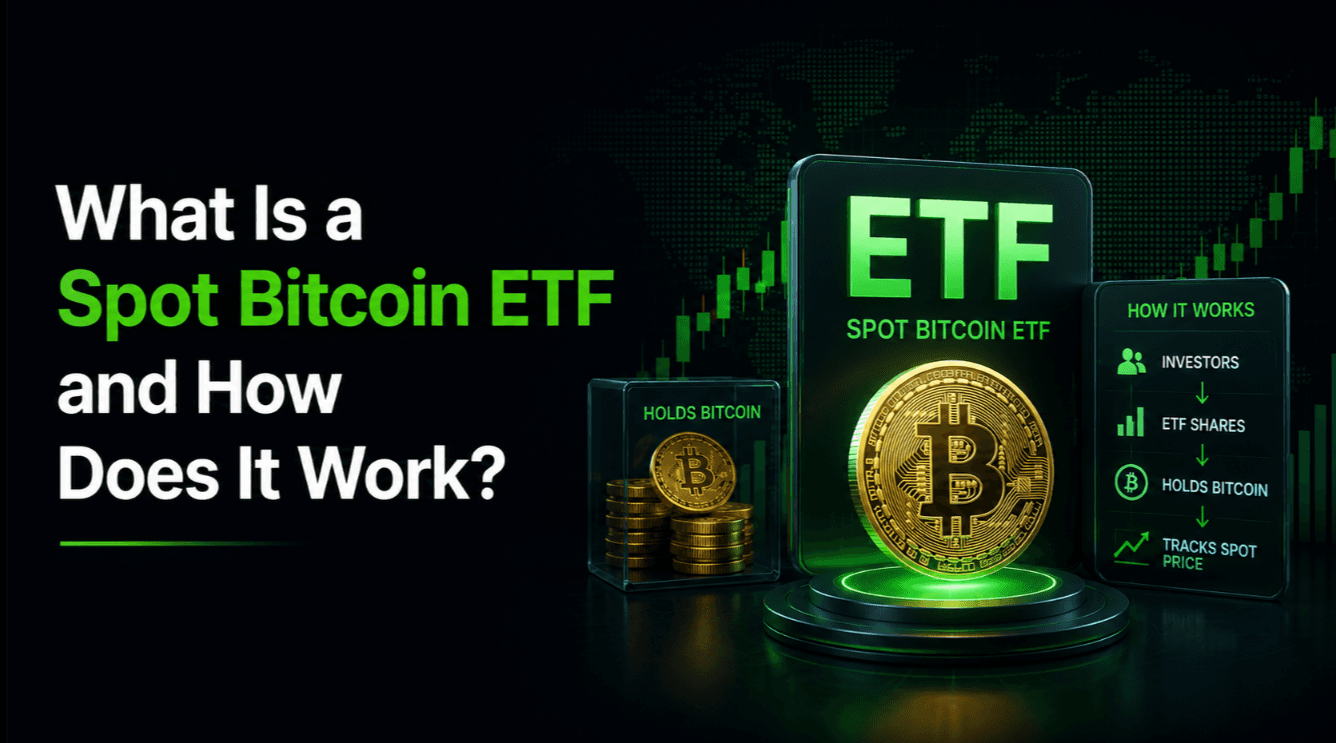
A spot Bitcoin ETF is an exchange-traded fund that holds actual bitcoin and issues shares tracking its price, letting investors gain exposure through an ordinary brokerage account without managing wallets or private keys. US regulators approved the first spot Bitcoin ETFs in January 2024 after more than a decade of rejections, and they became some of the fastest-growing funds in history. The word spot signals that the fund holds the real asset, unlike earlier products that tracked bitcoin indirectly through futures contracts.
Key takeaways
- A spot Bitcoin ETF holds real bitcoin and its share price tracks the market price closely.
- The US approved spot Bitcoin ETFs in January 2024 after years of rejected applications.
- Spot ETFs hold the asset directly, while futures ETFs hold derivatives that can drift from spot.
- ETFs offer convenience and regulated access but you do not hold the underlying coins.
- Trade-offs include annual fees, custodial risk, and the loss of Bitcoin's native features.
What an ETF is, briefly
An exchange-traded fund pools investor money to hold an underlying asset and issues shares that trade on a stock exchange throughout the day, much like a stock. A spot Bitcoin ETF applies that structure to bitcoin: the fund buys and stores bitcoin with a regulated custodian, and each share represents a claim on a slice of those holdings. Buying a share is, economically, buying exposure to that bitcoin without ever touching a wallet.
How the shares stay tied to the bitcoin price
An ETF keeps its share price aligned with the underlying asset through a creation-and-redemption mechanism operated by large firms called authorized participants. When demand pushes the share price above the value of the bitcoin behind it, these firms create new shares and the gap narrows; when shares trade below that value, they redeem shares and the gap closes the other way. This continuous arbitrage keeps the ETF tracking bitcoin within a narrow band most of the time.
What an authorized participant actually does
Authorized participants are the plumbing that keeps the price honest. When shares trade richly relative to the bitcoin backing them, such a firm can profit by creating new shares and selling them, which adds supply and pushes the price down toward fair value. The loop runs in reverse when shares trade cheaply: the firm buys discounted shares, redeems them with the fund, and removes supply, lifting the price back up. The fund manager does not have to intervene; ordinary profit-seeking does the work.
Spot ETFs versus futures ETFs
Before spot funds were approved, the only US-listed Bitcoin ETFs were futures-based, holding regulated futures contracts rather than bitcoin itself. Futures ETFs can follow the spot price loosely, but they carry roll costs, the expense of replacing expiring contracts with later-dated ones, which can erode returns over time under certain market conditions. Spot ETFs sidestep this by simply holding the asset directly.
- Spot ETF: holds actual bitcoin, tracks the price directly, and avoids roll costs.
- Futures ETF: holds derivatives contracts, can drift from spot, and is subject to roll costs.
Why the approval mattered
For more than a decade, US regulators rejected spot Bitcoin ETF applications, citing concerns about market manipulation and investor protection. A 2023 court ruling that challenged the regulator's reasoning helped clear the path, and approval followed in January 2024. The significance was access: financial advisers, retirement accounts, and cautious retail investors could now hold bitcoin exposure inside familiar, regulated accounts, drawing in capital that had previously stayed on the sidelines.
The spot ETF did not change what bitcoin is. It changed who can own it and how easily. — CoinRadar Daily analysis
The trade-offs of owning an ETF
Convenience comes at a cost. ETFs charge an annual management fee deducted from returns, and you are trusting the fund and its custodian to hold the bitcoin securely, a different risk profile from holding it yourself. You also give up Bitcoin's native properties: you cannot send ETF shares peer-to-peer, spend them, trade them outside market hours, or withdraw the underlying coins. In effect, you own a regulated wrapper around bitcoin rather than bitcoin itself.
Who each option suits
- ETFs suit investors who want exposure inside a brokerage or retirement account and prefer not to manage keys.
- Direct ownership suits those who want to self-custody, transact on-chain, or hold the asset outside the traditional system.
- Many holders use both: an ETF in tax-advantaged accounts and self-custody for long-term savings.
Fees, custody, and what to check
Spot Bitcoin ETFs compete largely on cost, and issuers launched with low headline fees, some temporarily waived to win market share. Over a long holding period, even small annual fees compound, so the expense ratio is worth comparing across funds. Custody matters too: the bitcoin behind the shares sits with a regulated custodian, and because a small number of custodians safeguard a large share of ETF assets, there is operational concentration behind the scenes that investors rarely see.
- Expense ratio: the annual fee deducted from the fund's value.
- Custodian: which firm safeguards the underlying bitcoin and how it is protected.
- Tracking and liquidity: how closely the share price follows bitcoin and how easily shares trade.
- Tax treatment: how the fund is taxed in your jurisdiction and account type.
Spot Bitcoin products beyond the US
The US approval drew the most attention, but exchange-traded products tracking bitcoin existed earlier elsewhere. Canada listed a spot Bitcoin ETF in 2021, and Europe has offered exchange-traded products tracking bitcoin for years, often structured as exchange-traded notes rather than funds. Structures and investor protections vary by jurisdiction, so a product's label matters less than how it actually holds the asset and what claim investors have on it.
How spot ETFs have affected the market
The spot ETFs absorbed large amounts of bitcoin in their early years, and their daily flows became a closely watched gauge of institutional demand. By routing more activity through regulated venues, they have tightened the link between bitcoin and traditional financial markets. That deeper integration cuts both ways: it adds legitimacy and liquidity, but it can also pull bitcoin's price more closely in step with broader risk-asset sentiment than it once moved.
This article is for general information only and is not financial, investment, or tax advice. ETFs carry fees and risks, and bitcoin is volatile; consult a licensed professional and read each fund's prospectus before investing.
Sources
3 references- 01Statement on the Approval of Spot Bitcoin Exchange-Traded Products
U.S. Securities and Exchange Commission · accessed August 22, 2026
- 02Grayscale Investments, LLC v. SEC, No. 22-1142 (D.C. Cir. 2023)
U.S. Government Publishing Office · accessed August 22, 2026
- 03Purpose Bitcoin ETF
Purpose Investments · accessed August 22, 2026
Frequently asked questions
What is a spot Bitcoin ETF in simple terms?+
It is a fund that holds real bitcoin and issues shares tracking its price, traded on a regular stock exchange. It lets you gain bitcoin exposure through a standard brokerage account without setting up a wallet or managing private keys yourself.
How is a spot ETF different from a futures Bitcoin ETF?+
A spot ETF holds actual bitcoin, so its price tracks the asset directly. A futures ETF holds derivatives contracts instead, which can drift from the spot price and incur roll costs when contracts are replaced, so spot funds generally track bitcoin more closely over time.
Do I own actual bitcoin if I buy a spot Bitcoin ETF?+
No. You own shares of a fund that holds bitcoin on your behalf through a custodian. You cannot withdraw the underlying coins, send them peer-to-peer, or spend them. You gain price exposure and convenience but give up the native features of holding bitcoin directly.
Is a spot Bitcoin ETF safer than holding bitcoin?+
It removes the risk of losing your own private keys and operates within regulated markets, which some investors prefer. But it adds custodial and counterparty risk and charges fees, and the bitcoin price itself stays just as volatile. Whether it is safer depends on which risks concern you most.
Written by
Emily VolkerEditor-in-ChiefEditorial Strategy, Investigative Journalism, Crypto Media, E-E-A-T Standards
Emily Volker is the Editor-in-Chief of CoinRadar Daily, where she leads a multilingual editorial team covering cryptocurrency markets, blockchain innovation, Web3, and global digital asset regulation across eight languages. With more than a decade of experience in financial and technology journalism, she has played a key role in developing high editorial standards and trusted reporting within the digital asset industry. Emily began her career as a financial journalist reporting on commodities, energy markets, and emerging technologies before discovering Bitcoin and decentralized finance in the early 2010s. She later moved to London to join one of Europe's early blockchain-focused media organizations, where she advanced into senior editorial leadership. Her experience reporting through both the rapid expansion of the 2017 ICO boom and the subsequent market correction reinforced her commitment to fact-based, research-driven journalism in an industry often influenced by speculation. She holds a Master's degree in International Journalism from City, University of London, and has completed executive studies in digital media strategy through the Reuters Institute at Oxford. Emily is a strong advocate for editorial transparency, rigorous verification, and responsible financial reporting. She also helped integrate Google's E-E-A-T principles—Experience, Expertise, Authoritativeness, and Trustworthiness—into the editorial standards followed by CoinRadar Daily. Under her leadership, CoinRadar Daily has expanded into a global cryptocurrency news platform publishing content in eight languages with a network of editors, analysts, and contributors across four continents. Emily oversees investigative reporting, editorial policy, content quality, and fact-checking processes to ensure every article meets the publication's standards for accuracy, credibility, and independence. Alongside her editorial responsibilities, Emily mentors aspiring journalists through digital media initiatives and regularly speaks at international conferences focused on journalism, fintech, blockchain technology, and digital assets, where she discusses responsible reporting, combating misinformation, and the evolving future of financial media.

✓Reviewed & edited by
Olivia BennettBlockchain Security ResearcherSmart Contract Security, Audit Reports, Exploits, DeFi Hacks, White-Hat Research
Olivia Bennett is the Blockchain Security Researcher at CoinRadar Daily, where she specializes in smart contract security, DeFi risk analysis, blockchain infrastructure, and protocol vulnerabilities. Drawing on years of hands-on cybersecurity experience, she delivers in-depth reporting that explains both the technical details and the real-world implications of security incidents across the digital asset ecosystem. Before joining CoinRadar Daily, Olivia built her career in cybersecurity, working in penetration testing, blockchain security assessments, and smart contract auditing. She participated in numerous security reviews for decentralized applications and blockchain protocols, helping identify critical vulnerabilities before they could be exploited. Her responsible disclosure work has contributed to improving the security of several major DeFi projects and protecting millions of dollars in digital assets. Olivia earned a Bachelor of Science in Computer Science from the University of Edinburgh and later completed advanced professional training in offensive security and blockchain technologies. Her combination of software security expertise and blockchain knowledge enables her to provide readers with clear, evidence-based analysis of exploits, protocol upgrades, and emerging attack vectors. At CoinRadar Daily, Olivia publishes detailed investigations into blockchain exploits, smart contract audits, cross-chain security, wallet protection, and evolving cyber threats affecting the crypto industry. She is particularly committed to translating highly technical research into practical guidance that helps investors, developers, and blockchain users better understand protocol risk and security best practices. Alongside her editorial work, Olivia contributes educational resources covering secure wallet management, decentralized finance security, and blockchain infrastructure. She also participates in industry events and technical discussions focused on strengthening Web3 security standards, supporting CoinRadar Daily's mission to provide accurate, research-driven coverage of the rapidly evolving digital asset landscape.
CoinRadar Daily content is written by named analysts and checked against our editorial standards. Market data is indicative and informational only — nothing here is financial advice.
Bitcoin services, rated
How we score →Independent, rubric-scored tables covering the services this bitcoin coverage keeps running into.
Best Hardware Wallets
Top rated: Trezor Safe 5 8.6
Devices whose only job is to keep a key away from the internet.
5rated →
Best Crypto Wallets
Top rated: Rabby 8.4
Software wallets for everyday use.
5rated →
Best Crypto Exchanges
Top rated: Kraken 8.6
Centralised venues that hold your funds while you trade.
6rated →
Keep Reading
Bitcoin Self-Custody: Hardware Wallets, Seed Phrases & Security
Self-custody means holding your own keys. Here is how hardware wallets and seed phrases protect Bitcoin, and the security habits that prevent loss.
James Park · May 25, 2026→

Bitcoin vs Gold: Which Is the Better Store of Value?
Bitcoin is often called digital gold, but the two assets store value very differently. Here is how they compare on scarcity, volatility, and risk.
Olivia Bennett · June 5, 2026→
Bitcoin Halving Explained: What It Is and Why It Matters
Roughly every four years Bitcoin halves the reward paid to miners, slowing new supply. Here is how the halving works and why investors pay attention.
James Park · June 16, 2026→