Bitcoin Halving Explained: What It Is and Why It Matters
Roughly every four years Bitcoin halves the reward paid to miners, slowing new supply. Here is how the halving works and why investors pay attention.

By James Park, NFT & Web3 Gaming Analyst
NFTs, Web3 Gaming, GameFi, Digital Collectibles, Creator Economy
✓ Reviewed by Olivia Bennett· Blockchain Security Researcher
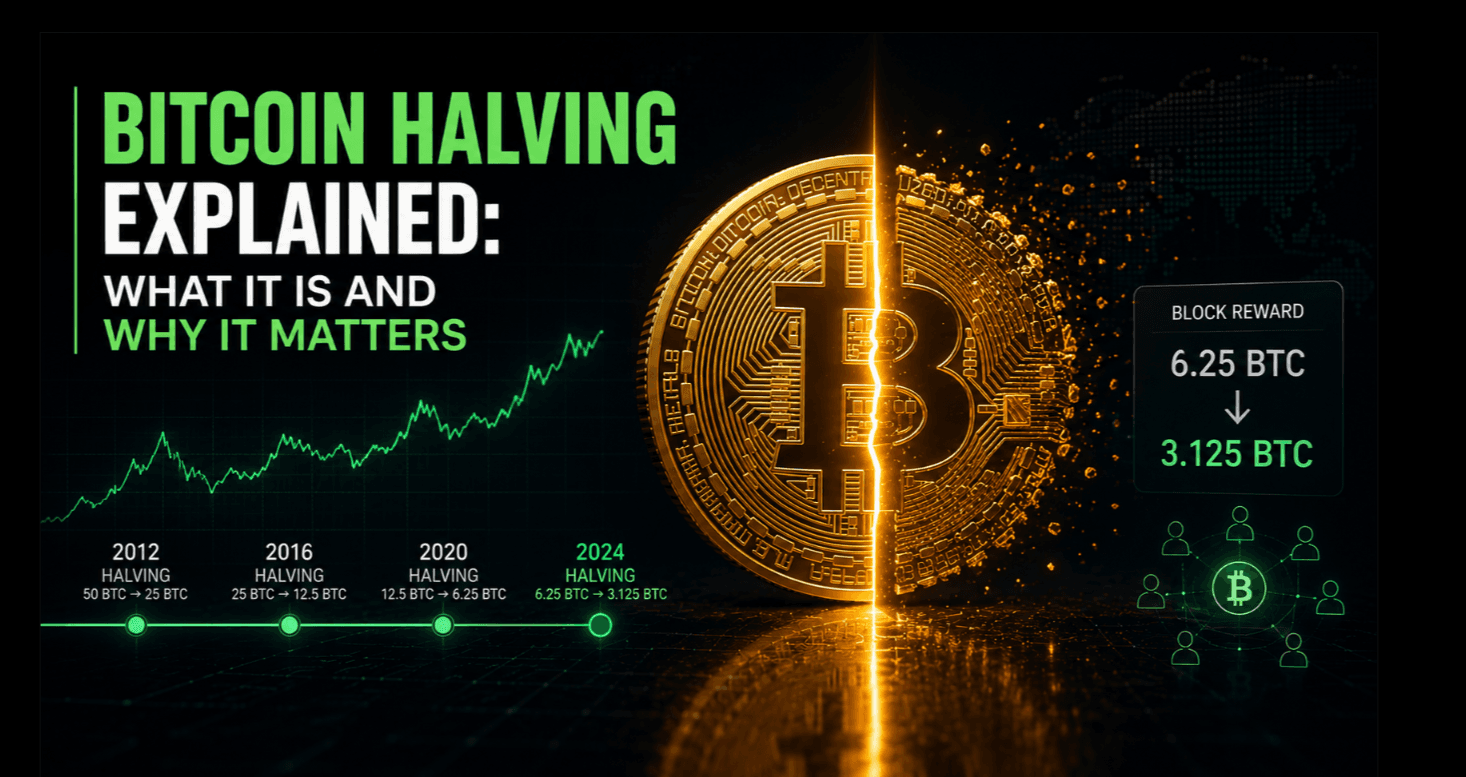
The Bitcoin halving is a scheduled event, occurring roughly every four years, that cuts the reward miners earn for adding a new block in half. It slows the pace at which new bitcoin enters circulation, reinforcing the network's fixed supply of 21 million coins. The most recent halving, in April 2024, lowered the block reward from 6.25 BTC to 3.125 BTC, and it matters because it is the mechanism that makes Bitcoin's scarcity predictable and tamper-proof.
Key takeaways
- The halving cuts the block subsidy in half every 210,000 blocks, about every four years.
- It is written into Bitcoin's code and cannot change without overwhelming network agreement.
- Halvings have occurred in 2012, 2016, 2020, and 2024, with the next expected around 2028.
- Each halving lowers Bitcoin's issuance rate, which had fallen below 1% per year by 2024.
- The supply effect is mechanical, but the price effect is debated and not guaranteed.
How the halving works mechanically
Bitcoin measures time in blocks rather than calendar dates. Every 210,000 blocks, the protocol automatically halves the subsidy paid to whichever miner produces the next block. Because the network targets one block roughly every ten minutes, 210,000 blocks take close to four years to accumulate. There is no vote and no announcement; the reduction is part of the consensus rules every node enforces, so it simply happens when the block count reaches the threshold.
This makes Bitcoin's monetary policy disinflationary. New coins keep arriving, but at a steadily slowing rate, until issuance effectively ends near the year 2140 when the final fraction of a coin is mined.
The history of Bitcoin halvings
Four halvings have happened so far, each cutting the new-coin reward in half.
- November 2012: the reward dropped from 50 BTC to 25 BTC per block.
- July 2016: the reward dropped from 25 BTC to 12.5 BTC per block.
- May 2020: the reward dropped from 12.5 BTC to 6.25 BTC per block.
- April 2024: the reward dropped from 6.25 BTC to 3.125 BTC per block.
Bitcoin's price rose substantially in the period following each of the first three halvings, which is why many people associate the event with bull markets. That association deserves caution. Three examples are not a reliable statistical pattern, and each of those periods also coincided with distinct macroeconomic conditions, shifting regulation, and growing adoption that influenced prices independently of the halving itself.
Why the halving exists
The halving was designed to imitate the gradual extraction of a scarce natural resource. Just as a finite metal becomes harder to pull from the ground over time, Bitcoin's new supply tapers on a fixed schedule. The intent was a form of money whose issuance no authority could inflate at will, released gradually into the world rather than printed on demand. The result is a supply curve that every participant can predict decades in advance.
The halving is monetary policy without a central bank: fixed in advance, enforced by code, and indifferent to politics. — CoinRadar Daily analysis
The shrinking inflation rate
In monetary terms, inflation describes how fast new supply is added relative to what already exists. Each halving roughly halves that rate. By 2024 Bitcoin's annual issuance had fallen below 1%, lower than the long-run supply growth of gold, and it keeps declining with every halving. This steadily tightening flow, not just the distant 21-million cap, is the heart of the argument that Bitcoin behaves like a scarce, hard money.
What the halving means for miners
For miners, a halving is effectively an overnight pay cut. The new-coin portion of their revenue drops by half while their electricity and hardware costs stay the same. Operators running older, less efficient machines or paying high power prices can be pushed offline, while the most efficient survive and absorb the share left behind. In the weeks after a halving, the network's total computing power often dips before recovering as the market reprices and weaker miners exit.
The growing role of transaction fees
As the subsidy shrinks with each halving, the fees users attach to transactions become a larger slice of miner income. Over the long run, Bitcoin's security is meant to be funded increasingly by fees rather than new issuance. How smoothly that transition unfolds is one of the genuine open questions about Bitcoin's future economics, and it grows more relevant with every halving.
Why investors watch the halving so closely
The appeal is straightforward: the halving is a rare moment when the supply side of an asset changes by a known amount on a known schedule. Each event cuts in half the quantity of new bitcoin that buyers must absorb each day. In theory, if demand holds steady while new supply falls, that imbalance supports the price. The reduction in daily new coins is the part of the story that is genuinely mechanical rather than speculative.
The reality is more nuanced. Because most existing bitcoin is already held by long-term owners and exchanges, the new coins from mining are only one input among many that move the market. And because the supply change is fully known in advance, an efficient market should price much of it in well before the event arrives.
The cycle narrative, in brief
- Before the halving: anticipation builds and miners prepare for reduced revenue.
- Right after: new issuance drops, weaker miners exit, and computing power rebalances.
- Over the following year or so: historically associated with rising prices, though never assured.
Does the halving guarantee a price rise?
No. The reduction in new supply is public knowledge long before it happens, so markets have ample time to anticipate it. History shows strong rallies after past halvings, but each cycle came with different conditions, and as new supply becomes a smaller fraction of the total, each future halving changes the overall picture less than the one before. Treat the halving as a defining structural feature of Bitcoin rather than a reliable trading signal.
This article is for general information only and is not financial or investment advice. Past performance does not predict future results; markets are uncertain, and you should research thoroughly before making any decision.
Sources
3 references- 01Bitcoin: A Peer-to-Peer Electronic Cash System
Satoshi Nakamoto · accessed August 22, 2026
- 02Controlled supply
Bitcoin Wiki · accessed August 22, 2026
- 03Block Chain — block reward schedule
Bitcoin Developer Reference · accessed August 22, 2026
Frequently asked questions
When is the next Bitcoin halving?+
The next halving is expected around 2028, when the block reward will fall from 3.125 BTC to about 1.5625 BTC. The exact date is not fixed because it depends on how quickly blocks are produced; it triggers automatically once the network reaches the scheduled block height.
Why does the Bitcoin halving happen?+
It is built into Bitcoin's code to control new supply and enforce scarcity. By cutting issuance in half every 210,000 blocks, the protocol gradually slows the creation of new coins toward the 21-million cap, producing a predictable, disinflationary money supply.
Does the halving always make the price go up?+
No. Prices rose after the 2012, 2016, and 2020 halvings, but that is only three examples, each with different market conditions. Because the supply change is known well in advance, much of its potential effect may already be reflected in the price.
How many Bitcoin halvings will there be in total?+
There will be 32 halvings. After the final one, around the year 2140, the block subsidy rounds down to zero and no new bitcoin will be created. From then on, miners are expected to be funded entirely by transaction fees.
Written by
James ParkNFT & Web3 Gaming AnalystNFTs, Web3 Gaming, GameFi, Digital Collectibles, Creator Economy
James Park serves as the NFT & Web3 Gaming Analyst at CoinRadar Daily, where he covers the rapidly evolving worlds of blockchain gaming, digital collectibles, metaverse ecosystems, and creator-driven economies. Combining expertise in interactive media with blockchain technology, he analyzes how NFTs and decentralized gaming continue to reshape digital ownership and online communities. James earned a Master of Fine Arts in Digital Media from NYU Tisch School of the Arts, giving him a unique perspective that blends creative storytelling, digital culture, and emerging technology. Rather than viewing NFTs solely through an investment lens, he examines their broader impact on entertainment, gaming, intellectual property, and community engagement. Prior to joining CoinRadar Daily, James reported on the NFT industry and blockchain gaming for several leading digital media outlets, covering the explosive growth of the NFT market, the transition toward utility-focused collections, and the evolution of GameFi. His close relationships with independent developers, digital artists, and gaming communities allow him to identify important industry trends long before they reach mainstream attention. His reporting places particular emphasis on sustainable Web3 game design, token economies, and the long-term viability of blockchain-powered virtual worlds. James has published extensive research analyzing why certain gaming ecosystems thrive while others struggle with inflationary token models, weak player retention, or unsustainable reward structures. His market analysis is frequently referenced by blockchain startups, investors, and game studios evaluating new Web3 projects. Beyond journalism, James actively participates in NFT and decentralized creator communities while following developments in digital art, virtual economies, and next-generation gaming technologies. He also contributes educational content on blockchain gaming and regularly speaks about the future of digital ownership, helping CoinRadar Daily deliver balanced, research-driven coverage at the intersection of technology, gaming, and crypto innovation.

✓Reviewed & edited by
Olivia BennettBlockchain Security ResearcherSmart Contract Security, Audit Reports, Exploits, DeFi Hacks, White-Hat Research
Olivia Bennett is the Blockchain Security Researcher at CoinRadar Daily, where she specializes in smart contract security, DeFi risk analysis, blockchain infrastructure, and protocol vulnerabilities. Drawing on years of hands-on cybersecurity experience, she delivers in-depth reporting that explains both the technical details and the real-world implications of security incidents across the digital asset ecosystem. Before joining CoinRadar Daily, Olivia built her career in cybersecurity, working in penetration testing, blockchain security assessments, and smart contract auditing. She participated in numerous security reviews for decentralized applications and blockchain protocols, helping identify critical vulnerabilities before they could be exploited. Her responsible disclosure work has contributed to improving the security of several major DeFi projects and protecting millions of dollars in digital assets. Olivia earned a Bachelor of Science in Computer Science from the University of Edinburgh and later completed advanced professional training in offensive security and blockchain technologies. Her combination of software security expertise and blockchain knowledge enables her to provide readers with clear, evidence-based analysis of exploits, protocol upgrades, and emerging attack vectors. At CoinRadar Daily, Olivia publishes detailed investigations into blockchain exploits, smart contract audits, cross-chain security, wallet protection, and evolving cyber threats affecting the crypto industry. She is particularly committed to translating highly technical research into practical guidance that helps investors, developers, and blockchain users better understand protocol risk and security best practices. Alongside her editorial work, Olivia contributes educational resources covering secure wallet management, decentralized finance security, and blockchain infrastructure. She also participates in industry events and technical discussions focused on strengthening Web3 security standards, supporting CoinRadar Daily's mission to provide accurate, research-driven coverage of the rapidly evolving digital asset landscape.
CoinRadar Daily content is written by named analysts and checked against our editorial standards. Market data is indicative and informational only — nothing here is financial advice.
Bitcoin services, rated
How we score →Independent, rubric-scored tables covering the services this bitcoin coverage keeps running into.
Best Hardware Wallets
Top rated: Trezor Safe 5 8.6
Devices whose only job is to keep a key away from the internet.
5rated →
Best Crypto Wallets
Top rated: Rabby 8.4
Software wallets for everyday use.
5rated →
Best Crypto Exchanges
Top rated: Kraken 8.6
Centralised venues that hold your funds while you trade.
6rated →
Keep Reading
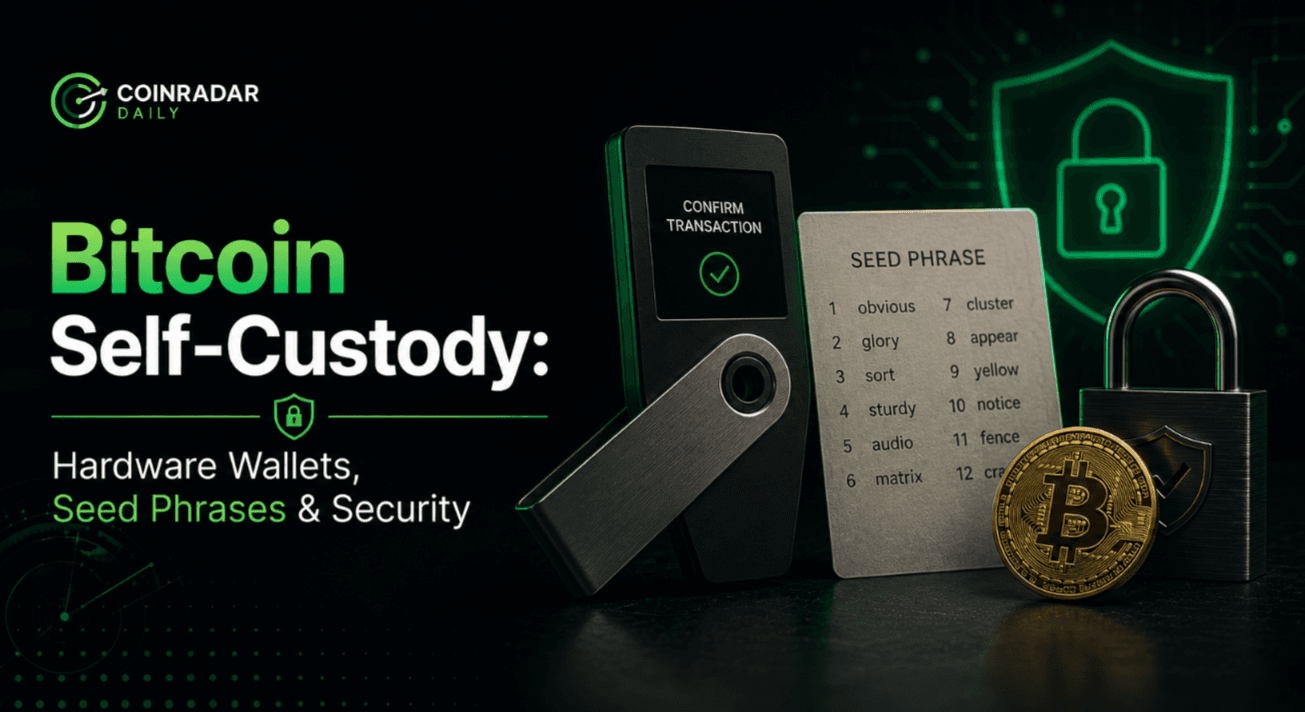
Bitcoin Self-Custody: Hardware Wallets, Seed Phrases & Security
Self-custody means holding your own keys. Here is how hardware wallets and seed phrases protect Bitcoin, and the security habits that prevent loss.
James Park · May 25, 2026→
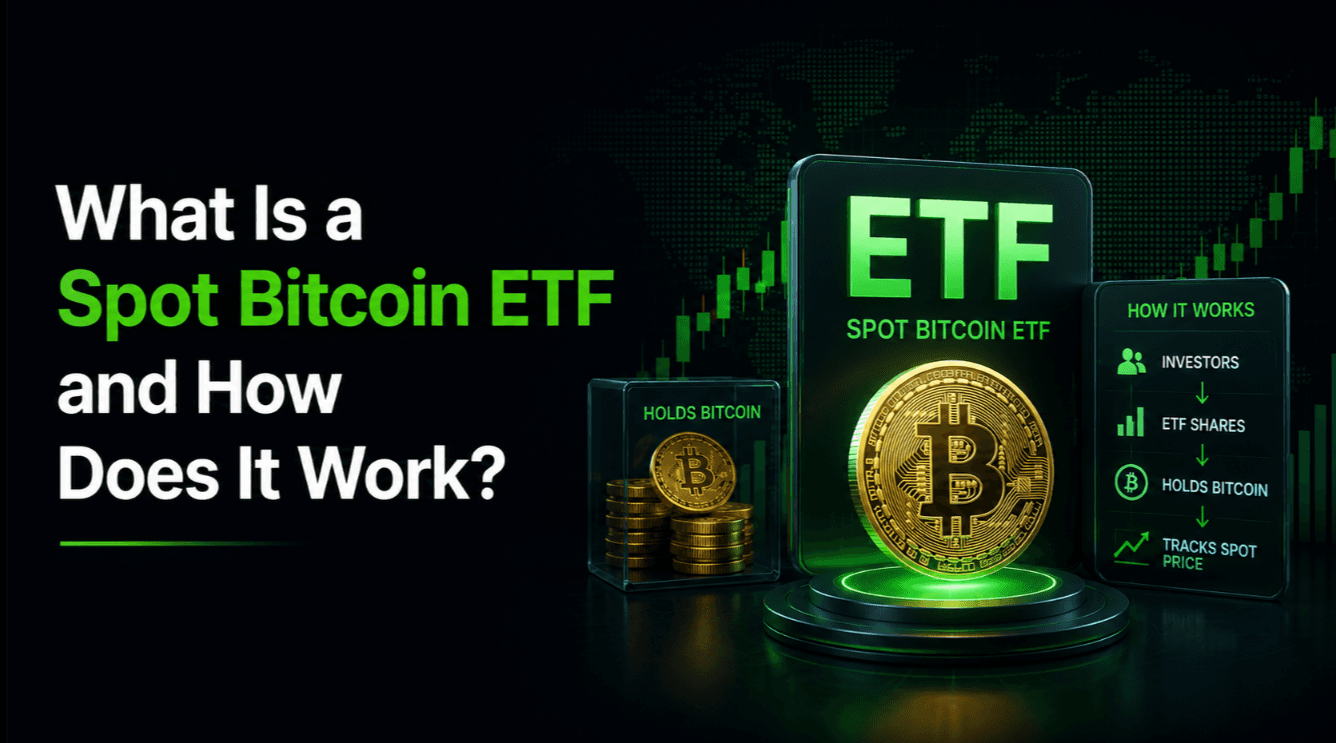
What Is a Spot Bitcoin ETF and How Does It Work?
A spot Bitcoin ETF holds actual bitcoin and lets investors gain exposure through a brokerage account. Here is how it works and what you give up.
Emily Volker · June 1, 2026→

Bitcoin vs Gold: Which Is the Better Store of Value?
Bitcoin is often called digital gold, but the two assets store value very differently. Here is how they compare on scarcity, volatility, and risk.
Olivia Bennett · June 5, 2026→