Bitcoin vs Gold: Which Is the Better Store of Value?
Bitcoin is often called digital gold, but the two assets store value very differently. Here is how they compare on scarcity, volatility, and risk.

By Olivia Bennett, Blockchain Security Researcher
Smart Contract Security, Audit Reports, Exploits, DeFi Hacks, White-Hat Research
✓ Reviewed by Emily Volker· Editor-in-Chief
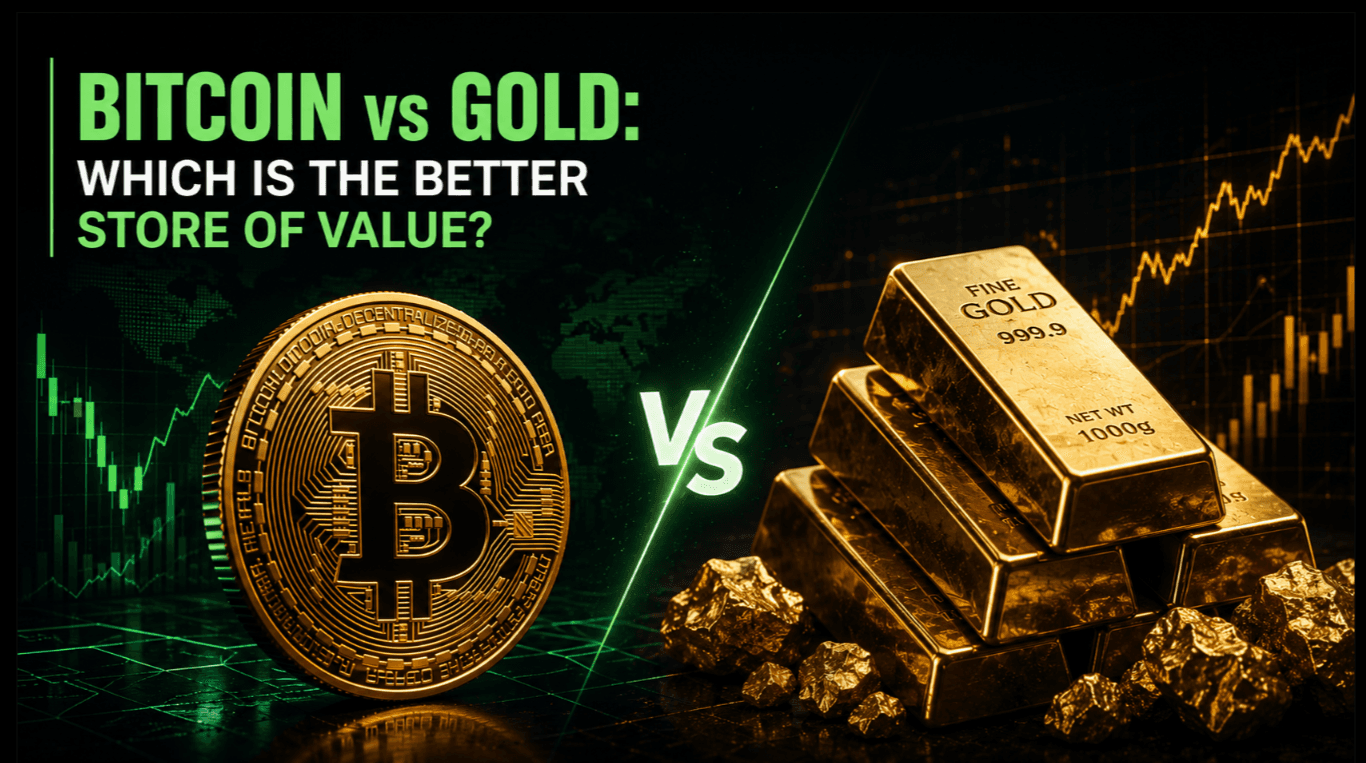
Bitcoin and gold are both used as a store of value, but they get there in opposite ways. Gold is a physical metal with thousands of years of history, broad acceptance, and relatively stable demand, while Bitcoin is a digital asset with a strictly fixed supply, easy global transfer, and a much shorter, far more volatile track record. Neither is automatically better; the right choice depends on whether you prioritize proven stability or scarcity and portability.
Key takeaways
- Gold offers a long history and lower volatility; Bitcoin offers absolute scarcity and easy transfer.
- Bitcoin's supply is capped at 21 million coins, while gold's supply grows slowly through mining.
- Gold is heavy and costly to move and store; Bitcoin moves globally in minutes.
- Bitcoin has experienced far larger price swings, both up and down, than gold.
- Many investors treat them as complements rather than as a strict either-or choice.
What makes a good store of value
A store of value is something you can hold over time and reasonably expect to retain purchasing power. The qualities that matter most are scarcity, durability, divisibility, portability, and broad recognition. Gold has anchored this role for millennia precisely because it is durable, scarce, and universally recognized. Bitcoin is a newer contender that scores highly on scarcity, divisibility, and portability, but lacks gold's long history of trust.
Scarcity: fixed versus slowly growing
Both assets are scarce, but in different ways. Bitcoin's supply is capped at 21 million coins by code, and its issuance shrinks on a fixed schedule, making future supply fully predictable. Gold is finite in the earth, but its total quantity is unknown and new gold is mined every year, typically expanding the above-ground supply by a low single-digit percentage. Bitcoin's scarcity is mathematically certain; gold's is geological and gradual.
The hardness argument
Supporters of Bitcoin argue it is harder money than gold because no amount of effort can produce more than the fixed cap, whereas a sustained rise in gold's price can incentivize more mining. Gold's defenders counter that its supply has stayed remarkably stable for centuries in practice, and that this very stability is part of why it has been trusted for so long.
Volatility and track record
This is where the two assets diverge most sharply. Gold's price moves, but slowly and within a relatively narrow band over short periods, which is part of its appeal during turmoil. Bitcoin has delivered far larger gains over its lifetime, but with dramatic swings, including drops of more than half its value within a single year on multiple occasions. For someone who needs stability over months, gold has behaved more predictably; for someone with a long horizon and tolerance for risk, Bitcoin's volatility has historically come alongside higher growth.
Gold has earned trust over millennia; Bitcoin is still earning it. The premium gold commands is a premium on time. — CoinRadar Daily analysis
Portability, storage, and verification
Moving value is where Bitcoin's advantages stand out. Sending a large sum of Bitcoin across the world takes minutes and costs a network fee, regardless of the amount, while moving an equivalent value in gold requires physical transport, security, and insurance. Storage follows the same pattern: gold takes physical space and often a vault, whereas Bitcoin is held through keys that can be secured on a small device or memorized as a recovery phrase.
- Portability: Bitcoin transfers digitally worldwide; gold must be physically shipped.
- Storage: gold needs secure physical space; Bitcoin needs secure key management.
- Verification: a gold bar's purity can be hard to confirm; a Bitcoin transaction is checked by the network.
- Divisibility: gold is hard to split precisely; Bitcoin divides into one hundred million units.
Risk profiles compared
Each asset carries a different shape of risk. Gold's main risks are physical theft, storage and insurance costs, and the slow erosion of returns if it merely holds steady while other assets grow. Bitcoin's risks are sharper and more varied: extreme price volatility, the permanent loss of coins if you lose your keys, evolving regulation, and the simple fact that it is a young asset whose long-term role is still being established.
Counterparty and custody risk
Both can be held without a counterparty, which is unusual and valuable. Physical gold in your possession and self-custodied Bitcoin both belong to you outright, with no bank or issuer standing behind them. The flip side is that both place full responsibility on the holder. Lose the gold or lose the keys, and there is no help desk to recover the value.
How market behavior compares
Investors often turn to gold during periods of fear, and it has frequently held its value or risen when stock markets fall, earning its reputation as a defensive asset. Bitcoin's behavior is less settled. At times it has moved like a risk asset, rising and falling alongside technology stocks, and at other times it has rallied on its own narrative as an alternative to traditional money. Its correlation with other markets has shifted over time, which makes it harder to slot neatly into the safe-haven category gold occupies.
Do you have to choose?
For many investors the question is not Bitcoin or gold but how much of each. They serve overlapping but distinct purposes: gold as a time-tested, lower-volatility anchor, and Bitcoin as a scarcer, more portable, higher-risk bet on a digital future. Holding some of both can balance the proven stability of one against the asymmetric potential of the other, and it avoids betting everything on a single thesis about how value will be stored in the decades ahead.
This article is for general information only and is not financial or investment advice. Both assets carry risk and can lose value; consider your own goals, time horizon, and a licensed professional before investing.
Frequently asked questions
Is Bitcoin really digital gold?+
The nickname captures a real similarity: both are scarce assets used to store value outside the traditional banking system. But Bitcoin is far more volatile and far younger than gold, and it transfers digitally rather than physically, so the comparison is useful as a metaphor rather than a precise equivalence.
Which is safer, Bitcoin or gold?+
Gold has historically been less volatile and has a longer track record, making it the more stable choice in the short term. Bitcoin offers higher potential growth but with much larger swings and additional risks like key loss and evolving regulation. Safer depends on your time horizon and risk tolerance.
Can Bitcoin replace gold?+
It is possible Bitcoin captures part of the role gold plays, especially among younger and more digital investors, but a full replacement is far from certain. Gold's deep history, industrial uses, and broad acceptance give it staying power, and many investors hold both rather than treating it as a winner-take-all contest.
Why is gold less volatile than Bitcoin?+
Gold has a much larger, more mature market built over centuries, with stable industrial and jewelry demand alongside investment demand. Bitcoin's market is younger, smaller, and driven more by shifting sentiment and adoption, which produces sharper price swings in both directions.
Written by
Olivia BennettBlockchain Security ResearcherSmart Contract Security, Audit Reports, Exploits, DeFi Hacks, White-Hat Research
Olivia Bennett is the Blockchain Security Researcher at CoinRadar Daily, where she specializes in smart contract security, DeFi risk analysis, blockchain infrastructure, and protocol vulnerabilities. Drawing on years of hands-on cybersecurity experience, she delivers in-depth reporting that explains both the technical details and the real-world implications of security incidents across the digital asset ecosystem. Before joining CoinRadar Daily, Olivia built her career in cybersecurity, working in penetration testing, blockchain security assessments, and smart contract auditing. She participated in numerous security reviews for decentralized applications and blockchain protocols, helping identify critical vulnerabilities before they could be exploited. Her responsible disclosure work has contributed to improving the security of several major DeFi projects and protecting millions of dollars in digital assets. Olivia earned a Bachelor of Science in Computer Science from the University of Edinburgh and later completed advanced professional training in offensive security and blockchain technologies. Her combination of software security expertise and blockchain knowledge enables her to provide readers with clear, evidence-based analysis of exploits, protocol upgrades, and emerging attack vectors. At CoinRadar Daily, Olivia publishes detailed investigations into blockchain exploits, smart contract audits, cross-chain security, wallet protection, and evolving cyber threats affecting the crypto industry. She is particularly committed to translating highly technical research into practical guidance that helps investors, developers, and blockchain users better understand protocol risk and security best practices. Alongside her editorial work, Olivia contributes educational resources covering secure wallet management, decentralized finance security, and blockchain infrastructure. She also participates in industry events and technical discussions focused on strengthening Web3 security standards, supporting CoinRadar Daily's mission to provide accurate, research-driven coverage of the rapidly evolving digital asset landscape.

✓Reviewed & edited by
Emily VolkerEditor-in-ChiefEditorial Strategy, Investigative Journalism, Crypto Media, E-E-A-T Standards
Emily Volker is the Editor-in-Chief of CoinRadar Daily, where she leads a multilingual editorial team covering cryptocurrency markets, blockchain innovation, Web3, and global digital asset regulation across eight languages. With more than a decade of experience in financial and technology journalism, she has played a key role in developing high editorial standards and trusted reporting within the digital asset industry. Emily began her career as a financial journalist reporting on commodities, energy markets, and emerging technologies before discovering Bitcoin and decentralized finance in the early 2010s. She later moved to London to join one of Europe's early blockchain-focused media organizations, where she advanced into senior editorial leadership. Her experience reporting through both the rapid expansion of the 2017 ICO boom and the subsequent market correction reinforced her commitment to fact-based, research-driven journalism in an industry often influenced by speculation. She holds a Master's degree in International Journalism from City, University of London, and has completed executive studies in digital media strategy through the Reuters Institute at Oxford. Emily is a strong advocate for editorial transparency, rigorous verification, and responsible financial reporting. She also helped integrate Google's E-E-A-T principles—Experience, Expertise, Authoritativeness, and Trustworthiness—into the editorial standards followed by CoinRadar Daily. Under her leadership, CoinRadar Daily has expanded into a global cryptocurrency news platform publishing content in eight languages with a network of editors, analysts, and contributors across four continents. Emily oversees investigative reporting, editorial policy, content quality, and fact-checking processes to ensure every article meets the publication's standards for accuracy, credibility, and independence. Alongside her editorial responsibilities, Emily mentors aspiring journalists through digital media initiatives and regularly speaks at international conferences focused on journalism, fintech, blockchain technology, and digital assets, where she discusses responsible reporting, combating misinformation, and the evolving future of financial media.
CoinRadar Daily content is written by named analysts and checked against our editorial standards. Market data is indicative and informational only — nothing here is financial advice.
Bitcoin services, rated
How we score →Independent, rubric-scored tables covering the services this bitcoin coverage keeps running into.
Best Hardware Wallets
Top rated: Trezor Safe 5 8.6
Devices whose only job is to keep a key away from the internet.
5rated →
Best Crypto Wallets
Top rated: Rabby 8.4
Software wallets for everyday use.
5rated →
Best Crypto Exchanges
Top rated: Kraken 8.6
Centralised venues that hold your funds while you trade.
6rated →
Keep Reading
Bitcoin Self-Custody: Hardware Wallets, Seed Phrases & Security
Self-custody means holding your own keys. Here is how hardware wallets and seed phrases protect Bitcoin, and the security habits that prevent loss.
James Park · May 25, 2026→
What Is a Spot Bitcoin ETF and How Does It Work?
A spot Bitcoin ETF holds actual bitcoin and lets investors gain exposure through a brokerage account. Here is how it works and what you give up.
Emily Volker · June 1, 2026→
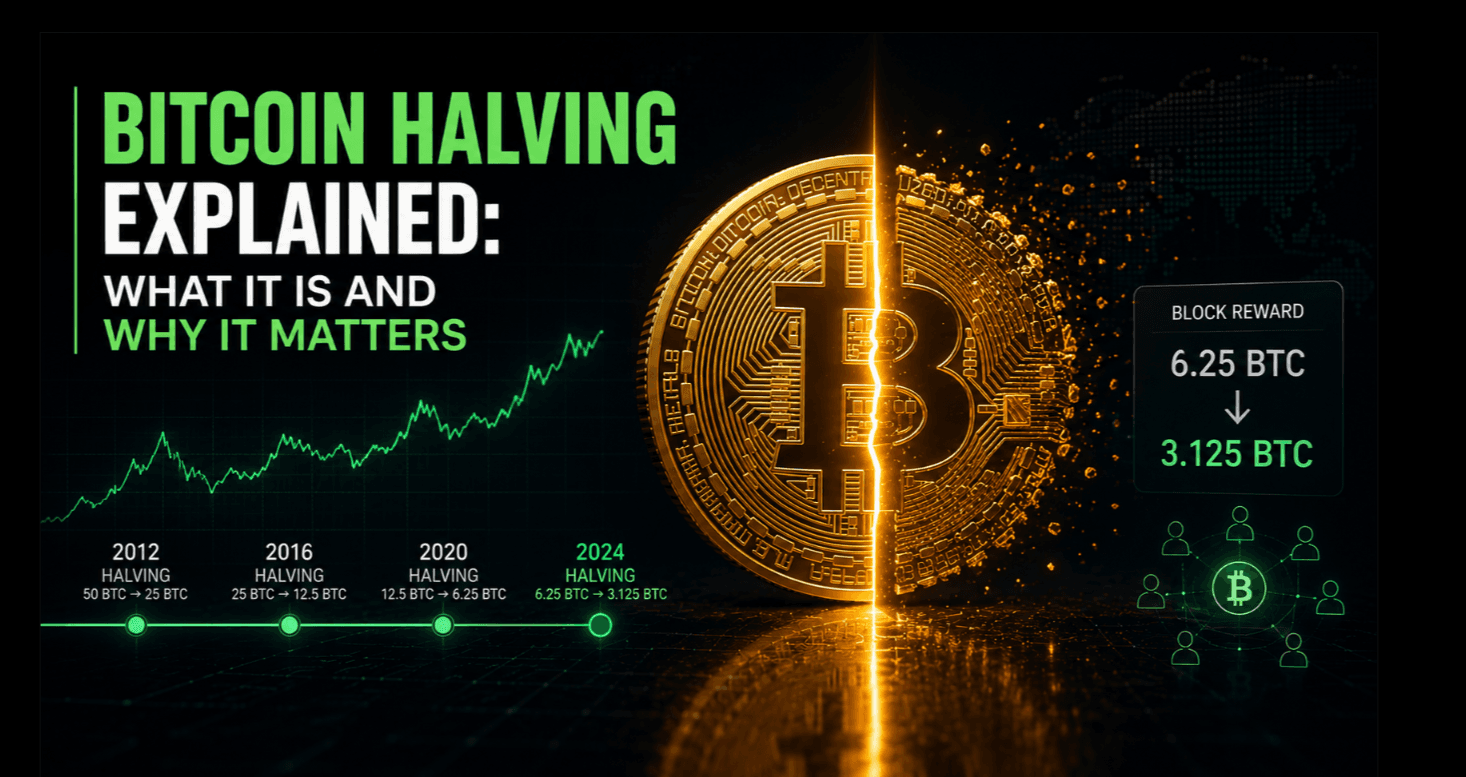
Bitcoin Halving Explained: What It Is and Why It Matters
Roughly every four years Bitcoin halves the reward paid to miners, slowing new supply. Here is how the halving works and why investors pay attention.
James Park · June 16, 2026→