Bull vs Bear Market: The Signals Worth Watching
Telling a bull market from a bear is easy in hindsight and hard in the moment. These are the signals that help you read the broader trend without chasing noise.

By Emily Volker, Editor-in-Chief
Editorial Strategy, Investigative Journalism, Crypto Media, E-E-A-T Standards
✓ Reviewed by Olivia Bennett· Blockchain Security Researcher
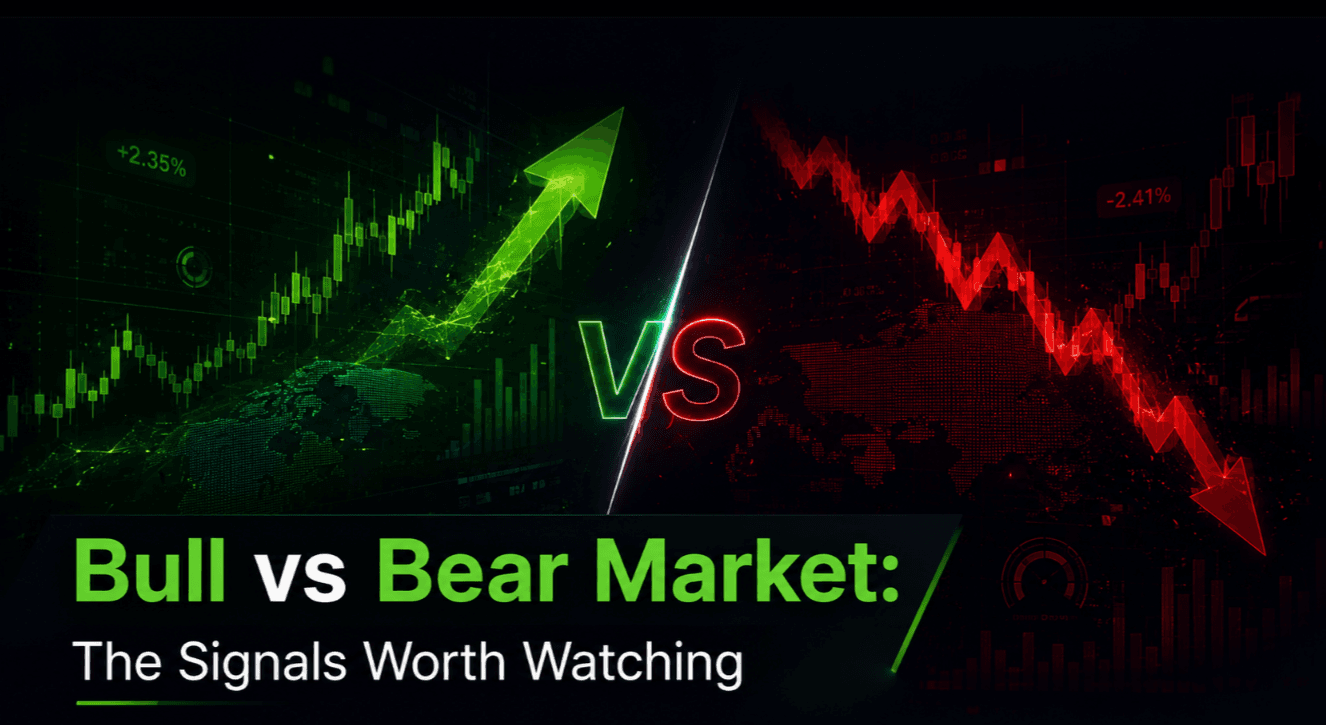
A bull market is a sustained uptrend marked by rising prices and improving sentiment, while a bear market is a sustained downtrend marked by falling prices and pervasive caution. The hard part is not the definition but recognising which regime you are in while it is happening, since both contain sharp countertrend moves that can fool you. The most reliable approach is to watch a combination of trend, sentiment, and behavioural signals together rather than relying on any single one.
Key takeaways
- Bull markets show higher highs and higher lows; bears show the reverse.
- Sentiment swings from greed and complacency in bulls to fear and apathy in bears.
- Countertrend rallies and pullbacks are normal and frequently mislead participants.
- Breadth, leverage, and volume add confirmation beyond price direction alone.
- No single signal is decisive; convergence across several is what matters.
Trend structure: the primary signal
The clearest distinction lives in price structure. Bull markets tend to print a sequence of higher highs and higher lows, with pullbacks finding support above prior levels. Bear markets do the opposite, carving lower highs and lower lows as rallies fail to reclaim previous peaks. This structure is the backbone of trend analysis, but it is best read over weeks and months rather than hours, where noise dominates.
Sentiment and behaviour
Markets are driven by emotion as much as fundamentals. In bull markets, optimism builds into greed, risk feels rewarded, and caution looks foolish. In bear markets, fear hardens into apathy, and even good news struggles to lift prices. Sentiment surveys and fear-and-greed style gauges try to capture this mood, and they are most useful at extremes, where crowd emotion tends to be wrong.
By the time a trend is obvious to everyone, much of the move is already behind us. The signal lives in the discomfort before consensus forms. — CoinRadar Daily analysis
Confirming signals beyond price
Market breadth
Breadth measures how many assets participate in a move. A healthy bull market tends to be broad, with many assets rising together, while a fragile one is narrow, carried by only a handful. When breadth deteriorates while headline prices hold up, it can hint that the trend is weakening beneath the surface.
Leverage and funding
Crypto markets carry significant leverage, and its conditions reveal positioning. Persistently high funding and crowded long positioning can leave a bull market vulnerable to sharp shakeouts, while heavy short positioning in a bear can fuel violent relief rallies. Leverage does not predict direction, but it shapes the character and intensity of moves.
Volume
Volume shows conviction behind a move. Trends supported by rising volume tend to be more durable, while moves on thin volume are easier to reverse. Reading volume alongside price helps you judge whether a breakout or breakdown is meaningful or likely to fade.
Avoiding the whipsaw trap
The single biggest mistake is overreacting to countertrend moves. Bull markets have brutal pullbacks and bear markets have explosive rallies, both of which tempt people into flipping their view at exactly the wrong time. The antidote is to anchor on the higher-timeframe trend and require confirmation across multiple signals before concluding the regime has changed.
It also helps to accept uncertainty. You will rarely have perfect clarity in real time, and transitions between regimes are often choppy and ambiguous. The goal is to be roughly right about the prevailing trend, not precisely right about every turn.
This article is educational and not financial advice. Signals describe probabilities, not certainties, and any of them can give false readings. Use them to inform a balanced view and a risk plan you can stick to under pressure.
Frequently asked questions
How can I tell if a rally is a real trend change or a bear market bounce?+
There is no certain way in real time. The strongest evidence comes from confirmation across signals: improving trend structure, broadening participation, and supportive volume. A single sharp rally on thin breadth is more consistent with a countertrend bounce.
Is the fear and greed index a reliable signal on its own?+
It is most useful at extremes, where crowd emotion is often wrong, but it should not be used in isolation. Pairing sentiment readings with trend and behavioural signals gives a far more balanced picture than any single gauge.
Do bull and bear markets have a fixed length?+
No. Their duration varies with liquidity, adoption, and external conditions. Historical ranges offer rough context, but treating them as fixed timelines tends to lead to poor expectations and premature decisions.
Why do so many investors get caught on the wrong side of the trend?+
Largely because countertrend moves are designed to be convincing and emotion peaks at the worst times. Greed near tops and fear near bottoms push people to act against the prevailing trend just as it matters most.
Written by
Emily VolkerEditor-in-ChiefEditorial Strategy, Investigative Journalism, Crypto Media, E-E-A-T Standards
Emily Volker is the Editor-in-Chief of CoinRadar Daily, where she leads a multilingual editorial team covering cryptocurrency markets, blockchain innovation, Web3, and global digital asset regulation across eight languages. With more than a decade of experience in financial and technology journalism, she has played a key role in developing high editorial standards and trusted reporting within the digital asset industry. Emily began her career as a financial journalist reporting on commodities, energy markets, and emerging technologies before discovering Bitcoin and decentralized finance in the early 2010s. She later moved to London to join one of Europe's early blockchain-focused media organizations, where she advanced into senior editorial leadership. Her experience reporting through both the rapid expansion of the 2017 ICO boom and the subsequent market correction reinforced her commitment to fact-based, research-driven journalism in an industry often influenced by speculation. She holds a Master's degree in International Journalism from City, University of London, and has completed executive studies in digital media strategy through the Reuters Institute at Oxford. Emily is a strong advocate for editorial transparency, rigorous verification, and responsible financial reporting. She also helped integrate Google's E-E-A-T principles—Experience, Expertise, Authoritativeness, and Trustworthiness—into the editorial standards followed by CoinRadar Daily. Under her leadership, CoinRadar Daily has expanded into a global cryptocurrency news platform publishing content in eight languages with a network of editors, analysts, and contributors across four continents. Emily oversees investigative reporting, editorial policy, content quality, and fact-checking processes to ensure every article meets the publication's standards for accuracy, credibility, and independence. Alongside her editorial responsibilities, Emily mentors aspiring journalists through digital media initiatives and regularly speaks at international conferences focused on journalism, fintech, blockchain technology, and digital assets, where she discusses responsible reporting, combating misinformation, and the evolving future of financial media.

✓Reviewed & edited by
Olivia BennettBlockchain Security ResearcherSmart Contract Security, Audit Reports, Exploits, DeFi Hacks, White-Hat Research
Olivia Bennett is the Blockchain Security Researcher at CoinRadar Daily, where she specializes in smart contract security, DeFi risk analysis, blockchain infrastructure, and protocol vulnerabilities. Drawing on years of hands-on cybersecurity experience, she delivers in-depth reporting that explains both the technical details and the real-world implications of security incidents across the digital asset ecosystem. Before joining CoinRadar Daily, Olivia built her career in cybersecurity, working in penetration testing, blockchain security assessments, and smart contract auditing. She participated in numerous security reviews for decentralized applications and blockchain protocols, helping identify critical vulnerabilities before they could be exploited. Her responsible disclosure work has contributed to improving the security of several major DeFi projects and protecting millions of dollars in digital assets. Olivia earned a Bachelor of Science in Computer Science from the University of Edinburgh and later completed advanced professional training in offensive security and blockchain technologies. Her combination of software security expertise and blockchain knowledge enables her to provide readers with clear, evidence-based analysis of exploits, protocol upgrades, and emerging attack vectors. At CoinRadar Daily, Olivia publishes detailed investigations into blockchain exploits, smart contract audits, cross-chain security, wallet protection, and evolving cyber threats affecting the crypto industry. She is particularly committed to translating highly technical research into practical guidance that helps investors, developers, and blockchain users better understand protocol risk and security best practices. Alongside her editorial work, Olivia contributes educational resources covering secure wallet management, decentralized finance security, and blockchain infrastructure. She also participates in industry events and technical discussions focused on strengthening Web3 security standards, supporting CoinRadar Daily's mission to provide accurate, research-driven coverage of the rapidly evolving digital asset landscape.
CoinRadar Daily content is written by named analysts and checked against our editorial standards. Market data is indicative and informational only — nothing here is financial advice.
Markets services, rated
How we score →Independent, rubric-scored tables covering the services this markets coverage keeps running into.
Best Crypto Exchanges
Top rated: Kraken 8.6
Centralised venues that hold your funds while you trade.
6rated →
Best Perpetual DEXs
Top rated: Hyperliquid 8.3
On-chain leverage.
5rated →
Best Crypto Trading Tools
Top rated: DefiLlama 8.7
Terminals, bots, screeners and portfolio trackers.
4rated →
Keep Reading
Risk Management for Crypto Investors: Sizing and Stops
Returns get the attention, but risk management decides who survives. Here is how position sizing, stop-losses, and sensible limits keep you in the game.
James Park · May 19, 2026→
Crypto Market Cap Explained, and Why It Matters
Market cap is the headline number everyone quotes, but few use it correctly. Here is how it is calculated, what it really tells you, and where it can be misleading.
Olivia Bennett · June 1, 2026→

How to Read On-Chain Metrics: A Practical Guide
On-chain data turns a public blockchain into a window on real user behaviour. Here is how to read the core metrics, and how to avoid drawing the wrong conclusions from them.
James Park · June 10, 2026→