Crypto Market Cap Explained, and Why It Matters
Market cap is the headline number everyone quotes, but few use it correctly. Here is how it is calculated, what it really tells you, and where it can be misleading.

By Olivia Bennett, Blockchain Security Researcher
Smart Contract Security, Audit Reports, Exploits, DeFi Hacks, White-Hat Research
✓ Reviewed by Emily Volker· Editor-in-Chief
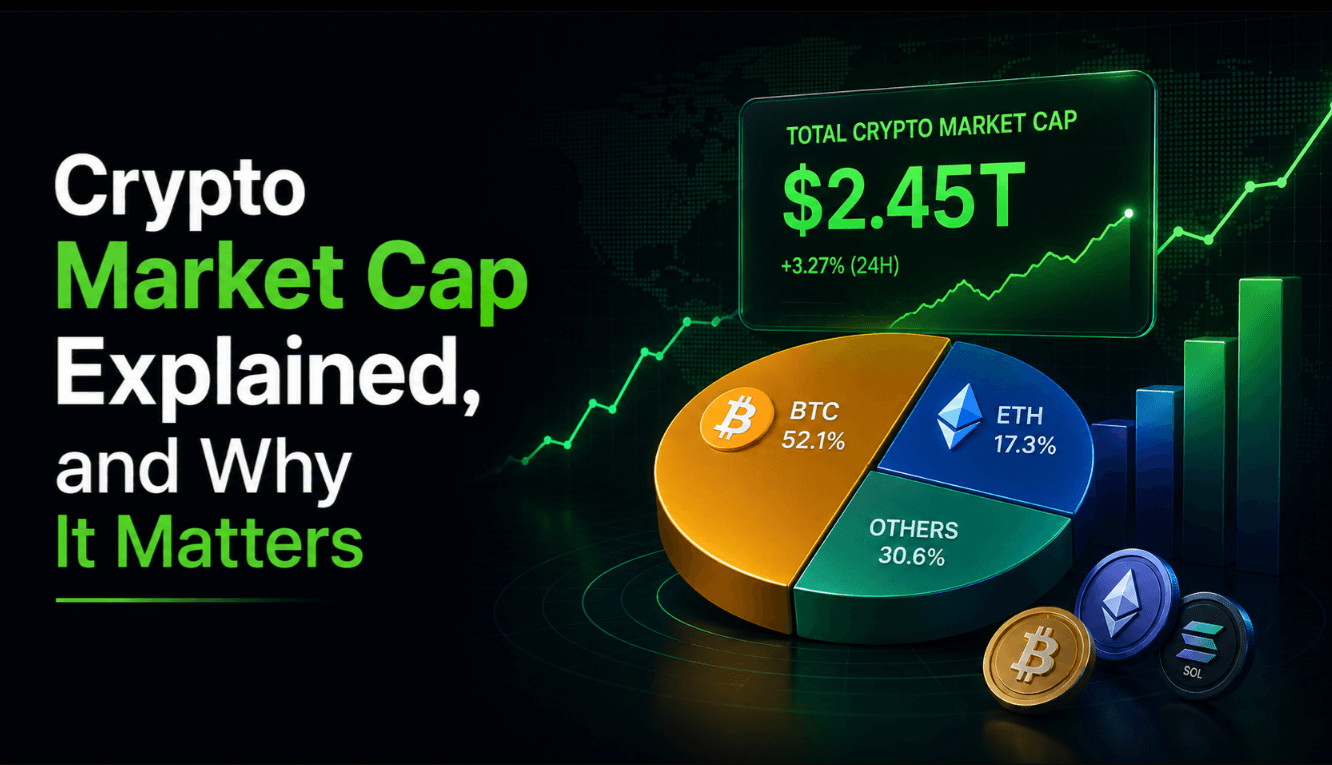
Crypto market capitalisation is the total value of a cryptocurrency, calculated by multiplying its current price by the number of coins in circulation. It matters because it gives a rough sense of a project's size and relative weight in the market, which is far more meaningful than price per coin alone. A token priced at a fraction of a cent can be worth more in total than one priced in the thousands, depending on how many units exist. Understanding market cap helps you compare assets on a fairer basis and avoid being fooled by a low or high unit price.
Key takeaways
- Market cap equals current price multiplied by circulating supply.
- It measures total value, making it a fairer comparison tool than price per coin.
- Larger caps generally imply more liquidity and lower volatility, though not safety.
- Fully diluted valuation and supply structure can change the picture dramatically.
- Market cap is a snapshot, not a guarantee that the value could be realised in cash.
How market cap is calculated
The formula is simple: market cap equals the current price multiplied by the circulating supply. If a coin trades at one dollar and ten million units are in circulation, its market cap is ten million dollars. The key variable people overlook is supply. Two coins at the same price can have wildly different market caps if one has far more units in existence, which is exactly why price per coin is a poor measure of size.
Why unit price is misleading
Beginners often assume a cheap coin has more room to grow than an expensive one. This is a misconception. A coin's potential depends on its total valuation relative to its prospects, not on the digits in its unit price. A token priced low simply has a large supply, and reaching a higher unit price would require an enormous increase in total market cap. Framing decisions around market cap, not price, corrects this trap.
Price per coin tells you almost nothing on its own. Market cap is the number that puts size into perspective. — CoinRadar Daily analysis
What market cap can and cannot tell you
Market cap is a useful gauge of relative size and, indirectly, of liquidity. Larger-cap assets tend to trade more easily and move less violently than tiny ones, which is why investors often think of them as broad tiers of risk. But market cap is not a measure of cash that exists or could be withdrawn. It is a theoretical figure: if everyone tried to sell at once, the realised value would be far lower because prices would fall as supply hit the market.
It also says nothing about quality, revenue, or fundamentals. A large market cap does not mean a project is sound, and a small one does not mean it is doomed. Market cap measures scale, not merit.
Circulating vs fully diluted supply
Two supply figures matter. Circulating supply is the number of coins available now, while total or maximum supply includes coins not yet released. Fully diluted valuation multiplies price by the maximum supply, showing what the market cap would be once all coins exist. A project with a low circulating cap but a huge unreleased supply can face significant dilution pressure as new coins enter circulation, so checking both figures is essential.
Using market cap responsibly
- Compare assets by market cap, not by price per coin.
- Check circulating and fully diluted supply to understand dilution risk.
- Treat large caps as generally more liquid, not automatically safer.
- Remember that market cap is a snapshot, not a pool of withdrawable cash.
Used correctly, market cap is one of the most practical tools for sizing up the market. Used carelessly, it can create false confidence. This article is educational and not financial advice; always pair any single metric with broader research before making decisions.
Frequently asked questions
Does a higher market cap mean a coin is safer?+
Not necessarily. Larger market caps usually come with more liquidity and lower volatility, but size alone does not guarantee quality, sound fundamentals, or protection from losses. It reflects scale, not safety.
What is the difference between market cap and fully diluted valuation?+
Market cap uses the circulating supply, while fully diluted valuation uses the maximum supply that will ever exist. The gap between them shows how much future dilution could occur as new coins are released.
Why is a cheap coin not necessarily a bargain?+
A low unit price usually just means a large supply. Potential depends on total market cap relative to prospects, so a cheap coin may need an enormous valuation increase to deliver meaningful unit-price gains.
Can a project's market cap be withdrawn as cash?+
No. Market cap is a theoretical figure based on the last traded price. If holders tried to sell large amounts at once, prices would fall and the realised value would be far less than the stated market cap.
Written by
Olivia BennettBlockchain Security ResearcherSmart Contract Security, Audit Reports, Exploits, DeFi Hacks, White-Hat Research
Olivia Bennett is the Blockchain Security Researcher at CoinRadar Daily, where she specializes in smart contract security, DeFi risk analysis, blockchain infrastructure, and protocol vulnerabilities. Drawing on years of hands-on cybersecurity experience, she delivers in-depth reporting that explains both the technical details and the real-world implications of security incidents across the digital asset ecosystem. Before joining CoinRadar Daily, Olivia built her career in cybersecurity, working in penetration testing, blockchain security assessments, and smart contract auditing. She participated in numerous security reviews for decentralized applications and blockchain protocols, helping identify critical vulnerabilities before they could be exploited. Her responsible disclosure work has contributed to improving the security of several major DeFi projects and protecting millions of dollars in digital assets. Olivia earned a Bachelor of Science in Computer Science from the University of Edinburgh and later completed advanced professional training in offensive security and blockchain technologies. Her combination of software security expertise and blockchain knowledge enables her to provide readers with clear, evidence-based analysis of exploits, protocol upgrades, and emerging attack vectors. At CoinRadar Daily, Olivia publishes detailed investigations into blockchain exploits, smart contract audits, cross-chain security, wallet protection, and evolving cyber threats affecting the crypto industry. She is particularly committed to translating highly technical research into practical guidance that helps investors, developers, and blockchain users better understand protocol risk and security best practices. Alongside her editorial work, Olivia contributes educational resources covering secure wallet management, decentralized finance security, and blockchain infrastructure. She also participates in industry events and technical discussions focused on strengthening Web3 security standards, supporting CoinRadar Daily's mission to provide accurate, research-driven coverage of the rapidly evolving digital asset landscape.

✓Reviewed & edited by
Emily VolkerEditor-in-ChiefEditorial Strategy, Investigative Journalism, Crypto Media, E-E-A-T Standards
Emily Volker is the Editor-in-Chief of CoinRadar Daily, where she leads a multilingual editorial team covering cryptocurrency markets, blockchain innovation, Web3, and global digital asset regulation across eight languages. With more than a decade of experience in financial and technology journalism, she has played a key role in developing high editorial standards and trusted reporting within the digital asset industry. Emily began her career as a financial journalist reporting on commodities, energy markets, and emerging technologies before discovering Bitcoin and decentralized finance in the early 2010s. She later moved to London to join one of Europe's early blockchain-focused media organizations, where she advanced into senior editorial leadership. Her experience reporting through both the rapid expansion of the 2017 ICO boom and the subsequent market correction reinforced her commitment to fact-based, research-driven journalism in an industry often influenced by speculation. She holds a Master's degree in International Journalism from City, University of London, and has completed executive studies in digital media strategy through the Reuters Institute at Oxford. Emily is a strong advocate for editorial transparency, rigorous verification, and responsible financial reporting. She also helped integrate Google's E-E-A-T principles—Experience, Expertise, Authoritativeness, and Trustworthiness—into the editorial standards followed by CoinRadar Daily. Under her leadership, CoinRadar Daily has expanded into a global cryptocurrency news platform publishing content in eight languages with a network of editors, analysts, and contributors across four continents. Emily oversees investigative reporting, editorial policy, content quality, and fact-checking processes to ensure every article meets the publication's standards for accuracy, credibility, and independence. Alongside her editorial responsibilities, Emily mentors aspiring journalists through digital media initiatives and regularly speaks at international conferences focused on journalism, fintech, blockchain technology, and digital assets, where she discusses responsible reporting, combating misinformation, and the evolving future of financial media.
CoinRadar Daily content is written by named analysts and checked against our editorial standards. Market data is indicative and informational only — nothing here is financial advice.
Markets services, rated
How we score →Independent, rubric-scored tables covering the services this markets coverage keeps running into.
Best Crypto Exchanges
Top rated: Kraken 8.6
Centralised venues that hold your funds while you trade.
6rated →
Best Perpetual DEXs
Top rated: Hyperliquid 8.3
On-chain leverage.
5rated →
Best Crypto Trading Tools
Top rated: DefiLlama 8.7
Terminals, bots, screeners and portfolio trackers.
4rated →
Keep Reading
Risk Management for Crypto Investors: Sizing and Stops
Returns get the attention, but risk management decides who survives. Here is how position sizing, stop-losses, and sensible limits keep you in the game.
James Park · May 19, 2026→
Bull vs Bear Market: The Signals Worth Watching
Telling a bull market from a bear is easy in hindsight and hard in the moment. These are the signals that help you read the broader trend without chasing noise.
Emily Volker · May 26, 2026→
How to Read On-Chain Metrics: A Practical Guide
On-chain data turns a public blockchain into a window on real user behaviour. Here is how to read the core metrics, and how to avoid drawing the wrong conclusions from them.
James Park · June 10, 2026→