Crypto Regulation Explained: A Plain-English Global Overview
Crypto rules vary by country, but most regimes circle the same goals: stopping fraud, protecting users and tracing illicit money. Here is how the global picture fits together.

By Emily Volker, Editor-in-Chief
Editorial Strategy, Investigative Journalism, Crypto Media, E-E-A-T Standards
✓ Reviewed by Olivia Bennett· Blockchain Security Researcher
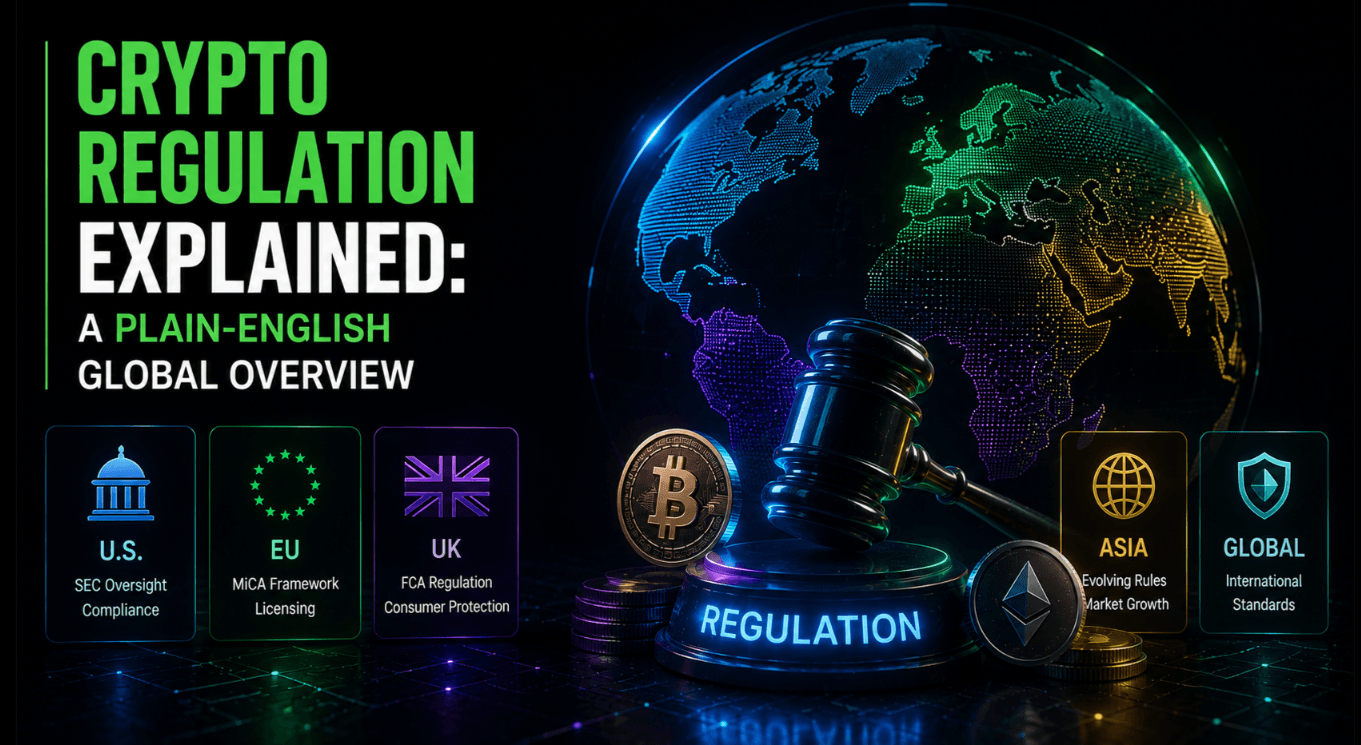
Crypto regulation is the set of laws and supervisory rules that governments apply to digital assets and the businesses built around them, and there is no single global version of it. Instead, each jurisdiction decides which existing legal categories crypto falls into, who supervises it, and what protections users get. Despite the patchwork, most frameworks pursue the same handful of aims: preventing fraud and market abuse, protecting consumers, keeping financial stability intact, and stopping money laundering and sanctions evasion. This article is general information, not legal advice, so treat it as a map rather than a substitute for a qualified professional in your country.
Key takeaways
- There is no worldwide crypto law; rules are set country by country and often by multiple agencies within each country.
- Most regimes share four goals: anti-fraud, consumer protection, financial stability and anti-money-laundering controls.
- How a token is classified, often as a security, commodity, payment instrument or something new, drives which rules apply.
- Exchanges and custodians usually face the heaviest obligations because they hold customer funds and touch the banking system.
- Rules change quickly, so a service that is legal in one place may be restricted or banned in another.
Why crypto is regulated at all
Money attracts oversight. The moment people store value, trade it and move it across borders, governments take an interest in whether that activity is honest, stable and traceable. Crypto added new wrinkles: assets that settle without a bank, software that runs without an operator, and markets that trade around the clock. Regulators responded by asking a simple question first, namely what is this thing, and then applying the closest existing rulebook.
That instinct explains why the same token can be treated very differently depending on where you stand. A coin marketed as an investment may be pulled into securities law, while a coin used mainly to pay for things may fall under payments or e-money rules. The label matters more than the technology.
Who the regulators are
Most countries spread crypto oversight across several bodies rather than one. The split usually follows function: one agency watches investment markets, another watches banking and payments, a financial-intelligence unit handles anti-money-laundering reporting, and a tax authority handles gains and income.
Securities and markets regulators
When a token behaves like an investment, the markets regulator tends to claim jurisdiction. These agencies care about disclosure, fair trading and whether the people selling an asset told the truth about it. Their reach often extends to exchanges that list such tokens.
Banking, payments and central banks
Central banks and prudential supervisors focus on stability and on anything that looks like money. Stablecoins draw their attention because a coin that promises to hold a steady value is, in effect, making a payment-and-redemption promise that can fail in a crisis.
The rules that touch almost everyone
Even where the broader legal status of crypto is unsettled, a few obligations show up nearly everywhere because they attach to the businesses, not the assets.
- Registration or licensing for exchanges, brokers and custodians before they can serve customers.
- Know-your-customer identity checks when users sign up to a regulated platform.
- Transaction monitoring and suspicious-activity reporting to financial-intelligence units.
- Safeguarding rules so that customer assets are held separately from company funds.
- Clear-marketing standards that limit misleading promises about returns or safety.
Internationally, a widely adopted standard known informally as the travel rule asks firms to pass along sender and recipient information for transfers above a threshold, mirroring how banks handle wires. It is one of the clearest examples of crypto rules converging across borders.
How approaches differ around the world
Broadly, jurisdictions fall into a few camps. Some have built comprehensive, crypto-specific frameworks that license firms and define token categories in one place. Others apply existing securities, payments and tax law case by case, leaving more room for interpretation and litigation. A smaller group restricts or bans large parts of the activity outright, often citing capital controls or financial stability. None of these stances is permanent; the trend over time has been toward clearer, more detailed rulebooks rather than looser ones.
The hardest part of crypto regulation is rarely writing the rule. It is deciding which old rule the new asset belongs to. — CoinRadar Daily analysis
What it means for everyday users
For most people, regulation shows up in small, practical ways: identity verification when opening an account, limits on which products are offered in your region, tax reporting at the end of the year, and stronger recourse if a licensed platform fails. Self-custody, where you hold your own keys, sits further from this perimeter, but the on-ramps and off-ramps you use to convert cash almost always sit inside it.
The sensible takeaway is to know your jurisdiction, use licensed services where they exist, keep records of your transactions, and remember that legality can shift. When real money or complex holdings are involved, confirm the current rules with a professional rather than relying on a general overview like this one.
Frequently asked questions
Is crypto legal?+
In most countries owning and trading crypto is legal, though it is regulated, taxed and sometimes restricted. A handful of jurisdictions ban or heavily limit it. Always check the current rules where you live before assuming a service is permitted.
Why is there no single global crypto regulator?+
Financial law is set at the national level, so each country regulates crypto through its own agencies. International bodies issue standards and recommendations, but they are adopted and enforced country by country rather than as one binding global rulebook.
Which crypto businesses face the most regulation?+
Exchanges, brokers, custodians and stablecoin issuers usually carry the heaviest obligations because they hold customer funds and connect to the banking system. Pure self-custody wallets and decentralized software often sit at the edges of these rules.
Does regulation make crypto safer?+
It can reduce certain risks, such as outright fraud and the failure of a licensed custodian, by requiring disclosures, safeguarding and reporting. It does not remove market risk; prices can still fall sharply, and unregulated services remain widely available.
Written by
Emily VolkerEditor-in-ChiefEditorial Strategy, Investigative Journalism, Crypto Media, E-E-A-T Standards
Emily Volker is the Editor-in-Chief of CoinRadar Daily, where she leads a multilingual editorial team covering cryptocurrency markets, blockchain innovation, Web3, and global digital asset regulation across eight languages. With more than a decade of experience in financial and technology journalism, she has played a key role in developing high editorial standards and trusted reporting within the digital asset industry. Emily began her career as a financial journalist reporting on commodities, energy markets, and emerging technologies before discovering Bitcoin and decentralized finance in the early 2010s. She later moved to London to join one of Europe's early blockchain-focused media organizations, where she advanced into senior editorial leadership. Her experience reporting through both the rapid expansion of the 2017 ICO boom and the subsequent market correction reinforced her commitment to fact-based, research-driven journalism in an industry often influenced by speculation. She holds a Master's degree in International Journalism from City, University of London, and has completed executive studies in digital media strategy through the Reuters Institute at Oxford. Emily is a strong advocate for editorial transparency, rigorous verification, and responsible financial reporting. She also helped integrate Google's E-E-A-T principles—Experience, Expertise, Authoritativeness, and Trustworthiness—into the editorial standards followed by CoinRadar Daily. Under her leadership, CoinRadar Daily has expanded into a global cryptocurrency news platform publishing content in eight languages with a network of editors, analysts, and contributors across four continents. Emily oversees investigative reporting, editorial policy, content quality, and fact-checking processes to ensure every article meets the publication's standards for accuracy, credibility, and independence. Alongside her editorial responsibilities, Emily mentors aspiring journalists through digital media initiatives and regularly speaks at international conferences focused on journalism, fintech, blockchain technology, and digital assets, where she discusses responsible reporting, combating misinformation, and the evolving future of financial media.

✓Reviewed & edited by
Olivia BennettBlockchain Security ResearcherSmart Contract Security, Audit Reports, Exploits, DeFi Hacks, White-Hat Research
Olivia Bennett is the Blockchain Security Researcher at CoinRadar Daily, where she specializes in smart contract security, DeFi risk analysis, blockchain infrastructure, and protocol vulnerabilities. Drawing on years of hands-on cybersecurity experience, she delivers in-depth reporting that explains both the technical details and the real-world implications of security incidents across the digital asset ecosystem. Before joining CoinRadar Daily, Olivia built her career in cybersecurity, working in penetration testing, blockchain security assessments, and smart contract auditing. She participated in numerous security reviews for decentralized applications and blockchain protocols, helping identify critical vulnerabilities before they could be exploited. Her responsible disclosure work has contributed to improving the security of several major DeFi projects and protecting millions of dollars in digital assets. Olivia earned a Bachelor of Science in Computer Science from the University of Edinburgh and later completed advanced professional training in offensive security and blockchain technologies. Her combination of software security expertise and blockchain knowledge enables her to provide readers with clear, evidence-based analysis of exploits, protocol upgrades, and emerging attack vectors. At CoinRadar Daily, Olivia publishes detailed investigations into blockchain exploits, smart contract audits, cross-chain security, wallet protection, and evolving cyber threats affecting the crypto industry. She is particularly committed to translating highly technical research into practical guidance that helps investors, developers, and blockchain users better understand protocol risk and security best practices. Alongside her editorial work, Olivia contributes educational resources covering secure wallet management, decentralized finance security, and blockchain infrastructure. She also participates in industry events and technical discussions focused on strengthening Web3 security standards, supporting CoinRadar Daily's mission to provide accurate, research-driven coverage of the rapidly evolving digital asset landscape.
CoinRadar Daily content is written by named analysts and checked against our editorial standards. Market data is indicative and informational only — nothing here is financial advice.
Regulation services, rated
How we score →Independent, rubric-scored tables covering the services this regulation coverage keeps running into.
Best Stablecoins
Top rated: USDC 8.4
A stablecoin is a promise about redemption.
4rated →
Best Crypto Cards
Top rated: Gnosis Pay 7.8
Spend crypto at the till.
4rated →
Best Crypto Exchanges
Top rated: Kraken 8.6
Centralised venues that hold your funds while you trade.
6rated →
Keep Reading
Security or Commodity? How Regulators Classify Crypto
Whether a token is a security or a commodity decides which rules apply and who supervises it. Here is how regulators draw that line and why it is so contested.
James Park · May 22, 2026→
Stablecoin Regulation Explained: Reserves, Redemption and Rules
Stablecoins promise a steady value, and that promise is exactly what regulators scrutinize. Here is how stablecoin rules tend to work and why reserves sit at the center.
Emily Volker · May 26, 2026→
MiCA Explained: How the EU Regulates Crypto Under One Rulebook
MiCA gives the European Union a single framework for crypto-assets and the firms that service them. Here is what it covers and why it changed the game in Europe.
Olivia Bennett · June 3, 2026→