Security or Commodity? How Regulators Classify Crypto
Whether a token is a security or a commodity decides which rules apply and who supervises it. Here is how regulators draw that line and why it is so contested.

By James Park, NFT & Web3 Gaming Analyst
NFTs, Web3 Gaming, GameFi, Digital Collectibles, Creator Economy
✓ Reviewed by Olivia Bennett· Blockchain Security Researcher
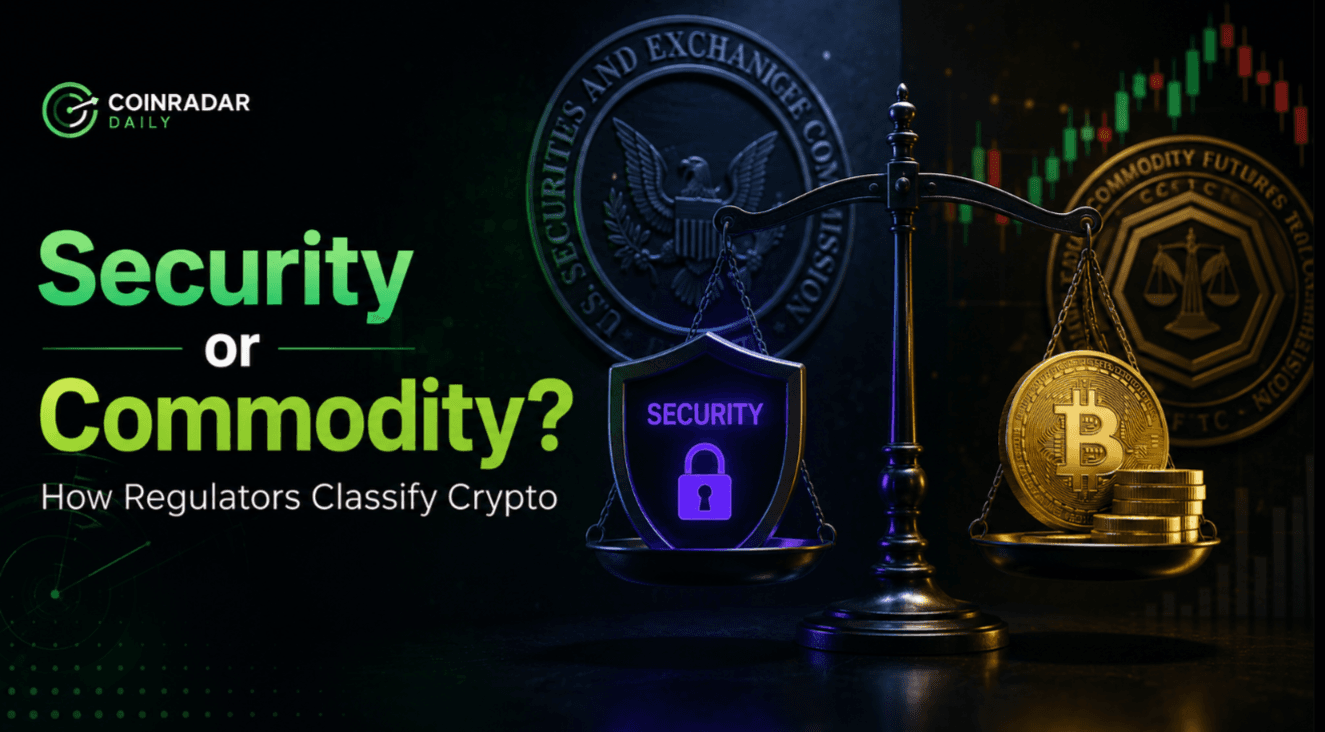
When regulators ask whether a crypto token is a security or a commodity, they are really deciding which rulebook governs it and which agency supervises it. The label matters enormously: a security typically triggers strict disclosure, registration and investor-protection rules, while a commodity sits under a different and often lighter regime focused on market integrity. The difficulty is that crypto does not slot neatly into categories written long before it existed, so regulators reach for older legal tests and apply them to new facts. This article explains how that classification generally works; it is educational and not legal advice, and the answer for any specific token can be genuinely uncertain.
Key takeaways
- Classification decides which rules apply, who supervises a token, and how it can be sold and traded.
- Securities regimes emphasize disclosure and investor protection; commodity regimes emphasize market integrity.
- Regulators often apply an investment-contract style test asking whether buyers expect profit from others' efforts.
- The same token may be assessed differently over time as a project becomes more decentralized.
- Uncertainty is the norm, which is why classification drives so much litigation and caution.
Why the label carries so much weight
Categories are not academic. If a token is a security, the people who issue and trade it generally face registration, prospectus-style disclosure and conduct rules designed to protect investors who lack inside knowledge. If it is a commodity, oversight tends to concentrate on preventing manipulation and ensuring fair markets, with lighter obligations at issuance. Because the consequences diverge so sharply, the classification question shapes everything from how a token is launched to whether an exchange will list it.
The test regulators reach for
Faced with a novel asset, regulators often start from a familiar question: did buyers hand over money expecting profits to come mainly from the efforts of a central team or promoter? This investment-contract reasoning, applied in various forms across jurisdictions, looks past the technology to the economic reality of the deal.
- Was money or value invested by the buyer?
- Was it invested into a common enterprise or pooled project?
- Did buyers reasonably expect a profit?
- Would that profit come predominantly from the work of others rather than the buyer?
When the answers lean yes, the asset looks more like a security. When a token functions mainly as a tool to use a network, or trades like a raw commodity with no central promoter steering its value, the case for the commodity label strengthens.
Why decentralization complicates everything
One reason crypto resists tidy labels is that a project can change character over time. A token sold early on to fund development, with buyers relying on a founding team, looks securities-like at that moment. Years later, if the network is run by a broad, dispersed community with no controlling promoter, the original logic may no longer fit. This moving-target quality means classification can depend not just on what a token is, but on when and how it was offered.
Crypto classification is less about the code and more about the promise. Regulators ask who was relying on whom, and for what. — CoinRadar Daily analysis
How different assets tend to be viewed
Some patterns recur, even if no outcome is guaranteed. Tokens sold in funding rounds with marketing that emphasizes future returns from a team's work attract securities scrutiny. Highly decentralized base-layer assets, with no central issuer and broad mining or staking participation, are more often discussed in commodity terms. Stablecoins and payment-style tokens are frequently routed toward payments or money rules entirely, sitting outside the security-versus-commodity debate. These are tendencies, not rules, and reasonable regulators and courts can disagree.
What it means in practice
For builders, the takeaway is that how you sell and describe a token can influence how it is classified, so the design and marketing of an offering carry legal weight. For exchanges, classification governs what they can list and to whom, which is why listing decisions often follow legal review. For users, the practical effect is which protections apply and which products are available in your region. Because the analysis is fact-specific and unsettled, anyone making real decisions should rely on current, jurisdiction-specific legal advice rather than a general guide like this one.
Frequently asked questions
What is the difference between a security and a commodity in crypto?+
A security generally involves an investment where buyers expect profit from others' efforts, triggering strict disclosure and investor-protection rules. A commodity is treated more like a tradable raw asset, with oversight focused on market integrity and fewer obligations at issuance.
Why does crypto classification matter so much?+
Because the label decides which rules apply, which agency supervises the token, and how it can be issued, listed and traded. The consequences for issuers and exchanges differ sharply between the two regimes, so the question shapes the entire lifecycle of a token.
What test do regulators use to classify a token?+
Many jurisdictions apply an investment-contract style analysis, asking whether buyers invested money in a common enterprise expecting profit mainly from the efforts of others. If so, the asset looks more like a security than a commodity.
Can a token's classification change over time?+
Yes. A token sold early on with buyers relying on a founding team may look securities-like, while the same token years later, if the network becomes broadly decentralized with no controlling promoter, may be viewed differently. Classification can depend on when and how it was offered.
Where do stablecoins fit in this debate?+
Stablecoins and payment-style tokens are often routed toward payments, e-money or money rules rather than the security-versus-commodity question. Their defining feature is acting like money, so regulators frequently apply a separate framework built around reserves and redemption.
Written by
James ParkNFT & Web3 Gaming AnalystNFTs, Web3 Gaming, GameFi, Digital Collectibles, Creator Economy
James Park serves as the NFT & Web3 Gaming Analyst at CoinRadar Daily, where he covers the rapidly evolving worlds of blockchain gaming, digital collectibles, metaverse ecosystems, and creator-driven economies. Combining expertise in interactive media with blockchain technology, he analyzes how NFTs and decentralized gaming continue to reshape digital ownership and online communities. James earned a Master of Fine Arts in Digital Media from NYU Tisch School of the Arts, giving him a unique perspective that blends creative storytelling, digital culture, and emerging technology. Rather than viewing NFTs solely through an investment lens, he examines their broader impact on entertainment, gaming, intellectual property, and community engagement. Prior to joining CoinRadar Daily, James reported on the NFT industry and blockchain gaming for several leading digital media outlets, covering the explosive growth of the NFT market, the transition toward utility-focused collections, and the evolution of GameFi. His close relationships with independent developers, digital artists, and gaming communities allow him to identify important industry trends long before they reach mainstream attention. His reporting places particular emphasis on sustainable Web3 game design, token economies, and the long-term viability of blockchain-powered virtual worlds. James has published extensive research analyzing why certain gaming ecosystems thrive while others struggle with inflationary token models, weak player retention, or unsustainable reward structures. His market analysis is frequently referenced by blockchain startups, investors, and game studios evaluating new Web3 projects. Beyond journalism, James actively participates in NFT and decentralized creator communities while following developments in digital art, virtual economies, and next-generation gaming technologies. He also contributes educational content on blockchain gaming and regularly speaks about the future of digital ownership, helping CoinRadar Daily deliver balanced, research-driven coverage at the intersection of technology, gaming, and crypto innovation.

✓Reviewed & edited by
Olivia BennettBlockchain Security ResearcherSmart Contract Security, Audit Reports, Exploits, DeFi Hacks, White-Hat Research
Olivia Bennett is the Blockchain Security Researcher at CoinRadar Daily, where she specializes in smart contract security, DeFi risk analysis, blockchain infrastructure, and protocol vulnerabilities. Drawing on years of hands-on cybersecurity experience, she delivers in-depth reporting that explains both the technical details and the real-world implications of security incidents across the digital asset ecosystem. Before joining CoinRadar Daily, Olivia built her career in cybersecurity, working in penetration testing, blockchain security assessments, and smart contract auditing. She participated in numerous security reviews for decentralized applications and blockchain protocols, helping identify critical vulnerabilities before they could be exploited. Her responsible disclosure work has contributed to improving the security of several major DeFi projects and protecting millions of dollars in digital assets. Olivia earned a Bachelor of Science in Computer Science from the University of Edinburgh and later completed advanced professional training in offensive security and blockchain technologies. Her combination of software security expertise and blockchain knowledge enables her to provide readers with clear, evidence-based analysis of exploits, protocol upgrades, and emerging attack vectors. At CoinRadar Daily, Olivia publishes detailed investigations into blockchain exploits, smart contract audits, cross-chain security, wallet protection, and evolving cyber threats affecting the crypto industry. She is particularly committed to translating highly technical research into practical guidance that helps investors, developers, and blockchain users better understand protocol risk and security best practices. Alongside her editorial work, Olivia contributes educational resources covering secure wallet management, decentralized finance security, and blockchain infrastructure. She also participates in industry events and technical discussions focused on strengthening Web3 security standards, supporting CoinRadar Daily's mission to provide accurate, research-driven coverage of the rapidly evolving digital asset landscape.
CoinRadar Daily content is written by named analysts and checked against our editorial standards. Market data is indicative and informational only — nothing here is financial advice.
Regulation services, rated
How we score →Independent, rubric-scored tables covering the services this regulation coverage keeps running into.
Best Stablecoins
Top rated: USDC 8.4
A stablecoin is a promise about redemption.
4rated →
Best Crypto Cards
Top rated: Gnosis Pay 7.8
Spend crypto at the till.
4rated →
Best Crypto Exchanges
Top rated: Kraken 8.6
Centralised venues that hold your funds while you trade.
6rated →
Keep Reading
Stablecoin Regulation Explained: Reserves, Redemption and Rules
Stablecoins promise a steady value, and that promise is exactly what regulators scrutinize. Here is how stablecoin rules tend to work and why reserves sit at the center.
Emily Volker · May 26, 2026→
MiCA Explained: How the EU Regulates Crypto Under One Rulebook
MiCA gives the European Union a single framework for crypto-assets and the firms that service them. Here is what it covers and why it changed the game in Europe.
Olivia Bennett · June 3, 2026→
How Crypto Taxes Generally Work: A Beginner's Guide
Selling, swapping, spending or earning crypto can create a tax bill. Here is how the main concepts work and why your records matter more than you think.
James Park · June 10, 2026→