MiCA Explained: How the EU Regulates Crypto Under One Rulebook
MiCA gives the European Union a single framework for crypto-assets and the firms that service them. Here is what it covers and why it changed the game in Europe.

By Olivia Bennett, Blockchain Security Researcher
Smart Contract Security, Audit Reports, Exploits, DeFi Hacks, White-Hat Research
✓ Reviewed by James Park· NFT & Web3 Gaming Analyst
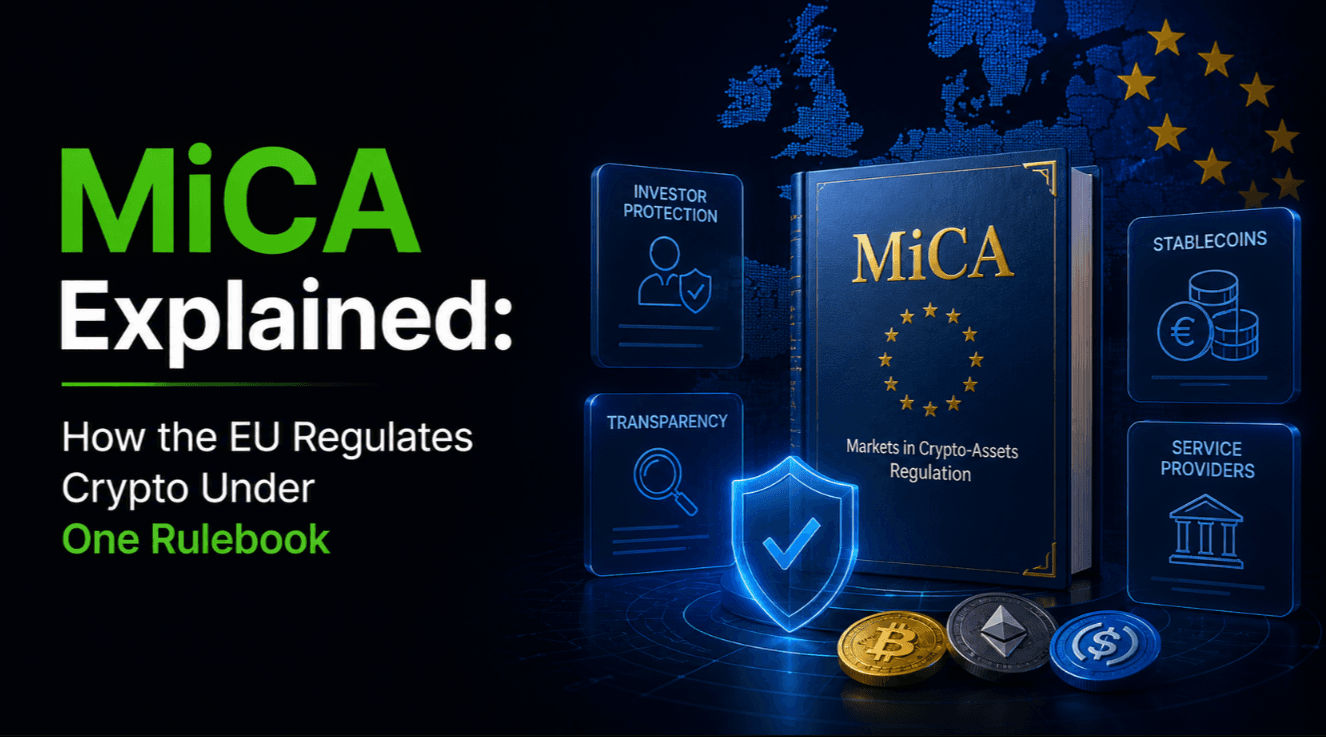
MiCA, the European Union's Markets in Crypto-Assets regulation, is a single rulebook that replaces a scattered set of national approaches with one harmonized regime across the bloc. Its core idea is straightforward: a firm authorized to issue crypto-assets or provide crypto services in one member state can passport that authorization across the others, while users get a baseline of disclosure, safeguarding and conduct protections wherever they are. It draws lines around different kinds of tokens, sets tougher requirements for stablecoins, and brings exchanges, custodians and brokers under licensing. The notes here are general and not legal advice; firms should confirm how the rules apply to them with qualified counsel.
Key takeaways
- MiCA creates one EU-wide framework, so a single authorization can passport across member states.
- It sorts tokens into categories, with asset-referenced and e-money tokens, the stablecoin family, treated most strictly.
- Crypto-asset service providers, known as CASPs, must be licensed and meet capital, governance and safeguarding standards.
- Issuers face disclosure duties, often through a published information document about the token.
- Some fully decentralized arrangements sit outside or at the edges of the regime, which keeps interpretation contested.
Why the EU built MiCA
Before MiCA, a crypto firm in Europe faced as many rulebooks as there were countries it wanted to serve. Some states wrote detailed regimes, others barely addressed the sector, and a token treated one way in one capital might be treated differently a border away. That fragmentation raised costs, created gaps and made consumer protection uneven. A single framework was meant to fix all three problems at once: clarity for firms, a level playing field, and consistent protection for users.
How MiCA classifies tokens
Much of MiCA's logic flows from how it categorizes crypto-assets, because the category sets the obligations. The framework focuses on assets not already covered by existing financial law, and it singles out the ones that behave like money.
Asset-referenced and e-money tokens
Tokens designed to hold a stable value, whether by referencing a basket of currencies and assets or by referencing a single official currency, carry the heaviest requirements. These are the stablecoins, and because they make a redemption promise that could strain payments and stability if it fails, issuers face reserve, governance and disclosure rules, with extra scrutiny for the largest ones.
Other crypto-assets
Tokens that do not fall into the stablecoin family or into existing securities law are treated as a broader category with lighter, though still meaningful, obligations centered on honest disclosure and fair conduct. Tokens that already qualify as financial instruments under existing EU law remain under that law rather than MiCA.
What MiCA asks of service providers
The businesses most users deal with day to day, exchanges, custodians, brokers and the like, are captured as crypto-asset service providers. To operate, they generally need authorization and then must run their business to a defined standard.
- Hold capital appropriate to the services they offer.
- Keep customer assets safeguarded and separated from company funds.
- Maintain governance, complaints handling and conflict-of-interest controls.
- Provide clear information and fair marketing to customers.
- Meet ongoing reporting and supervisory expectations.
MiCA's real shift is psychological as much as legal. It tells European crypto firms to behave like supervised financial businesses, not experiments. — CoinRadar Daily analysis
What it means for issuers and users
For issuers, the practical effect is documentation and accountability: publishing accurate information about a token and standing behind it. For users, the benefits are more recourse against licensed firms, clearer disclosures before they buy, and safeguarding rules that aim to protect their assets if a provider fails. None of this removes market risk; a compliant token can still lose value, and MiCA does not promise that any asset is a good investment.
The limits and open questions
MiCA does not cover everything. Fully decentralized protocols with no identifiable operator, certain niche assets, and some emerging activities sit outside or at the edges of the text, and how supervisors interpret those edges will shape the regime in practice. The framework is also a starting point rather than the last word; like any major financial law, it will be refined as the market and the technology evolve. Firms operating in Europe should treat ongoing legal review as part of doing business, not a one-time task.
Frequently asked questions
What does MiCA stand for?+
MiCA stands for Markets in Crypto-Assets, the European Union's regulation that creates a single, harmonized framework for issuing crypto-assets and providing crypto services across member states.
Who does MiCA apply to?+
It applies to issuers of crypto-assets and to crypto-asset service providers such as exchanges, custodians and brokers operating in the EU. Tokens that already qualify as financial instruments under existing EU law generally remain under that law instead.
How does MiCA treat stablecoins?+
Stablecoins, covered as asset-referenced tokens and e-money tokens, face the strictest requirements, including reserve, governance and disclosure obligations, with additional scrutiny for the largest issuers because of their potential impact on payments and stability.
Does MiCA cover decentralized finance?+
Fully decentralized arrangements with no identifiable operator sit outside or at the edges of MiCA. How supervisors interpret those boundaries is still developing, so the treatment of specific DeFi projects can be uncertain.
Written by
Olivia BennettBlockchain Security ResearcherSmart Contract Security, Audit Reports, Exploits, DeFi Hacks, White-Hat Research
Olivia Bennett is the Blockchain Security Researcher at CoinRadar Daily, where she specializes in smart contract security, DeFi risk analysis, blockchain infrastructure, and protocol vulnerabilities. Drawing on years of hands-on cybersecurity experience, she delivers in-depth reporting that explains both the technical details and the real-world implications of security incidents across the digital asset ecosystem. Before joining CoinRadar Daily, Olivia built her career in cybersecurity, working in penetration testing, blockchain security assessments, and smart contract auditing. She participated in numerous security reviews for decentralized applications and blockchain protocols, helping identify critical vulnerabilities before they could be exploited. Her responsible disclosure work has contributed to improving the security of several major DeFi projects and protecting millions of dollars in digital assets. Olivia earned a Bachelor of Science in Computer Science from the University of Edinburgh and later completed advanced professional training in offensive security and blockchain technologies. Her combination of software security expertise and blockchain knowledge enables her to provide readers with clear, evidence-based analysis of exploits, protocol upgrades, and emerging attack vectors. At CoinRadar Daily, Olivia publishes detailed investigations into blockchain exploits, smart contract audits, cross-chain security, wallet protection, and evolving cyber threats affecting the crypto industry. She is particularly committed to translating highly technical research into practical guidance that helps investors, developers, and blockchain users better understand protocol risk and security best practices. Alongside her editorial work, Olivia contributes educational resources covering secure wallet management, decentralized finance security, and blockchain infrastructure. She also participates in industry events and technical discussions focused on strengthening Web3 security standards, supporting CoinRadar Daily's mission to provide accurate, research-driven coverage of the rapidly evolving digital asset landscape.

✓Reviewed & edited by
James ParkNFT & Web3 Gaming AnalystNFTs, Web3 Gaming, GameFi, Digital Collectibles, Creator Economy
James Park serves as the NFT & Web3 Gaming Analyst at CoinRadar Daily, where he covers the rapidly evolving worlds of blockchain gaming, digital collectibles, metaverse ecosystems, and creator-driven economies. Combining expertise in interactive media with blockchain technology, he analyzes how NFTs and decentralized gaming continue to reshape digital ownership and online communities. James earned a Master of Fine Arts in Digital Media from NYU Tisch School of the Arts, giving him a unique perspective that blends creative storytelling, digital culture, and emerging technology. Rather than viewing NFTs solely through an investment lens, he examines their broader impact on entertainment, gaming, intellectual property, and community engagement. Prior to joining CoinRadar Daily, James reported on the NFT industry and blockchain gaming for several leading digital media outlets, covering the explosive growth of the NFT market, the transition toward utility-focused collections, and the evolution of GameFi. His close relationships with independent developers, digital artists, and gaming communities allow him to identify important industry trends long before they reach mainstream attention. His reporting places particular emphasis on sustainable Web3 game design, token economies, and the long-term viability of blockchain-powered virtual worlds. James has published extensive research analyzing why certain gaming ecosystems thrive while others struggle with inflationary token models, weak player retention, or unsustainable reward structures. His market analysis is frequently referenced by blockchain startups, investors, and game studios evaluating new Web3 projects. Beyond journalism, James actively participates in NFT and decentralized creator communities while following developments in digital art, virtual economies, and next-generation gaming technologies. He also contributes educational content on blockchain gaming and regularly speaks about the future of digital ownership, helping CoinRadar Daily deliver balanced, research-driven coverage at the intersection of technology, gaming, and crypto innovation.
CoinRadar Daily content is written by named analysts and checked against our editorial standards. Market data is indicative and informational only — nothing here is financial advice.
Regulation services, rated
How we score →Independent, rubric-scored tables covering the services this regulation coverage keeps running into.
Best Stablecoins
Top rated: USDC 8.4
A stablecoin is a promise about redemption.
4rated →
Best Crypto Cards
Top rated: Gnosis Pay 7.8
Spend crypto at the till.
4rated →
Best Crypto Exchanges
Top rated: Kraken 8.6
Centralised venues that hold your funds while you trade.
6rated →
Keep Reading
Security or Commodity? How Regulators Classify Crypto
Whether a token is a security or a commodity decides which rules apply and who supervises it. Here is how regulators draw that line and why it is so contested.
James Park · May 22, 2026→
Stablecoin Regulation Explained: Reserves, Redemption and Rules
Stablecoins promise a steady value, and that promise is exactly what regulators scrutinize. Here is how stablecoin rules tend to work and why reserves sit at the center.
Emily Volker · May 26, 2026→

How Crypto Taxes Generally Work: A Beginner's Guide
Selling, swapping, spending or earning crypto can create a tax bill. Here is how the main concepts work and why your records matter more than you think.
James Park · June 10, 2026→