Stablecoin Regulation Explained: Reserves, Redemption and Rules
Stablecoins promise a steady value, and that promise is exactly what regulators scrutinize. Here is how stablecoin rules tend to work and why reserves sit at the center.

By Emily Volker, Editor-in-Chief
Editorial Strategy, Investigative Journalism, Crypto Media, E-E-A-T Standards
✓ Reviewed by James Park· NFT & Web3 Gaming Analyst
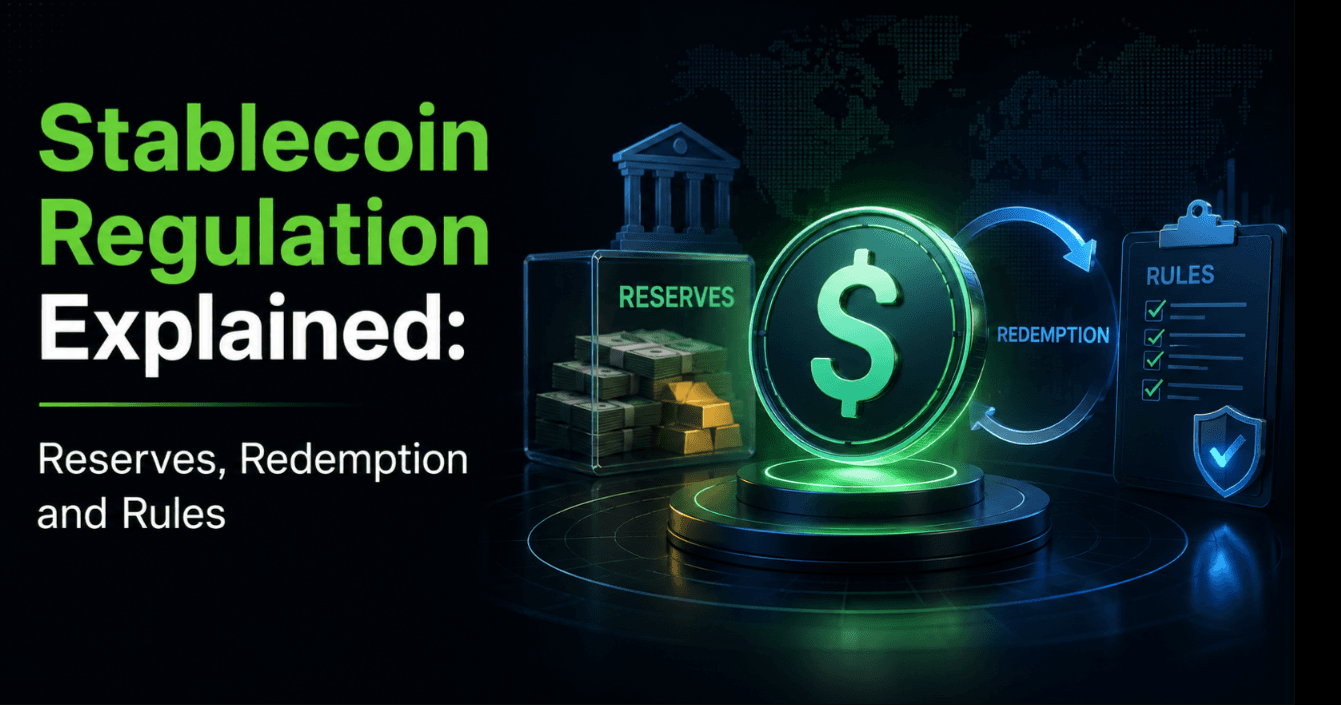
Stablecoin regulation is the body of rules aimed at tokens that promise to hold a steady value, usually by tracking an official currency. Regulators care about them more than other crypto-assets for one reason: a coin that pledges one-to-one redemption is making a financial promise that can break under stress, and if the coin is widely used, that break can ripple into payments and the broader system. As a result, most emerging frameworks converge on the same demands, namely high-quality reserves, a reliable right to redeem, transparency about what backs the coin, and a supervised issuer. What follows is a general explainer rather than legal or financial advice; the precise rules differ by jurisdiction and continue to evolve.
Key takeaways
- Stablecoins draw heavier oversight because they act like money and make a redemption promise that can fail.
- Reserve quality and a dependable right to redeem at par sit at the center of most rules.
- Transparency, often through reserve disclosures or attestations, is a recurring requirement.
- Algorithmic designs that rely on market incentives rather than held reserves attract extra caution.
- Oversight reduces some risks but does not guarantee a peg will always hold.
Why stablecoins are treated differently
Most crypto-assets are openly volatile, and regulators largely treat their price swings as the buyer's risk. A stablecoin is different because its entire selling point is that it will not swing. That promise invites trust, and trust at scale is precisely what financial regulation exists to protect. If millions of people treat a coin as a cash equivalent, a sudden loss of confidence can trigger a rush to redeem, the digital version of a bank run.
What regulators focus on
Across jurisdictions, stablecoin rules tend to circle a consistent set of concerns rather than the technology itself.
Reserves
The first question is always what stands behind each coin. Rules increasingly require that reserves be safe, liquid and sufficient, so that the issuer can actually meet redemptions in a hurry. The closer the reserve sits to cash and short-dated, high-quality instruments, the more confidence supervisors tend to have.
Redemption
A reserve is only useful if holders can reach it. Frameworks therefore emphasize a clear, enforceable right to redeem at par, ideally without onerous conditions, because a redemption promise that is hard to exercise is barely a promise at all.
Transparency and governance
Because users cannot inspect a vault, disclosure substitutes for it. Many regimes call for regular reporting or independent attestations describing what backs the coin, alongside governance standards covering how the issuer is run and how risks are managed.
The harder case of algorithmic designs
Not every stablecoin holds a pile of reserves. Some designs try to maintain a peg through algorithms and market incentives, minting and burning tokens to steer the price. These models have a difficult history under stress, and regulators tend to view them with caution, sometimes restricting them or holding them to standards that effectively require backing. The lesson many frameworks have absorbed is that a promise of stability is most credible when something tangible stands behind it.
A stablecoin is only as stable as the worst day on which everyone tries to redeem it at once. Regulation is mostly about that day. — CoinRadar Daily desk note
What oversight means for issuers and users
For issuers, regulation usually means licensing, capital, reserve management, disclosure and the operational discipline to honor redemptions on demand. For users, it means a better-grounded expectation that a regulated coin is actually backed and redeemable, plus clearer information about what they are holding. It does not turn a stablecoin into a risk-free instrument. Pegs can still slip during turmoil, reserves can be managed well or poorly, and an unregulated coin offers fewer protections of all. Treat the regulatory status of a coin as one input, confirm the specifics yourself, and seek professional advice before relying on any stablecoin for significant sums.
Frequently asked questions
What is a stablecoin in simple terms?+
A stablecoin is a crypto-asset designed to hold a steady value, usually by tracking an official currency at roughly one to one. The aim is to combine the convenience of crypto with the price stability of traditional money.
Why do regulators focus so heavily on stablecoins?+
Because stablecoins behave like money and promise redemption at par. If a widely used coin loses confidence, holders may rush to redeem at once, which can strain the issuer and spill into payments and the broader financial system.
What do stablecoin rules usually require?+
Most frameworks center on high-quality, liquid reserves sufficient to meet redemptions, a clear right to redeem at par, transparency about what backs the coin through disclosures or attestations, and a supervised, well-governed issuer.
Are algorithmic stablecoins regulated differently?+
Often yes. Designs that rely on algorithms and market incentives rather than held reserves have struggled under stress, so regulators tend to treat them more cautiously, sometimes restricting them or requiring backing similar to reserve-based coins.
Does regulation guarantee a stablecoin will hold its peg?+
No. Oversight can reduce certain risks by requiring reserves, redemption rights and transparency, but it cannot guarantee a peg will always hold. Pegs can slip in turbulent markets, so a stablecoin is not a risk-free instrument.
Written by
Emily VolkerEditor-in-ChiefEditorial Strategy, Investigative Journalism, Crypto Media, E-E-A-T Standards
Emily Volker is the Editor-in-Chief of CoinRadar Daily, where she leads a multilingual editorial team covering cryptocurrency markets, blockchain innovation, Web3, and global digital asset regulation across eight languages. With more than a decade of experience in financial and technology journalism, she has played a key role in developing high editorial standards and trusted reporting within the digital asset industry. Emily began her career as a financial journalist reporting on commodities, energy markets, and emerging technologies before discovering Bitcoin and decentralized finance in the early 2010s. She later moved to London to join one of Europe's early blockchain-focused media organizations, where she advanced into senior editorial leadership. Her experience reporting through both the rapid expansion of the 2017 ICO boom and the subsequent market correction reinforced her commitment to fact-based, research-driven journalism in an industry often influenced by speculation. She holds a Master's degree in International Journalism from City, University of London, and has completed executive studies in digital media strategy through the Reuters Institute at Oxford. Emily is a strong advocate for editorial transparency, rigorous verification, and responsible financial reporting. She also helped integrate Google's E-E-A-T principles—Experience, Expertise, Authoritativeness, and Trustworthiness—into the editorial standards followed by CoinRadar Daily. Under her leadership, CoinRadar Daily has expanded into a global cryptocurrency news platform publishing content in eight languages with a network of editors, analysts, and contributors across four continents. Emily oversees investigative reporting, editorial policy, content quality, and fact-checking processes to ensure every article meets the publication's standards for accuracy, credibility, and independence. Alongside her editorial responsibilities, Emily mentors aspiring journalists through digital media initiatives and regularly speaks at international conferences focused on journalism, fintech, blockchain technology, and digital assets, where she discusses responsible reporting, combating misinformation, and the evolving future of financial media.

✓Reviewed & edited by
James ParkNFT & Web3 Gaming AnalystNFTs, Web3 Gaming, GameFi, Digital Collectibles, Creator Economy
James Park serves as the NFT & Web3 Gaming Analyst at CoinRadar Daily, where he covers the rapidly evolving worlds of blockchain gaming, digital collectibles, metaverse ecosystems, and creator-driven economies. Combining expertise in interactive media with blockchain technology, he analyzes how NFTs and decentralized gaming continue to reshape digital ownership and online communities. James earned a Master of Fine Arts in Digital Media from NYU Tisch School of the Arts, giving him a unique perspective that blends creative storytelling, digital culture, and emerging technology. Rather than viewing NFTs solely through an investment lens, he examines their broader impact on entertainment, gaming, intellectual property, and community engagement. Prior to joining CoinRadar Daily, James reported on the NFT industry and blockchain gaming for several leading digital media outlets, covering the explosive growth of the NFT market, the transition toward utility-focused collections, and the evolution of GameFi. His close relationships with independent developers, digital artists, and gaming communities allow him to identify important industry trends long before they reach mainstream attention. His reporting places particular emphasis on sustainable Web3 game design, token economies, and the long-term viability of blockchain-powered virtual worlds. James has published extensive research analyzing why certain gaming ecosystems thrive while others struggle with inflationary token models, weak player retention, or unsustainable reward structures. His market analysis is frequently referenced by blockchain startups, investors, and game studios evaluating new Web3 projects. Beyond journalism, James actively participates in NFT and decentralized creator communities while following developments in digital art, virtual economies, and next-generation gaming technologies. He also contributes educational content on blockchain gaming and regularly speaks about the future of digital ownership, helping CoinRadar Daily deliver balanced, research-driven coverage at the intersection of technology, gaming, and crypto innovation.
CoinRadar Daily content is written by named analysts and checked against our editorial standards. Market data is indicative and informational only — nothing here is financial advice.
Regulation services, rated
How we score →Independent, rubric-scored tables covering the services this regulation coverage keeps running into.
Best Stablecoins
Top rated: USDC 8.4
A stablecoin is a promise about redemption.
4rated →
Best Crypto Cards
Top rated: Gnosis Pay 7.8
Spend crypto at the till.
4rated →
Best Crypto Exchanges
Top rated: Kraken 8.6
Centralised venues that hold your funds while you trade.
6rated →
Keep Reading

Security or Commodity? How Regulators Classify Crypto
Whether a token is a security or a commodity decides which rules apply and who supervises it. Here is how regulators draw that line and why it is so contested.
James Park · May 22, 2026→
MiCA Explained: How the EU Regulates Crypto Under One Rulebook
MiCA gives the European Union a single framework for crypto-assets and the firms that service them. Here is what it covers and why it changed the game in Europe.
Olivia Bennett · June 3, 2026→

How Crypto Taxes Generally Work: A Beginner's Guide
Selling, swapping, spending or earning crypto can create a tax bill. Here is how the main concepts work and why your records matter more than you think.
James Park · June 10, 2026→