Supply-Chain Attacks on Signing Devices
Everything about hardware wallet security assumes the device you received is the device the manufacturer shipped. That assumption has been broken repeatedly, and most of the checks users are told to perform would not have caught any of it.

By Olivia Bennett, Blockchain Security Researcher
Smart Contract Security, Audit Reports, Exploits, DeFi Hacks, White-Hat Research
✓ Reviewed by Emily Volker· Editor-in-Chief
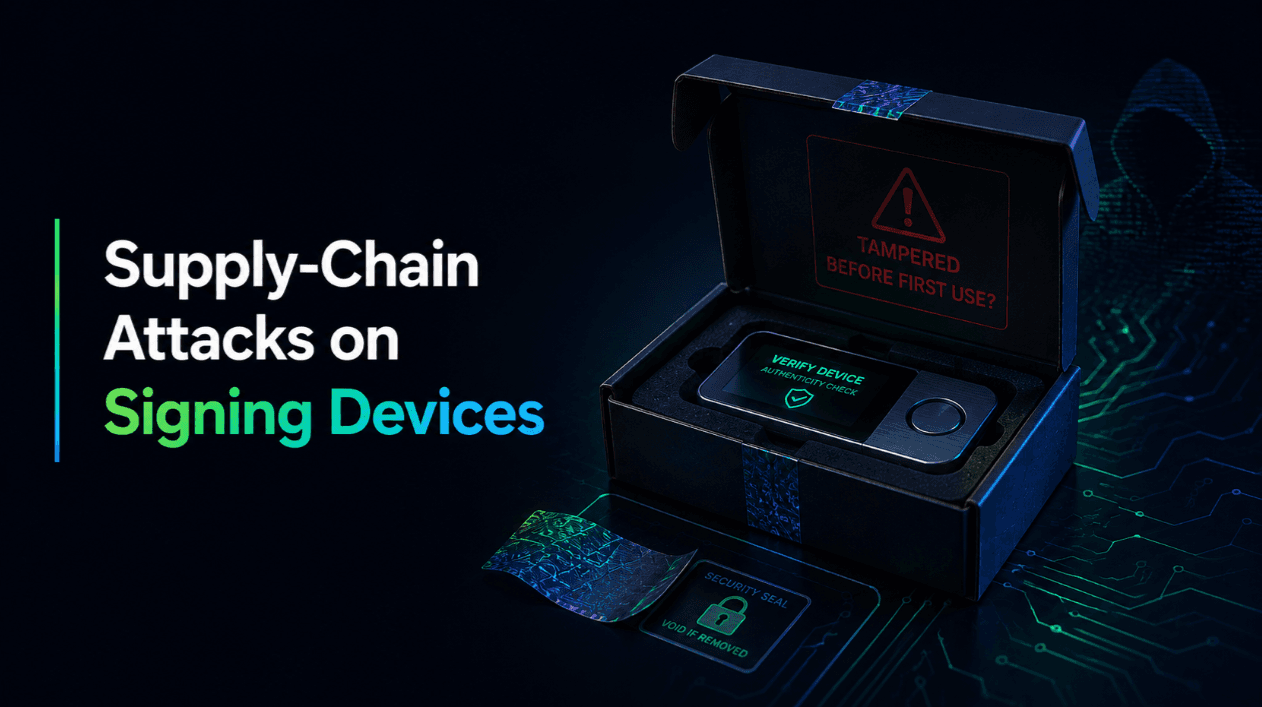
A signing device protects a key that was generated on it. If someone interfered with the device before it reached you — replacing it, altering its firmware, or arranging for it to produce a key they already know — every downstream protection is decoration. This attack requires no exploit and no user error, and it is why where you buy the device is a security decision.
The three shapes
Pre-seeded devices are the crudest and most effective. The package contains a card with a seed phrase already printed, and instructions saying to use it. The device is genuine, the phrase is valid, and the attacker generated it. Any funds sent to the resulting wallet are immediately spendable by them.
The reason this works is that it inverts the one habit users have been taught: write down the phrase the device shows you. A pre-printed phrase looks like the manufacturer being helpful, and a novice has no basis to distinguish it from legitimate packaging.
Modified firmware is more sophisticated: a genuine device flashed with code that generates keys from reduced entropy, so the attacker can search the small space of possible seeds later. The device looks and behaves correctly, the phrase is unique, and the wallet is compromised from the first block.
Counterfeit hardware replaces the device entirely with something that resembles it. This has grown harder as devices adopt attestation, and it remains viable against buyers who never verify.
Which checks actually help
Tamper-evident seals are close to worthless on their own. Holographic stickers are manufactured in bulk and available to anyone, and users have no reference for what an intact one looks like on a device they have never seen. A device arriving with a seal is not evidence; a device arriving with an obviously broken one is only evidence that the attacker was careless.
Genuine-device attestation is meaningful when it is cryptographic. The device proves possession of a key installed at manufacture, verified against the manufacturer's servers by their software. It is a real check against counterfeits, and it depends on trusting the manufacturer's infrastructure — which is a smaller thing to trust than an unverified package.
Firmware verification is the strongest technical check. A device that reports its firmware version and hash, verifiable against published values and ideally against a reproducible build, tells you what code you are running. Modified firmware fails this check specifically.
And the one that always works: generate the seed yourself, on the device, after you receive it. Whatever happened in transit, a phrase created on your device after a factory reset that you initiated is a phrase nobody else has seen.
The rule that covers the crude attack completely
Never use a seed phrase you did not watch the device generate.
Not a phrase on a card in the box. Not one in a printed manual. Not one supplied by support. Not one on a website. If the words did not appear on the device's own screen during a setup you started, they are worthless to you and valuable to someone else.
This single rule defeats the pre-seeded attack entirely, which is the variant that has taken the most money from the fewest sophisticated attackers.
Reducing the exposure
- Buy from the manufacturer directly or from a distributor they list. Marketplace listings, including those fulfilled by the platform, have repeatedly been the vector.
- Run the manufacturer's attestation check before setup, and treat a failure as final rather than as a support ticket.
- Verify the firmware version and hash against published values before generating anything.
- Factory reset the device yourself and generate the seed on it, regardless of how it arrived.
- Send a small amount first and confirm you can move it out again before funding properly.
Why the last step matters
Every check above can be defeated by a sufficiently resourced attacker, and none of them are things a non-expert performs confidently. A small test transaction, sent and then withdrawn, exercises the whole arrangement end to end and costs the price of two network fees.
It does not prove the key is unknown to anyone else — a patient attacker waits. But combined with generating the seed yourself, it converts the security question from a set of checks you may have done wrong into a property you established by doing it.
Sources
3 references- 01Security
ethereum.org · accessed August 22, 2026
- 02FIPS 140-3: Security Requirements for Cryptographic Modules
NIST · accessed August 22, 2026
- 03BIP-39: Mnemonic code for generating deterministic keys
Bitcoin Improvement Proposals · accessed August 22, 2026
Frequently asked questions
Can a hardware wallet be compromised before I receive it?+
Yes, and it has happened repeatedly. The three shapes are a device shipped with a pre-printed seed phrase the attacker generated, a genuine device flashed with firmware that produces predictable keys, and outright counterfeit hardware. None of them require an exploit or a user mistake.
Are tamper-evident seals reliable?+
Largely not on their own. Holographic stickers are available in bulk to anyone, and a buyer has no reference for what an intact seal looks like on a device they have never seen. Cryptographic attestation and firmware verification are the checks with real content.
What is the single most important rule?+
Never use a seed phrase you did not watch the device generate. Not one on a card in the box, in the manual, from support or from a website. A phrase created on your device during a setup you started is one nobody else has seen, and that rule defeats the crudest and most effective attack outright.
Where should I buy a signing device?+
From the manufacturer directly or from a distributor they name. Marketplace listings have repeatedly been the vector, including those fulfilled by the platform itself, because the supply chain behind a listing is not something the buyer can inspect.
Written by
Olivia BennettBlockchain Security ResearcherSmart Contract Security, Audit Reports, Exploits, DeFi Hacks, White-Hat Research
Olivia Bennett is the Blockchain Security Researcher at CoinRadar Daily, where she specializes in smart contract security, DeFi risk analysis, blockchain infrastructure, and protocol vulnerabilities. Drawing on years of hands-on cybersecurity experience, she delivers in-depth reporting that explains both the technical details and the real-world implications of security incidents across the digital asset ecosystem. Before joining CoinRadar Daily, Olivia built her career in cybersecurity, working in penetration testing, blockchain security assessments, and smart contract auditing. She participated in numerous security reviews for decentralized applications and blockchain protocols, helping identify critical vulnerabilities before they could be exploited. Her responsible disclosure work has contributed to improving the security of several major DeFi projects and protecting millions of dollars in digital assets. Olivia earned a Bachelor of Science in Computer Science from the University of Edinburgh and later completed advanced professional training in offensive security and blockchain technologies. Her combination of software security expertise and blockchain knowledge enables her to provide readers with clear, evidence-based analysis of exploits, protocol upgrades, and emerging attack vectors. At CoinRadar Daily, Olivia publishes detailed investigations into blockchain exploits, smart contract audits, cross-chain security, wallet protection, and evolving cyber threats affecting the crypto industry. She is particularly committed to translating highly technical research into practical guidance that helps investors, developers, and blockchain users better understand protocol risk and security best practices. Alongside her editorial work, Olivia contributes educational resources covering secure wallet management, decentralized finance security, and blockchain infrastructure. She also participates in industry events and technical discussions focused on strengthening Web3 security standards, supporting CoinRadar Daily's mission to provide accurate, research-driven coverage of the rapidly evolving digital asset landscape.

✓Reviewed & edited by
Emily VolkerEditor-in-ChiefEditorial Strategy, Investigative Journalism, Crypto Media, E-E-A-T Standards
Emily Volker is the Editor-in-Chief of CoinRadar Daily, where she leads a multilingual editorial team covering cryptocurrency markets, blockchain innovation, Web3, and global digital asset regulation across eight languages. With more than a decade of experience in financial and technology journalism, she has played a key role in developing high editorial standards and trusted reporting within the digital asset industry. Emily began her career as a financial journalist reporting on commodities, energy markets, and emerging technologies before discovering Bitcoin and decentralized finance in the early 2010s. She later moved to London to join one of Europe's early blockchain-focused media organizations, where she advanced into senior editorial leadership. Her experience reporting through both the rapid expansion of the 2017 ICO boom and the subsequent market correction reinforced her commitment to fact-based, research-driven journalism in an industry often influenced by speculation. She holds a Master's degree in International Journalism from City, University of London, and has completed executive studies in digital media strategy through the Reuters Institute at Oxford. Emily is a strong advocate for editorial transparency, rigorous verification, and responsible financial reporting. She also helped integrate Google's E-E-A-T principles—Experience, Expertise, Authoritativeness, and Trustworthiness—into the editorial standards followed by CoinRadar Daily. Under her leadership, CoinRadar Daily has expanded into a global cryptocurrency news platform publishing content in eight languages with a network of editors, analysts, and contributors across four continents. Emily oversees investigative reporting, editorial policy, content quality, and fact-checking processes to ensure every article meets the publication's standards for accuracy, credibility, and independence. Alongside her editorial responsibilities, Emily mentors aspiring journalists through digital media initiatives and regularly speaks at international conferences focused on journalism, fintech, blockchain technology, and digital assets, where she discusses responsible reporting, combating misinformation, and the evolving future of financial media.
CoinRadar Daily content is written by named analysts and checked against our editorial standards. Market data is indicative and informational only — nothing here is financial advice.
Bitcoin services, rated
How we score →Independent, rubric-scored tables covering the services this bitcoin coverage keeps running into.
Best Hardware Wallets
Top rated: Trezor Safe 5 8.6
Devices whose only job is to keep a key away from the internet.
5rated →
Best Crypto Wallets
Top rated: Rabby 8.3
Software wallets for everyday use.
5rated →
Best Crypto Exchanges
Top rated: Kraken 8.4
Centralised venues that hold your funds while you trade.
6rated →
Keep Reading
Bitcoin Self-Custody: Hardware Wallets, Seed Phrases & Security
Self-custody means holding your own keys. Here is how hardware wallets and seed phrases protect Bitcoin, and the security habits that prevent loss.
James Park · May 25, 2026→
What Is a Spot Bitcoin ETF and How Does It Work?
A spot Bitcoin ETF holds actual bitcoin and lets investors gain exposure through a brokerage account. Here is how it works and what you give up.
Emily Volker · June 1, 2026→

Bitcoin vs Gold: Which Is the Better Store of Value?
Bitcoin is often called digital gold, but the two assets store value very differently. Here is how they compare on scarcity, volatility, and risk.
Olivia Bennett · June 5, 2026→