Card Rails: What Happens Between Tap and Settlement
A crypto card looks like paying with crypto. What actually happens is a card transaction on the same network as any other card, funded by a conversion performed on your behalf in the moments around it — and every cost lives in that conversion.

By Emily Volker, Editor-in-Chief
Editorial Strategy, Investigative Journalism, Crypto Media, E-E-A-T Standards
✓ Reviewed by James Park· NFT & Web3 Gaming Analyst
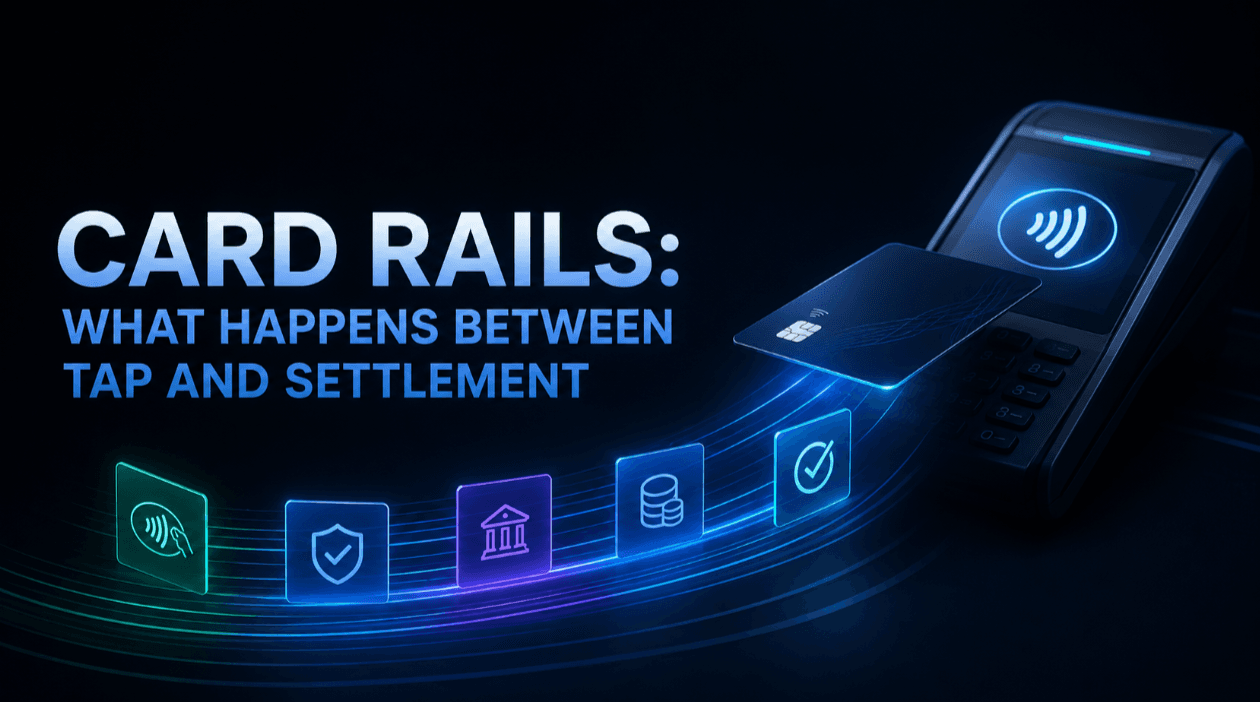
Merchants do not accept crypto when you tap a crypto card. They accept a card payment in local currency, exactly as with any other card, on the same networks and under the same rules. The crypto part happens behind that, and understanding where it sits explains both the costs and the ways these products fail.
The five steps
The merchant terminal requests authorisation in local currency from the card network, which routes it to the issuing bank behind the card. Every crypto card has one; the crypto company is a programme manager rather than an issuer.
The issuer checks whether the account can cover it. This is where the crypto layer appears: the programme manager either holds a converted fiat balance already, or must convert crypto to fiat at that moment, or extends credit against crypto collateral.
Authorisation is approved or declined within a second or two, which is the constraint shaping everything else — there is no time for an on-chain transaction, so the conversion is handled off-chain against a balance the provider controls.
Settlement follows over the next day or two through the ordinary card settlement process.
Reconciliation is where the provider squares its position, and where any difference between the rate it quoted you and the rate it achieved becomes its profit or loss.
The three funding models
Pre-converted balance: you convert to fiat in advance and spend that. Simple, no conversion at the till, and you carry currency exposure between conversion and spending.
Convert on spend: the provider sells your crypto at authorisation. Convenient, and the rate you receive is the provider's, applied at a moment you did not choose.
Credit against collateral: you borrow against holdings rather than selling. No disposal is triggered, which matters for tax in some jurisdictions, and every purchase becomes a leveraged position that a price fall can liquidate.
Where the money goes
The FX and conversion spread is the dominant cost and the least visible, applied between your asset and the settlement currency at a rate the provider sets.
The network's own currency conversion applies on top when you spend outside the card's settlement currency, and is a separate charge from the one above.
Explicit fees — monthly, ATM, foreign transaction — are published and are usually the smaller part.
And rewards are funded from interchange, the fee merchants pay to the card network, which is why reward rates are structurally limited by what interchange yields. A reward substantially above that has to be funded from somewhere else, which is generally a token you are required to lock.
The failure points
- Programme manager failure. The issuing bank and the network continue; your card stops. This has happened and cards have been withdrawn at short notice.
- Conversion at a bad moment. With convert-on-spend, a volatile market means the rate you get is the rate at the till.
- Liquidation, on credit-line cards, where a drawdown can force a sale of collateral you were treating as savings.
- Geographic restriction, since these are regulated payment products and availability follows licensing rather than the chain.
- Balance held by the provider, which is a custodial exposure separate from every other risk on this list.
The structurally safest arrangement is one that spends from an account you control rather than a float held by a provider — which is rare, has no rewards, and is the only design where a programme manager failing does not touch your money.
Sources
2 references- 01Stablecoins
ethereum.org · accessed August 22, 2026
- 02Regulation (EU) 2023/1114 on markets in crypto-assets (MiCA)
EUR-Lex · accessed August 22, 2026
Frequently asked questions
Does the merchant receive crypto when I use a crypto card?+
No. The merchant receives local currency through the ordinary card network, exactly as with any other card. The crypto is converted behind the transaction by the programme manager, which is why these are payment products with a conversion attached rather than crypto payments.
What is the real cost of a crypto card transaction?+
Mostly the conversion spread between your asset and the settlement currency, applied at a rate the provider sets and rarely shown as a fee. The card network's own currency conversion applies on top when spending abroad. Published fees are usually the smaller part.
Why are crypto card rewards limited?+
Because they are funded from interchange — the fee merchants pay the network — which caps what a card can economically pay back. A reward rate well above that has to come from somewhere else, which in practice means a token you are required to lock.
What happens if the card provider fails?+
The issuing bank and the card network carry on; your card stops working and any balance held by the provider is exposed. Cards have been withdrawn at short notice before. A product that spends from an account you control avoids this entirely, at the cost of rewards.
Written by
Emily VolkerEditor-in-ChiefEditorial Strategy, Investigative Journalism, Crypto Media, E-E-A-T Standards
Emily Volker is the Editor-in-Chief of CoinRadar Daily, where she leads a multilingual editorial team covering cryptocurrency markets, blockchain innovation, Web3, and global digital asset regulation across eight languages. With more than a decade of experience in financial and technology journalism, she has played a key role in developing high editorial standards and trusted reporting within the digital asset industry. Emily began her career as a financial journalist reporting on commodities, energy markets, and emerging technologies before discovering Bitcoin and decentralized finance in the early 2010s. She later moved to London to join one of Europe's early blockchain-focused media organizations, where she advanced into senior editorial leadership. Her experience reporting through both the rapid expansion of the 2017 ICO boom and the subsequent market correction reinforced her commitment to fact-based, research-driven journalism in an industry often influenced by speculation. She holds a Master's degree in International Journalism from City, University of London, and has completed executive studies in digital media strategy through the Reuters Institute at Oxford. Emily is a strong advocate for editorial transparency, rigorous verification, and responsible financial reporting. She also helped integrate Google's E-E-A-T principles—Experience, Expertise, Authoritativeness, and Trustworthiness—into the editorial standards followed by CoinRadar Daily. Under her leadership, CoinRadar Daily has expanded into a global cryptocurrency news platform publishing content in eight languages with a network of editors, analysts, and contributors across four continents. Emily oversees investigative reporting, editorial policy, content quality, and fact-checking processes to ensure every article meets the publication's standards for accuracy, credibility, and independence. Alongside her editorial responsibilities, Emily mentors aspiring journalists through digital media initiatives and regularly speaks at international conferences focused on journalism, fintech, blockchain technology, and digital assets, where she discusses responsible reporting, combating misinformation, and the evolving future of financial media.

✓Reviewed & edited by
James ParkNFT & Web3 Gaming AnalystNFTs, Web3 Gaming, GameFi, Digital Collectibles, Creator Economy
James Park serves as the NFT & Web3 Gaming Analyst at CoinRadar Daily, where he covers the rapidly evolving worlds of blockchain gaming, digital collectibles, metaverse ecosystems, and creator-driven economies. Combining expertise in interactive media with blockchain technology, he analyzes how NFTs and decentralized gaming continue to reshape digital ownership and online communities. James earned a Master of Fine Arts in Digital Media from NYU Tisch School of the Arts, giving him a unique perspective that blends creative storytelling, digital culture, and emerging technology. Rather than viewing NFTs solely through an investment lens, he examines their broader impact on entertainment, gaming, intellectual property, and community engagement. Prior to joining CoinRadar Daily, James reported on the NFT industry and blockchain gaming for several leading digital media outlets, covering the explosive growth of the NFT market, the transition toward utility-focused collections, and the evolution of GameFi. His close relationships with independent developers, digital artists, and gaming communities allow him to identify important industry trends long before they reach mainstream attention. His reporting places particular emphasis on sustainable Web3 game design, token economies, and the long-term viability of blockchain-powered virtual worlds. James has published extensive research analyzing why certain gaming ecosystems thrive while others struggle with inflationary token models, weak player retention, or unsustainable reward structures. His market analysis is frequently referenced by blockchain startups, investors, and game studios evaluating new Web3 projects. Beyond journalism, James actively participates in NFT and decentralized creator communities while following developments in digital art, virtual economies, and next-generation gaming technologies. He also contributes educational content on blockchain gaming and regularly speaks about the future of digital ownership, helping CoinRadar Daily deliver balanced, research-driven coverage at the intersection of technology, gaming, and crypto innovation.
CoinRadar Daily content is written by named analysts and checked against our editorial standards. Market data is indicative and informational only — nothing here is financial advice.
DeFi services, rated
How we score →Independent, rubric-scored tables covering the services this defi coverage keeps running into.
Best DeFi Protocols
Top rated: Uniswap Protocol 8.9
The base layer everything else is built on.
4rated →
Best Decentralised Exchanges
Top rated: Uniswap 8.7
Swap venues where you never hand over your keys.
5rated →
Best Crypto Lending Platforms
Top rated: Aave 8.0
Borrow against your holdings, or lend them out.
4rated →
Keep Reading
DeFi Risks and How to Stay Safe
DeFi opens powerful financial tools to anyone, but it also removes the safety nets of traditional finance. Here are the main risks and the habits that help you avoid them.
James Park · May 24, 2026→
DEX vs CEX: Decentralized vs Centralized Exchanges
Centralized exchanges hold your funds and feel like apps; decentralized exchanges let you trade from your own wallet. Here is how the two compare and when to use each.
Emily Volker · May 26, 2026→
Stablecoins Explained: USDT, USDC, and DAI
Stablecoins aim to hold a steady value, usually one US dollar, so crypto users can move and store money without volatility. Here is how USDT, USDC, and DAI differ.
Olivia Bennett · June 4, 2026→