Liquid Staking Tokens: Redemption Price vs Market Price
A staking receipt trades at one price and redeems at another. The gap between them is not a malfunction — it is the market pricing the exit queue — and reading it correctly means knowing which of the two numbers is a promise.

By James Park, NFT & Web3 Gaming Analyst
NFTs, Web3 Gaming, GameFi, Digital Collectibles, Creator Economy
✓ Reviewed by Olivia Bennett· Blockchain Security Researcher
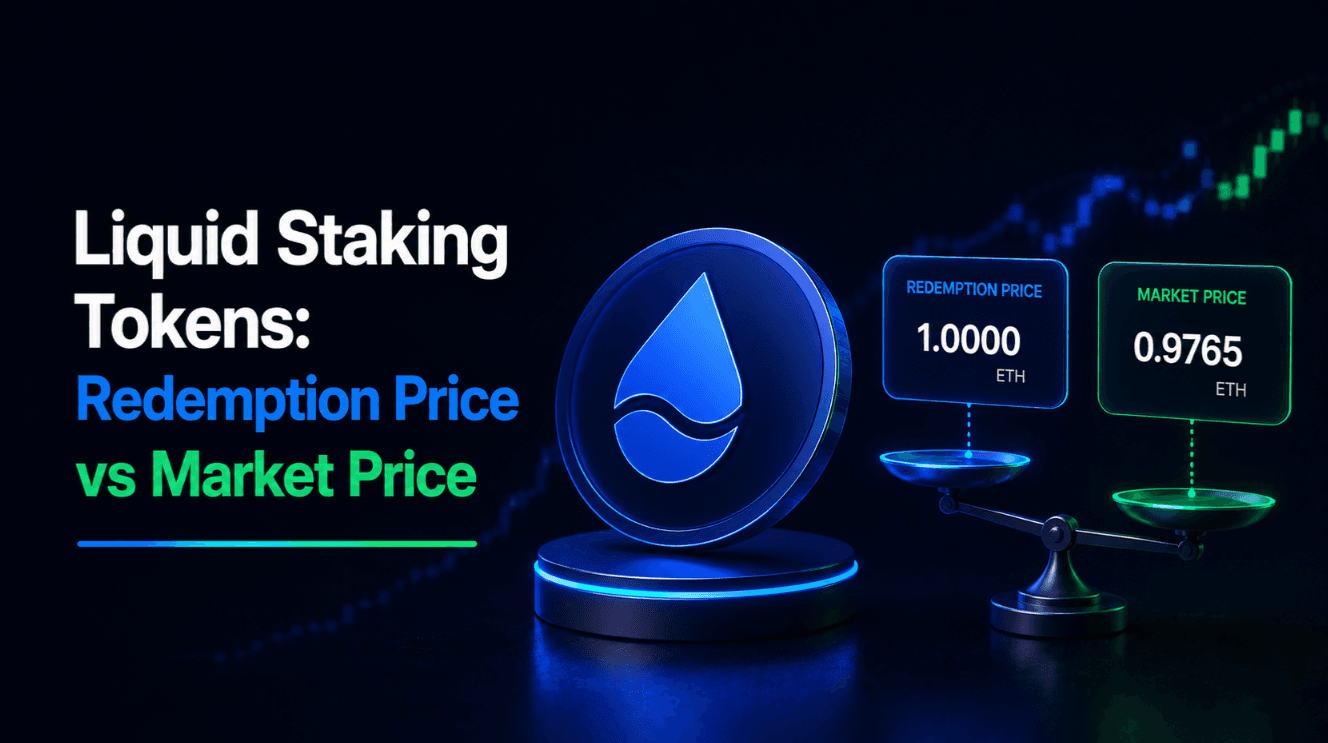
A liquid staking token represents staked capital plus accrued rewards. That underlying value is calculable and moves in one direction. The token also trades on the open market at whatever buyers will pay, which moves in both. When people say a staking token has de-pegged, they mean the second number has fallen below the first — and whether that matters depends entirely on a question about the protocol, not about the market.
Two numbers, one of them a claim
The redemption value is what the protocol will give you for the token: the underlying stake plus its share of rewards, less any fee. It is arithmetic. It does not fall because sentiment fell.
The market price is what a buyer will pay at any given moment to take the token off you. It reflects the redemption value, the time and hassle of redeeming, and the current balance of people wanting in against people wanting out.
Arbitrage normally keeps the two close. If the token trades below redemption value, buying it and redeeming is profitable, and enough people doing that lifts the price back. This is the entire mechanism holding the peg, and it has one dependency worth naming: redemption has to be open.
Why a discount usually is not a solvency signal
When exits queue, redemption takes time. A buyer who acquires the discounted token has to wait through that queue before realising the value, and they will only accept the trade at a price that compensates them for the wait and the risk over it. That discount is the queue, expressed as a number.
So a modest discount during a period of heavy exits is the system working. Everyone wanting out at once cannot all be accommodated instantly, and the market allocates the available immediacy by price. The alternative — no discount and no queue — would require the protocol to hold liquid reserves against every possible redemption, which would mean not staking the capital.
The distinction that matters is between a discount that reflects time and one that reflects doubt. Time-based discounts narrow as the queue clears. Doubt-based discounts widen, and they are accompanied by a specific question the market cannot answer: is the underlying stake actually there and actually recoverable.
The case where a discount is unbounded
The mechanism breaks when redemption is unavailable. If a protocol has issued receipt tokens but not yet enabled redemptions — during a launch phase, pending a governance step, or while a token event completes — then the arbitrage that anchors the price cannot happen. Nobody can buy cheaply and redeem at par, because redeeming is switched off.
At that point the token's price is set purely by the balance of buyers and sellers in a market that may be thin. A concentrated rush for the door has nothing pushing back against it, and the price can fall far below the underlying value while the underlying value itself is entirely intact. Positions using the token as collateral get liquidated on the market price, which turns a liquidity event into realised losses for people who were never trying to sell.
This is the single most important thing to check about any staking receipt, and it is a yes-or-no question: can I redeem this today, without permission, for the underlying.
Rebasing and reward-accruing tokens behave differently
Two designs are common and they make the peg look different on a chart.
A rebasing token keeps its unit value near parity with the underlying asset and increases your balance as rewards accrue. Its chart looks flat and a discount is immediately visible as a deviation from one.
A reward-accruing token keeps your balance fixed and lets the unit value rise over time as rewards accumulate. Its chart trends upward, and the correct comparison is not against the underlying asset but against the protocol's published exchange rate. Somebody comparing a reward-accruing token to spot and concluding it trades at a premium has simply observed accrued rewards.
Neither design is safer. They differ in tax treatment in some jurisdictions and in how easily a de-peg is spotted by eye, which is a real if unglamorous consideration.
What to check
- Is redemption open, permissionless and unrestricted today. This is the question the peg depends on.
- How deep is the secondary market. A sound redemption path with a thin market is a theoretical exit.
- Is the token rebasing or reward-accruing, so you are comparing against the right reference.
- How much of the token is deposited as collateral elsewhere. Heavy collateral use turns a discount into forced selling.
- What the historical record shows during past exit waves, and whether redemption stayed open through them.
A liquid staking token is not staked capital with liquidity added. It is a claim on staked capital that can be sold, and the difference between selling it and claiming it is the whole subject.
Lending markets price these tokens through their own oracles, and a feed that mismeasures the exchange rate liquidates borrowers who did nothing wrong. Those incidents, and the firms that configured the feeds, are recorded in our DeFi risk manager rankings.
Sources
2 references- 01Staking withdrawals
ethereum.org · accessed August 22, 2026
- 02Lido documentation
Lido · accessed August 22, 2026
Frequently asked questions
What does it mean when a liquid staking token de-pegs?+
The market price has fallen below the redemption value. If redemption is open, that gap is usually the market pricing the wait in the exit queue and it closes as the queue clears. If redemption is closed, nothing anchors the price, and the gap can widen well past anything the underlying justifies.
Should I sell or redeem?+
Redeeming returns full value and takes as long as the queue takes. Selling is immediate at the market price, which under stress is below par. You are choosing between value and speed, and the discount is the price of speed.
Why does a reward-accruing token trade above the underlying asset?+
It is not a premium. That design keeps your balance fixed and lets the unit value rise as rewards accrue, so the correct comparison is against the protocol's published exchange rate rather than against spot. Comparing it to spot just measures rewards earned.
Is a de-peg a sign the protocol is insolvent?+
Rarely on its own. The useful test is whether the discount narrows as exits clear — a time-based discount does, a doubt-based one does not. The serious case is a protocol where redemption is unavailable, because then the price has nothing tethering it to the underlying at all.
Written by
James ParkNFT & Web3 Gaming AnalystNFTs, Web3 Gaming, GameFi, Digital Collectibles, Creator Economy
James Park serves as the NFT & Web3 Gaming Analyst at CoinRadar Daily, where he covers the rapidly evolving worlds of blockchain gaming, digital collectibles, metaverse ecosystems, and creator-driven economies. Combining expertise in interactive media with blockchain technology, he analyzes how NFTs and decentralized gaming continue to reshape digital ownership and online communities. James earned a Master of Fine Arts in Digital Media from NYU Tisch School of the Arts, giving him a unique perspective that blends creative storytelling, digital culture, and emerging technology. Rather than viewing NFTs solely through an investment lens, he examines their broader impact on entertainment, gaming, intellectual property, and community engagement. Prior to joining CoinRadar Daily, James reported on the NFT industry and blockchain gaming for several leading digital media outlets, covering the explosive growth of the NFT market, the transition toward utility-focused collections, and the evolution of GameFi. His close relationships with independent developers, digital artists, and gaming communities allow him to identify important industry trends long before they reach mainstream attention. His reporting places particular emphasis on sustainable Web3 game design, token economies, and the long-term viability of blockchain-powered virtual worlds. James has published extensive research analyzing why certain gaming ecosystems thrive while others struggle with inflationary token models, weak player retention, or unsustainable reward structures. His market analysis is frequently referenced by blockchain startups, investors, and game studios evaluating new Web3 projects. Beyond journalism, James actively participates in NFT and decentralized creator communities while following developments in digital art, virtual economies, and next-generation gaming technologies. He also contributes educational content on blockchain gaming and regularly speaks about the future of digital ownership, helping CoinRadar Daily deliver balanced, research-driven coverage at the intersection of technology, gaming, and crypto innovation.

✓Reviewed & edited by
Olivia BennettBlockchain Security ResearcherSmart Contract Security, Audit Reports, Exploits, DeFi Hacks, White-Hat Research
Olivia Bennett is the Blockchain Security Researcher at CoinRadar Daily, where she specializes in smart contract security, DeFi risk analysis, blockchain infrastructure, and protocol vulnerabilities. Drawing on years of hands-on cybersecurity experience, she delivers in-depth reporting that explains both the technical details and the real-world implications of security incidents across the digital asset ecosystem. Before joining CoinRadar Daily, Olivia built her career in cybersecurity, working in penetration testing, blockchain security assessments, and smart contract auditing. She participated in numerous security reviews for decentralized applications and blockchain protocols, helping identify critical vulnerabilities before they could be exploited. Her responsible disclosure work has contributed to improving the security of several major DeFi projects and protecting millions of dollars in digital assets. Olivia earned a Bachelor of Science in Computer Science from the University of Edinburgh and later completed advanced professional training in offensive security and blockchain technologies. Her combination of software security expertise and blockchain knowledge enables her to provide readers with clear, evidence-based analysis of exploits, protocol upgrades, and emerging attack vectors. At CoinRadar Daily, Olivia publishes detailed investigations into blockchain exploits, smart contract audits, cross-chain security, wallet protection, and evolving cyber threats affecting the crypto industry. She is particularly committed to translating highly technical research into practical guidance that helps investors, developers, and blockchain users better understand protocol risk and security best practices. Alongside her editorial work, Olivia contributes educational resources covering secure wallet management, decentralized finance security, and blockchain infrastructure. She also participates in industry events and technical discussions focused on strengthening Web3 security standards, supporting CoinRadar Daily's mission to provide accurate, research-driven coverage of the rapidly evolving digital asset landscape.
CoinRadar Daily content is written by named analysts and checked against our editorial standards. Market data is indicative and informational only — nothing here is financial advice.
DeFi services, rated
How we score →Independent, rubric-scored tables covering the services this defi coverage keeps running into.
Best DeFi Protocols
Top rated: Uniswap Protocol 8.9
The base layer everything else is built on.
4rated →
Best Decentralised Exchanges
Top rated: Uniswap 8.7
Swap venues where you never hand over your keys.
5rated →
Best Crypto Lending Platforms
Top rated: Aave 8.0
Borrow against your holdings, or lend them out.
4rated →
Keep Reading
DeFi Risks and How to Stay Safe
DeFi opens powerful financial tools to anyone, but it also removes the safety nets of traditional finance. Here are the main risks and the habits that help you avoid them.
James Park · May 24, 2026→
DEX vs CEX: Decentralized vs Centralized Exchanges
Centralized exchanges hold your funds and feel like apps; decentralized exchanges let you trade from your own wallet. Here is how the two compare and when to use each.
Emily Volker · May 26, 2026→
Stablecoins Explained: USDT, USDC, and DAI
Stablecoins aim to hold a steady value, usually one US dollar, so crypto users can move and store money without volatility. Here is how USDT, USDC, and DAI differ.
Olivia Bennett · June 4, 2026→