Liquidation Cascades: How One Asset Takes Down a Pool
A liquidation cascade is not simply a lot of liquidations. It is a feedback loop in which the mechanism designed to protect the protocol becomes the thing driving the price down, and it has a recognisable sequence with identifiable points where it can be broken.

By Emily Volker, Editor-in-Chief
Editorial Strategy, Investigative Journalism, Crypto Media, E-E-A-T Standards
✓ Reviewed by James Park· NFT & Web3 Gaming Analyst

Liquidation exists to keep a lending market solvent: when collateral falls far enough, it is sold to repay the debt before the position goes underwater. Executed on a normal day, it is unremarkable. Executed simultaneously across many positions holding the same collateral, it becomes reflexive — the selling required to protect the protocol pushes the price down, which triggers more liquidations, which requires more selling.
The five stages
First, a price move takes a cluster of positions below their liquidation threshold. Clustering is normal rather than coincidental: borrowers using the same collateral face similar parameters and tend to borrow to similar comfort levels.
Second, liquidators buy the collateral at a discount and sell it to recover their capital. That selling hits the same market that just fell.
Third, the selling depresses the price further, taking the next tranche of positions below their threshold.
Fourth, the loop repeats, and the rate at which it repeats depends on how much collateral sits in each price band and how deep the market is beneath.
Fifth, one of three things ends it: the price falls to where buyers absorb the supply, liquidity arrives from elsewhere, or the collateral runs out. The third case is the bad one, because it usually means positions were liquidated at prices that did not cover their debt.
The conditions that make it possible
Cascades need specific ingredients, and their absence is what makes most sharp price moves ordinary.
Concentrated collateral. If one asset backs a large share of borrowing in a market, its price move is the market's problem. Diversified collateral spreads the trigger across uncorrelated moves.
Thin liquidity relative to the collateral held. The important comparison is not the asset's headline trading volume but the depth available at the moment liquidations fire — which is exactly when it is thinnest.
Clustered thresholds. When many positions liquidate within a narrow price band, the loop has fuel. Varied collateral factors across assets spread the bands out.
Reflexive collateral. The worst case is collateral whose value depends on the health of the system borrowing against it — a protocol's own token used as collateral in its own market, for instance. A price fall then damages both sides of the equation at once.
Why liquidation penalties cut both ways
The liquidation penalty — the discount a liquidator receives — has to be calibrated carefully, and both errors are costly.
Too small, and liquidators do not act during congestion, when transaction costs spike and the profit no longer covers the risk of the price moving before execution. Positions then go underwater and the protocol takes bad debt. This is the failure mode behind several of the largest losses in on-chain lending: not that liquidation was wrong, but that nobody found it worth doing at the moment it mattered.
Too large, and the penalty itself accelerates the cascade by transferring more value out of borrowers on every step and putting more collateral onto the market than the debt required.
The parameter is therefore a judgement about which failure the protocol fears more, made in advance, published, and tested only when conditions are at their worst.
What actually breaks the loop
Several mechanisms exist and they work at different points.
Supply caps limit how much of one asset can ever be posted as collateral, which bounds the fuel available before anything happens. This is the most effective intervention because it is preventive.
Isolated markets confine a collateral failure to the market that accepted it, so a bad listing damages its own depositors rather than everyone. This is the structural argument for isolated designs over shared pools.
Partial liquidation closes only enough of a position to restore health rather than all of it, which reduces the collateral hitting the market per step.
Circuit breakers and pauses stop the loop directly and are the bluntest tool: they also trap solvent users who wanted out, and they require someone to hold the authority to trigger them, which is a control risk of its own.
Assessing a market's exposure
- What share of borrowing is backed by a single collateral asset, and how deep is that asset's market at stress levels rather than average ones.
- Are supply caps set, and are they small relative to on-chain liquidity for that asset.
- Are markets isolated or shared, which determines whether a bad listing is contained.
- Is the liquidation penalty large enough to attract liquidators during congestion, when it is actually needed.
- Does any accepted collateral derive its value from the protocol itself, which is the reflexive case.
A market that has never seen a cascade is not necessarily well-designed; it may simply not have been tested. The parameters above are observable in advance, which is the only time the answer is useful.
Sources
2 references- 01Liquidation
Compound · accessed September 17, 2026
- 02Collateral and borrowing
Compound · accessed September 17, 2026
Frequently asked questions
What is a liquidation cascade?+
A feedback loop where liquidating undercollateralised positions requires selling the collateral, that selling pushes the price down, and the lower price triggers the next round of liquidations. The mechanism protecting the protocol becomes the force driving the price, which is what distinguishes a cascade from a lot of liquidations happening at once.
What makes a lending market vulnerable?+
Collateral concentrated in one asset, thin market depth relative to the collateral held, liquidation thresholds clustered in a narrow price band, and collateral whose value depends on the health of the system borrowing against it. Diversified collateral with conservative caps is the opposite profile.
Why do protocols end up with bad debt?+
Usually because liquidation did not happen fast enough, not because it happened. During congestion, transaction costs rise and prices move mid-execution, so liquidators stop acting unless the penalty compensates them. Positions then fall below the value of their debt and the shortfall lands on the protocol.
How do isolated markets help?+
They confine a collateral failure to the market that accepted that collateral, so depositors elsewhere are unaffected. In a shared pool, one bad listing socialises its loss across everyone. Isolation limits the damage; it does not vet the market you chose to enter.
Written by
Emily VolkerEditor-in-ChiefEditorial Strategy, Investigative Journalism, Crypto Media, E-E-A-T Standards
Emily Volker is the Editor-in-Chief of CoinRadar Daily, where she leads a multilingual editorial team covering cryptocurrency markets, blockchain innovation, Web3, and global digital asset regulation across eight languages. With more than a decade of experience in financial and technology journalism, she has played a key role in developing high editorial standards and trusted reporting within the digital asset industry. Emily began her career as a financial journalist reporting on commodities, energy markets, and emerging technologies before discovering Bitcoin and decentralized finance in the early 2010s. She later moved to London to join one of Europe's early blockchain-focused media organizations, where she advanced into senior editorial leadership. Her experience reporting through both the rapid expansion of the 2017 ICO boom and the subsequent market correction reinforced her commitment to fact-based, research-driven journalism in an industry often influenced by speculation. She holds a Master's degree in International Journalism from City, University of London, and has completed executive studies in digital media strategy through the Reuters Institute at Oxford. Emily is a strong advocate for editorial transparency, rigorous verification, and responsible financial reporting. She also helped integrate Google's E-E-A-T principles—Experience, Expertise, Authoritativeness, and Trustworthiness—into the editorial standards followed by CoinRadar Daily. Under her leadership, CoinRadar Daily has expanded into a global cryptocurrency news platform publishing content in eight languages with a network of editors, analysts, and contributors across four continents. Emily oversees investigative reporting, editorial policy, content quality, and fact-checking processes to ensure every article meets the publication's standards for accuracy, credibility, and independence. Alongside her editorial responsibilities, Emily mentors aspiring journalists through digital media initiatives and regularly speaks at international conferences focused on journalism, fintech, blockchain technology, and digital assets, where she discusses responsible reporting, combating misinformation, and the evolving future of financial media.

✓Reviewed & edited by
James ParkNFT & Web3 Gaming AnalystNFTs, Web3 Gaming, GameFi, Digital Collectibles, Creator Economy
James Park serves as the NFT & Web3 Gaming Analyst at CoinRadar Daily, where he covers the rapidly evolving worlds of blockchain gaming, digital collectibles, metaverse ecosystems, and creator-driven economies. Combining expertise in interactive media with blockchain technology, he analyzes how NFTs and decentralized gaming continue to reshape digital ownership and online communities. James earned a Master of Fine Arts in Digital Media from NYU Tisch School of the Arts, giving him a unique perspective that blends creative storytelling, digital culture, and emerging technology. Rather than viewing NFTs solely through an investment lens, he examines their broader impact on entertainment, gaming, intellectual property, and community engagement. Prior to joining CoinRadar Daily, James reported on the NFT industry and blockchain gaming for several leading digital media outlets, covering the explosive growth of the NFT market, the transition toward utility-focused collections, and the evolution of GameFi. His close relationships with independent developers, digital artists, and gaming communities allow him to identify important industry trends long before they reach mainstream attention. His reporting places particular emphasis on sustainable Web3 game design, token economies, and the long-term viability of blockchain-powered virtual worlds. James has published extensive research analyzing why certain gaming ecosystems thrive while others struggle with inflationary token models, weak player retention, or unsustainable reward structures. His market analysis is frequently referenced by blockchain startups, investors, and game studios evaluating new Web3 projects. Beyond journalism, James actively participates in NFT and decentralized creator communities while following developments in digital art, virtual economies, and next-generation gaming technologies. He also contributes educational content on blockchain gaming and regularly speaks about the future of digital ownership, helping CoinRadar Daily deliver balanced, research-driven coverage at the intersection of technology, gaming, and crypto innovation.
CoinRadar Daily content is written by named analysts and checked against our editorial standards. Market data is indicative and informational only — nothing here is financial advice.
DeFi services, rated
How we score →Independent, rubric-scored tables covering the services this defi coverage keeps running into.
Best DeFi Protocols
Top rated: Uniswap Protocol 9.0
The base layer everything else is built on.
4rated →
Best Decentralised Exchanges
Top rated: Uniswap 8.7
Swap venues where you never hand over your keys.
5rated →
Best Crypto Lending Platforms
Top rated: Aave 8.3
Borrow against your holdings, or lend them out.
4rated →
Keep Reading

DeFi Risks and How to Stay Safe
DeFi opens powerful financial tools to anyone, but it also removes the safety nets of traditional finance. Here are the main risks and the habits that help you avoid them.
James Park · May 24, 2026→
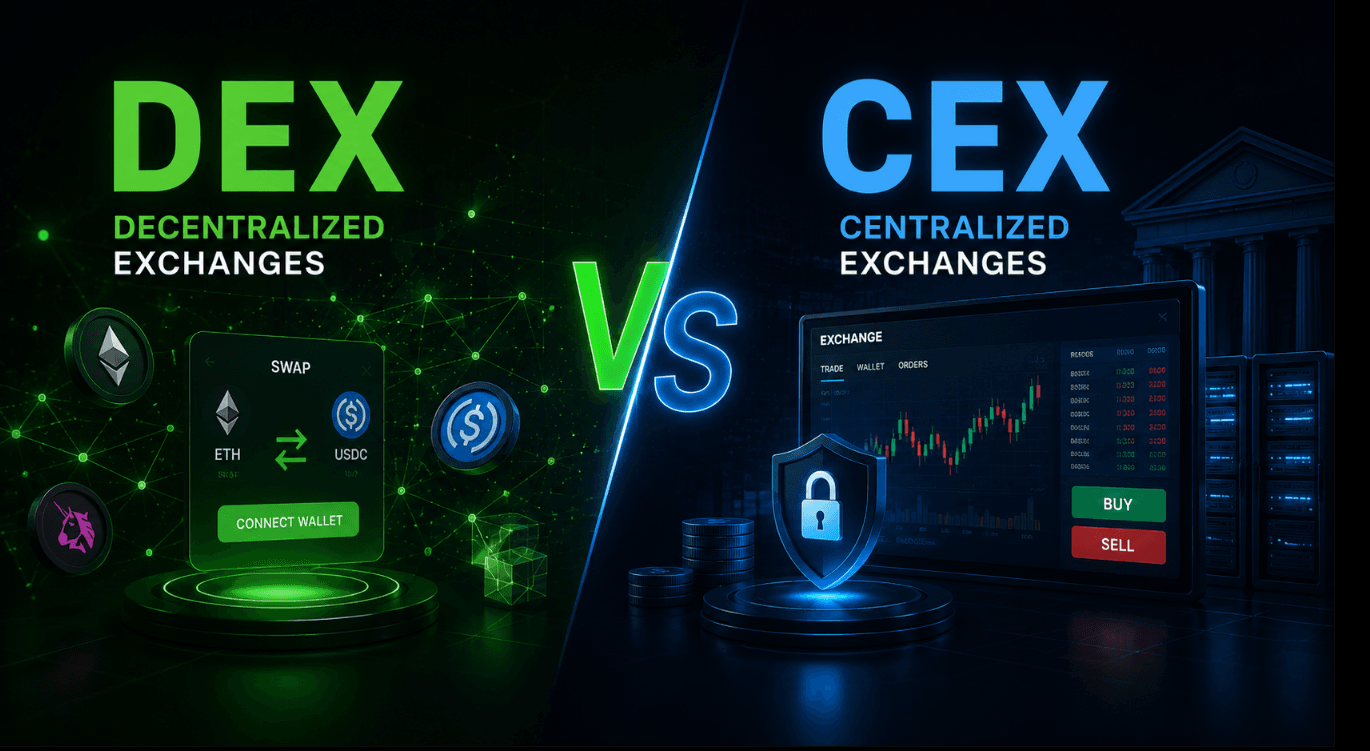
DEX vs CEX: Decentralized vs Centralized Exchanges
Centralized exchanges hold your funds and feel like apps; decentralized exchanges let you trade from your own wallet. Here is how the two compare and when to use each.
Emily Volker · May 26, 2026→
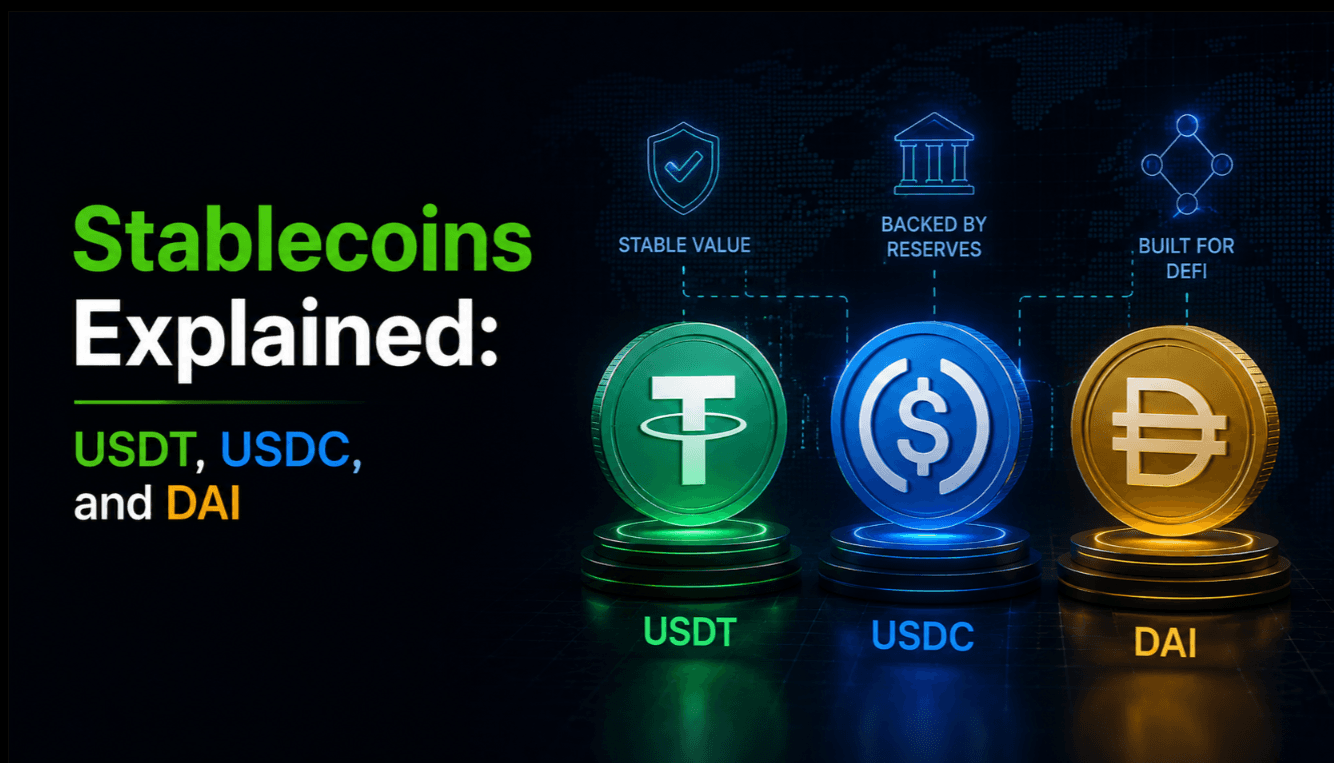
Stablecoins Explained: USDT, USDC, and DAI
Stablecoins aim to hold a steady value, usually one US dollar, so crypto users can move and store money without volatility. Here is how USDT, USDC, and DAI differ.
Olivia Bennett · June 4, 2026→