Proof of Reserves: What It Shows and What It Cannot
Proof of reserves is the standard answer to whether an exchange has your money, and it answers a narrower question than the name implies. Knowing exactly which question it answers is the difference between a useful check and false comfort.

By Olivia Bennett, Blockchain Security Researcher
Smart Contract Security, Audit Reports, Exploits, DeFi Hacks, White-Hat Research
✓ Reviewed by Emily Volker· Editor-in-Chief
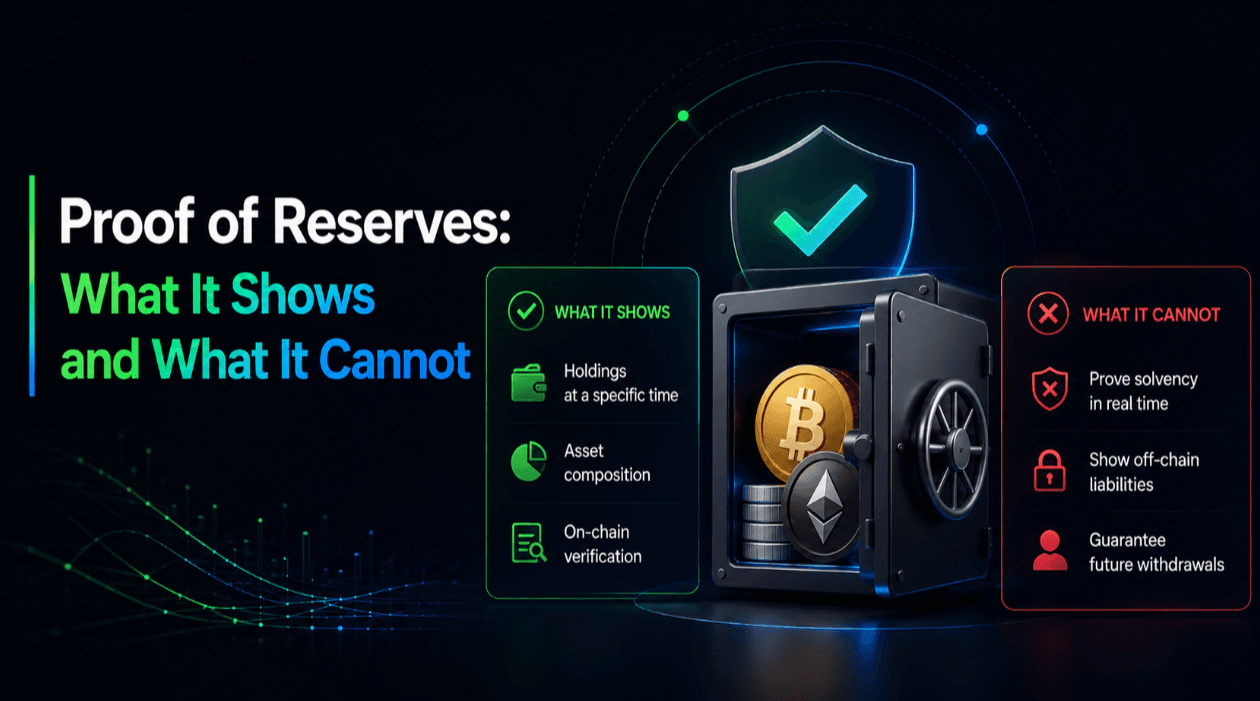
A custodian publishes proof that it controls a stated quantity of assets. That is a real, checkable claim, and it is half of a balance sheet. Solvency requires assets to exceed liabilities, and liabilities — what the custodian owes its customers — are the half that is hard to prove and usually absent.
The assets half, and how it is proven
Demonstrating control of on-chain assets is straightforward: publish the addresses and sign a message from each, proving possession of the keys at a moment in time.
The weaknesses are known. Borrowed assets can be moved in for the snapshot and returned afterwards, so a point-in-time proof shows a moment rather than a state. Repeating the exercise unpredictably raises the cost of that considerably, which is why frequency matters more than any single publication.
And addresses can be shared. Two custodians proving control of the same assets both produce valid proofs, which is why an attestation covering the completeness of the address set — that these are all the addresses and they are exclusively ours — is worth more than the signatures alone.
The liabilities half, and the Merkle approach
Proving what a custodian owes is harder, because it means proving a total over private customer balances without publishing anyone's balance.
The Merkle tree approach solves part of it. Each customer balance is hashed into a tree, the root is published, and every customer receives a proof letting them verify their own balance is included in the total. If enough customers check, the custodian cannot understate the total without being caught by whoever it excluded.
This is a genuine improvement over an accountant's letter, because verification does not require trusting the accountant. It has two gaps.
It relies on customers checking. A published root nobody verifies proves nothing, since an omitted customer only discovers the omission by looking.
And it does not cover off-platform liabilities. Loans taken by the custodian, obligations to counterparties, and money owed to anyone who is not a customer with a balance are outside the tree entirely. A custodian can be fully reserved against customer balances and insolvent because of debts the scheme never touched.
Why the strongest version is still not an audit
The best available arrangement — recurring proof of both halves, verified by customers, with an accountant attesting to address completeness — is materially stronger than a letter. It still is not an audit.
An audit examines financial statements as a whole: liabilities of every kind, related-party transactions, controls, going-concern assessment. Proof of reserves examines one line and a moment. Both are useful; only one of them would have caught the failures people invoke proof of reserves to prevent.
This is why no custodian in our exchange ratings scores at the top of the custody pillar on reserve proof alone, and why a publicly listed company filing audited accounts is treated as a different class of evidence.
Reading a scheme
- Does it cover liabilities as well as assets, or only assets — this is the first question and it eliminates most schemes.
- Can you verify your own balance is included, and have you actually done it.
- How often is it published, and on a predictable schedule or an unpredictable one.
- Does an accountant attest that the address set is complete and exclusive, or only that the addresses hold what is claimed.
- Are off-platform borrowings disclosed anywhere, since they sit outside every proof-of-reserves scheme.
The realistic conclusion is that proof of reserves raises the cost of a specific deception and does not establish solvency. It is worth demanding, worth checking, and worth not mistaking for the thing it is named after.
Sources
2 referencesFrequently asked questions
Does proof of reserves mean an exchange is solvent?+
No. It shows assets exist at a moment in time. Solvency requires assets to exceed liabilities, and most schemes cover only the asset side. A custodian can prove substantial reserves and still be insolvent because of borrowings that no proof-of-reserves scheme touches.
What does a Merkle proof add?+
It lets you verify that your own balance was included in the published total without exposing anyone's balance. That removes the need to trust the accountant who summarised the figures — but only if customers actually check, since an omitted balance is discovered by the person omitted.
Can reserves be faked?+
A single point-in-time proof can be gamed by borrowing assets for the snapshot, and addresses can be shared between entities so two custodians prove the same coins. Frequent, unpredictable publication and an attestation that the address set is complete and exclusive are what raise the cost of both.
Is proof of reserves better than an audit?+
It is different and narrower. An audit examines liabilities of every kind, controls, related-party dealings and going-concern status. Proof of reserves examines one line at one moment. Only the audit would have caught the failures people invoke proof of reserves to prevent.
Written by
Olivia BennettBlockchain Security ResearcherSmart Contract Security, Audit Reports, Exploits, DeFi Hacks, White-Hat Research
Olivia Bennett is the Blockchain Security Researcher at CoinRadar Daily, where she specializes in smart contract security, DeFi risk analysis, blockchain infrastructure, and protocol vulnerabilities. Drawing on years of hands-on cybersecurity experience, she delivers in-depth reporting that explains both the technical details and the real-world implications of security incidents across the digital asset ecosystem. Before joining CoinRadar Daily, Olivia built her career in cybersecurity, working in penetration testing, blockchain security assessments, and smart contract auditing. She participated in numerous security reviews for decentralized applications and blockchain protocols, helping identify critical vulnerabilities before they could be exploited. Her responsible disclosure work has contributed to improving the security of several major DeFi projects and protecting millions of dollars in digital assets. Olivia earned a Bachelor of Science in Computer Science from the University of Edinburgh and later completed advanced professional training in offensive security and blockchain technologies. Her combination of software security expertise and blockchain knowledge enables her to provide readers with clear, evidence-based analysis of exploits, protocol upgrades, and emerging attack vectors. At CoinRadar Daily, Olivia publishes detailed investigations into blockchain exploits, smart contract audits, cross-chain security, wallet protection, and evolving cyber threats affecting the crypto industry. She is particularly committed to translating highly technical research into practical guidance that helps investors, developers, and blockchain users better understand protocol risk and security best practices. Alongside her editorial work, Olivia contributes educational resources covering secure wallet management, decentralized finance security, and blockchain infrastructure. She also participates in industry events and technical discussions focused on strengthening Web3 security standards, supporting CoinRadar Daily's mission to provide accurate, research-driven coverage of the rapidly evolving digital asset landscape.

✓Reviewed & edited by
Emily VolkerEditor-in-ChiefEditorial Strategy, Investigative Journalism, Crypto Media, E-E-A-T Standards
Emily Volker is the Editor-in-Chief of CoinRadar Daily, where she leads a multilingual editorial team covering cryptocurrency markets, blockchain innovation, Web3, and global digital asset regulation across eight languages. With more than a decade of experience in financial and technology journalism, she has played a key role in developing high editorial standards and trusted reporting within the digital asset industry. Emily began her career as a financial journalist reporting on commodities, energy markets, and emerging technologies before discovering Bitcoin and decentralized finance in the early 2010s. She later moved to London to join one of Europe's early blockchain-focused media organizations, where she advanced into senior editorial leadership. Her experience reporting through both the rapid expansion of the 2017 ICO boom and the subsequent market correction reinforced her commitment to fact-based, research-driven journalism in an industry often influenced by speculation. She holds a Master's degree in International Journalism from City, University of London, and has completed executive studies in digital media strategy through the Reuters Institute at Oxford. Emily is a strong advocate for editorial transparency, rigorous verification, and responsible financial reporting. She also helped integrate Google's E-E-A-T principles—Experience, Expertise, Authoritativeness, and Trustworthiness—into the editorial standards followed by CoinRadar Daily. Under her leadership, CoinRadar Daily has expanded into a global cryptocurrency news platform publishing content in eight languages with a network of editors, analysts, and contributors across four continents. Emily oversees investigative reporting, editorial policy, content quality, and fact-checking processes to ensure every article meets the publication's standards for accuracy, credibility, and independence. Alongside her editorial responsibilities, Emily mentors aspiring journalists through digital media initiatives and regularly speaks at international conferences focused on journalism, fintech, blockchain technology, and digital assets, where she discusses responsible reporting, combating misinformation, and the evolving future of financial media.
CoinRadar Daily content is written by named analysts and checked against our editorial standards. Market data is indicative and informational only — nothing here is financial advice.
Markets services, rated
How we score →Independent, rubric-scored tables covering the services this markets coverage keeps running into.
Best Crypto Exchanges
Top rated: Kraken 8.4
Centralised venues that hold your funds while you trade.
6rated →
Best Perpetual DEXs
Top rated: GMX 7.2
On-chain leverage.
4rated →
Best Crypto Trading Tools
Top rated: TradingView 8.5
Terminals, bots, screeners and portfolio trackers.
4rated →
Keep Reading
Risk Management for Crypto Investors: Sizing and Stops
Returns get the attention, but risk management decides who survives. Here is how position sizing, stop-losses, and sensible limits keep you in the game.
James Park · May 19, 2026→

Bull vs Bear Market: The Signals Worth Watching
Telling a bull market from a bear is easy in hindsight and hard in the moment. These are the signals that help you read the broader trend without chasing noise.
Emily Volker · May 26, 2026→
Crypto Market Cap Explained, and Why It Matters
Market cap is the headline number everyone quotes, but few use it correctly. Here is how it is calculated, what it really tells you, and where it can be misleading.
Olivia Bennett · June 1, 2026→