Real Yield and Emissions: Telling Them Apart
Two protocols advertise the same rate. One is distributing money that users paid it. The other is distributing tokens it created for the purpose. Nothing on the interface distinguishes them, and the difference is the whole of the analysis.

By James Park, NFT & Web3 Gaming Analyst
NFTs, Web3 Gaming, GameFi, Digital Collectibles, Creator Economy
✓ Reviewed by Olivia Bennett· Blockchain Security Researcher
A yield figure answers how much you receive. It does not answer where it came from, and in decentralised finance the answer is one of two things with very different futures. Real yield is revenue: someone paid the protocol for something and a share reaches you. Emissions are newly created tokens distributed to attract capital. Both show up as a percentage.
The test
The question that separates them is simple to ask and surprisingly hard to dodge: if the protocol stopped creating new tokens tomorrow, what would this rate be.
For a lending market, the answer is whatever borrowers pay. That number exists independently of any token, and it is real yield.
For a trading venue, it is the share of trading fees routed to liquidity providers. Also real.
For a protocol whose advertised rate is largely a governance token distributed to depositors, the answer is close to nothing. The rate is a marketing budget denominated in equity, and it persists exactly as long as the protocol chooses to spend it.
Why emissions are not simply fake
It would be convenient to treat emissions as worthless, and that is wrong in a specific way.
Emissions are a real transfer. Someone receiving them holds tokens that can be sold, and the person who sells early has genuinely realised value. What is not true is that the value came from outside — it came from existing holders, whose ownership is diluted by exactly the amount distributed.
So emissions are a redistribution from holders to depositors, and their sustainability depends on whether the deposits they attract build something that eventually generates revenue. Used as a bootstrapping mechanism they are a defensible expenditure. Used as a permanent substitute for revenue they are a slow transfer from the patient to the mobile, and the mobile know it.
This is why an emissions-driven rate falls as it succeeds: more capital arrives to share the same fixed distribution, so the per-unit yield declines, which is the opposite of how a revenue-driven rate behaves under growing demand.
How to find the split
Most protocols disclose enough to separate the two, though rarely in one place.
Look for protocol revenue reported separately from token distribution. Serious protocols publish fee revenue, and independent aggregators track it with a documented methodology.
Look at the composition of what actually arrives in your wallet. If the rewards are denominated in the protocol's own token, they are emissions unless the protocol is buying that token on the open market with revenue — which happens and which the protocol will tell you about, at length, because it is a favourable fact.
Look at whether the rate is quoted as a base plus a reward component. That presentation is honest and common: the base is usually real, the reward component usually is not.
What the distinction predicts
The reason to care is that the two behave differently in exactly the situations where the difference is expensive.
In a downturn, revenue falls because activity falls, so real yield declines and is visibly connected to something. Emissions continue on schedule, so the advertised rate can look stable while the token it is paid in falls faster than the yield accrues. Depositors chasing the headline discover the return was denominated in the thing that was falling.
In a competitive market, real yield is defended by the protocol's position — the fees it can charge because users value what it does. Emissions are defended by the treasury, and a competitor with a larger treasury can outbid it. Capital attracted by emissions leaves for the next emissions programme, which is why emissions-led deposits are the least sticky in the market.
Applying it
- Ask what the rate would be with emissions removed, and find that number before depositing.
- Check the denomination of the rewards. Rewards in the protocol's own token are emissions unless revenue is buying them.
- Compare protocol fee revenue to the value of tokens distributed. If the second is much larger, the yield is a marketing budget.
- Treat a stable advertised rate through a downturn as a signal to look harder, not as reassurance.
- Judge stickiness by source. Emissions-led deposits leave when a better programme appears, which affects the liquidity you may be relying on.
None of this argues against depositing into an emissions programme with open eyes. It argues against confusing one for the other, which is what a single percentage figure is very good at helping you do.
Sources
2 references- 01Aave risk parameters
Aave · accessed August 22, 2026
- 02Proof-of-stake rewards and penalties
ethereum.org · accessed August 22, 2026
Frequently asked questions
What is real yield in DeFi?+
Return funded by revenue the protocol actually earned — interest paid by borrowers, trading fees paid by traders — rather than by newly issued tokens. The test is what the rate would be if the protocol stopped creating tokens: whatever remains is real.
Are emissions worthless?+
No, but they are a transfer rather than income. Tokens distributed to depositors dilute existing holders by the same amount, so value moves between participants rather than entering from outside. As a bootstrapping expense that is defensible; as a permanent substitute for revenue it is a transfer from patient holders to mobile capital.
Why does an emissions yield fall as more people deposit?+
Because a fixed distribution is shared among more capital, so the per-unit rate declines. Revenue-driven yield behaves oppositely under growing demand, which makes the direction of travel a useful diagnostic on its own.
How do I find the split?+
Check whether rewards are denominated in the protocol's own token, compare reported fee revenue against the value of tokens distributed, and look for a rate quoted as a base plus a reward component — that presentation usually separates the real part from the emitted part for you.
Written by
James ParkNFT & Web3 Gaming AnalystNFTs, Web3 Gaming, GameFi, Digital Collectibles, Creator Economy
James Park serves as the NFT & Web3 Gaming Analyst at CoinRadar Daily, where he covers the rapidly evolving worlds of blockchain gaming, digital collectibles, metaverse ecosystems, and creator-driven economies. Combining expertise in interactive media with blockchain technology, he analyzes how NFTs and decentralized gaming continue to reshape digital ownership and online communities. James earned a Master of Fine Arts in Digital Media from NYU Tisch School of the Arts, giving him a unique perspective that blends creative storytelling, digital culture, and emerging technology. Rather than viewing NFTs solely through an investment lens, he examines their broader impact on entertainment, gaming, intellectual property, and community engagement. Prior to joining CoinRadar Daily, James reported on the NFT industry and blockchain gaming for several leading digital media outlets, covering the explosive growth of the NFT market, the transition toward utility-focused collections, and the evolution of GameFi. His close relationships with independent developers, digital artists, and gaming communities allow him to identify important industry trends long before they reach mainstream attention. His reporting places particular emphasis on sustainable Web3 game design, token economies, and the long-term viability of blockchain-powered virtual worlds. James has published extensive research analyzing why certain gaming ecosystems thrive while others struggle with inflationary token models, weak player retention, or unsustainable reward structures. His market analysis is frequently referenced by blockchain startups, investors, and game studios evaluating new Web3 projects. Beyond journalism, James actively participates in NFT and decentralized creator communities while following developments in digital art, virtual economies, and next-generation gaming technologies. He also contributes educational content on blockchain gaming and regularly speaks about the future of digital ownership, helping CoinRadar Daily deliver balanced, research-driven coverage at the intersection of technology, gaming, and crypto innovation.

✓Reviewed & edited by
Olivia BennettBlockchain Security ResearcherSmart Contract Security, Audit Reports, Exploits, DeFi Hacks, White-Hat Research
Olivia Bennett is the Blockchain Security Researcher at CoinRadar Daily, where she specializes in smart contract security, DeFi risk analysis, blockchain infrastructure, and protocol vulnerabilities. Drawing on years of hands-on cybersecurity experience, she delivers in-depth reporting that explains both the technical details and the real-world implications of security incidents across the digital asset ecosystem. Before joining CoinRadar Daily, Olivia built her career in cybersecurity, working in penetration testing, blockchain security assessments, and smart contract auditing. She participated in numerous security reviews for decentralized applications and blockchain protocols, helping identify critical vulnerabilities before they could be exploited. Her responsible disclosure work has contributed to improving the security of several major DeFi projects and protecting millions of dollars in digital assets. Olivia earned a Bachelor of Science in Computer Science from the University of Edinburgh and later completed advanced professional training in offensive security and blockchain technologies. Her combination of software security expertise and blockchain knowledge enables her to provide readers with clear, evidence-based analysis of exploits, protocol upgrades, and emerging attack vectors. At CoinRadar Daily, Olivia publishes detailed investigations into blockchain exploits, smart contract audits, cross-chain security, wallet protection, and evolving cyber threats affecting the crypto industry. She is particularly committed to translating highly technical research into practical guidance that helps investors, developers, and blockchain users better understand protocol risk and security best practices. Alongside her editorial work, Olivia contributes educational resources covering secure wallet management, decentralized finance security, and blockchain infrastructure. She also participates in industry events and technical discussions focused on strengthening Web3 security standards, supporting CoinRadar Daily's mission to provide accurate, research-driven coverage of the rapidly evolving digital asset landscape.
CoinRadar Daily content is written by named analysts and checked against our editorial standards. Market data is indicative and informational only — nothing here is financial advice.
DeFi services, rated
How we score →Independent, rubric-scored tables covering the services this defi coverage keeps running into.
Best DeFi Protocols
Top rated: Uniswap Protocol 9.0
The base layer everything else is built on.
4rated →
Best Decentralised Exchanges
Top rated: Uniswap 8.7
Swap venues where you never hand over your keys.
5rated →
Best Crypto Lending Platforms
Top rated: Aave 8.3
Borrow against your holdings, or lend them out.
4rated →
Keep Reading
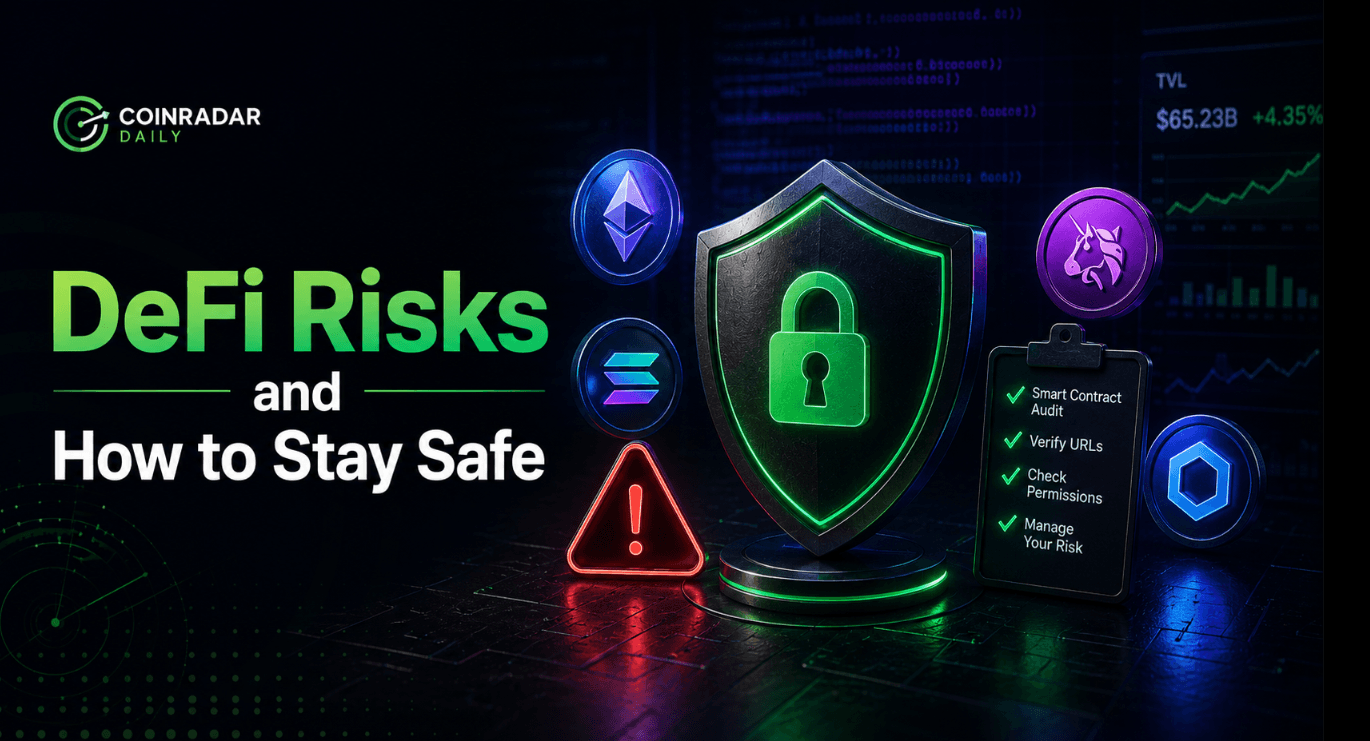
DeFi Risks and How to Stay Safe
DeFi opens powerful financial tools to anyone, but it also removes the safety nets of traditional finance. Here are the main risks and the habits that help you avoid them.
James Park · May 24, 2026→
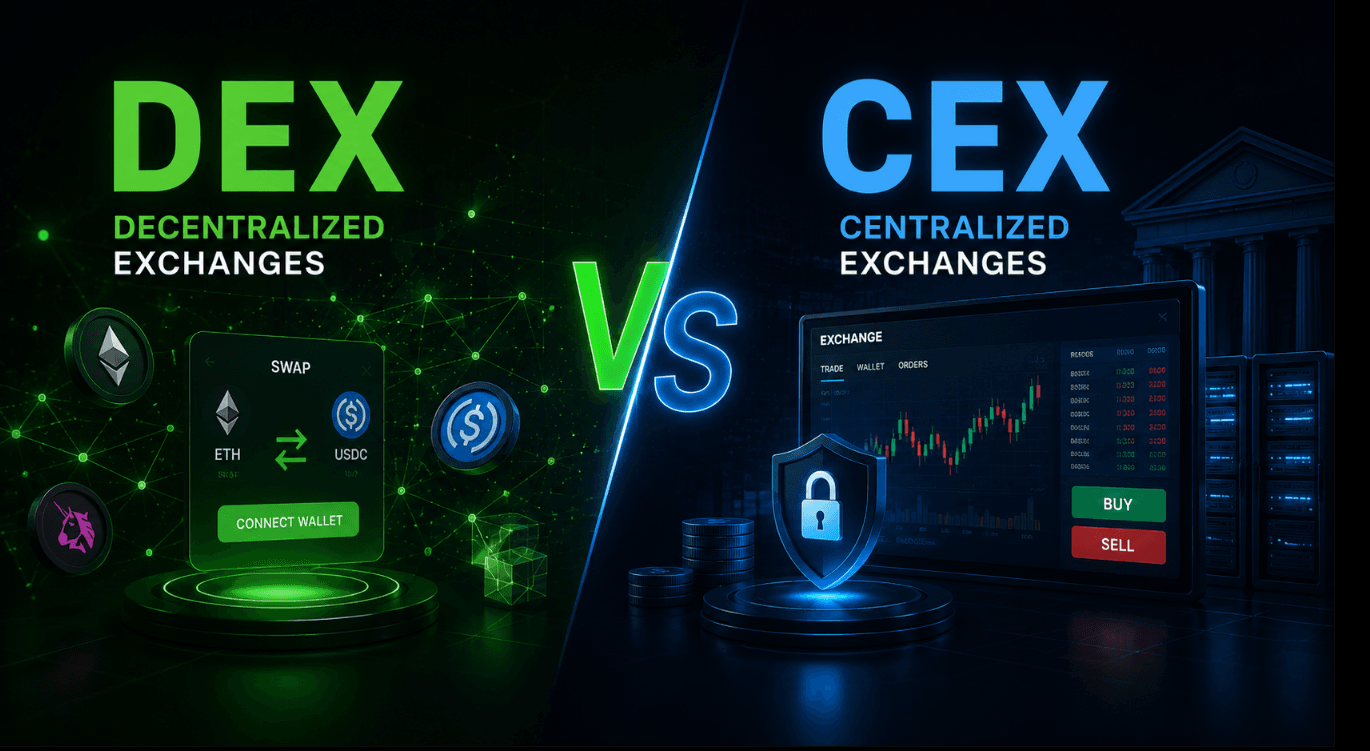
DEX vs CEX: Decentralized vs Centralized Exchanges
Centralized exchanges hold your funds and feel like apps; decentralized exchanges let you trade from your own wallet. Here is how the two compare and when to use each.
Emily Volker · May 26, 2026→
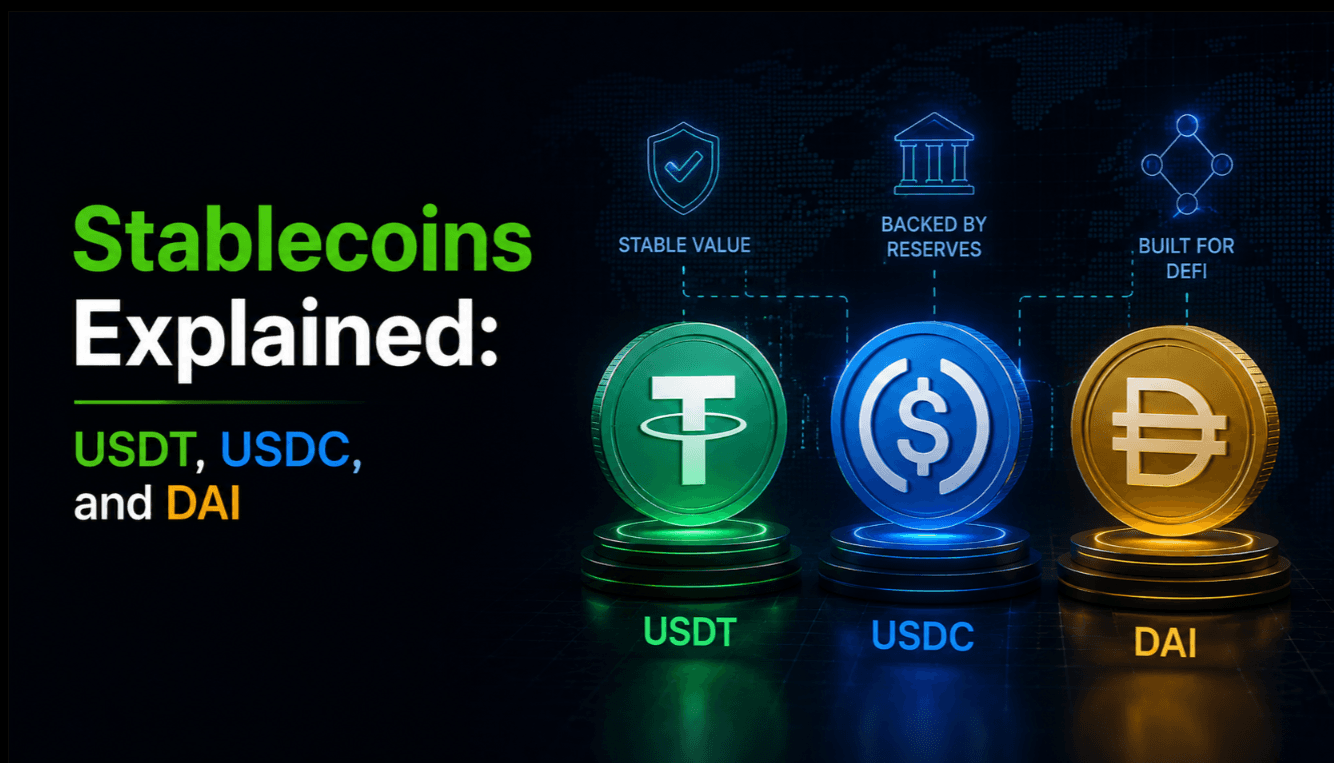
Stablecoins Explained: USDT, USDC, and DAI
Stablecoins aim to hold a steady value, usually one US dollar, so crypto users can move and store money without volatility. Here is how USDT, USDC, and DAI differ.
Olivia Bennett · June 4, 2026→