Freeze Functions: The Censorship Surface of Fiat-Backed Coins
A self-custodied stablecoin can be rendered unspendable without anyone touching your keys. The capability is written into the contract, it is used, and it is the clearest trade in crypto between a redemption guarantee and control of your own money.

By Emily Volker, Editor-in-Chief
Editorial Strategy, Investigative Journalism, Crypto Media, E-E-A-T Standards
✓ Reviewed by James Park· NFT & Web3 Gaming Analyst
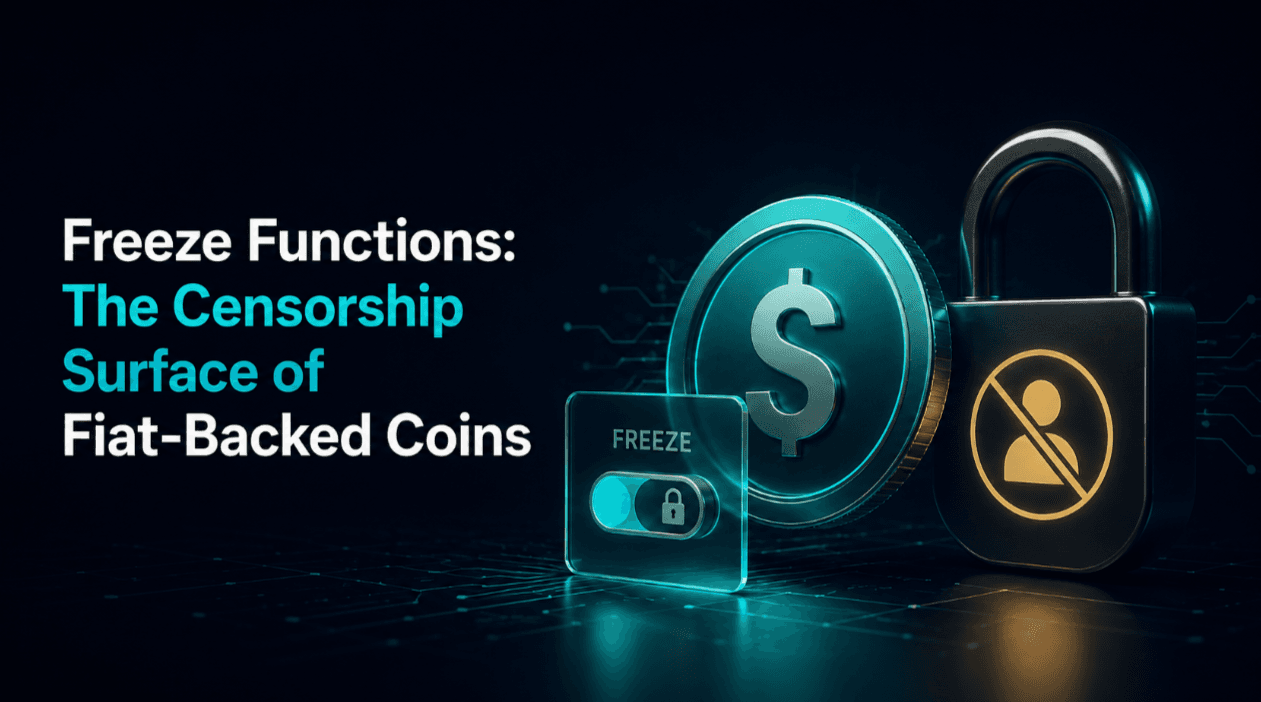
Fiat-backed stablecoin contracts include a function letting the issuer mark an address as blocked, after which tokens at that address cannot be moved. This is not a bug or an emergency backdoor; it is a designed capability, present because the issuer is a regulated entity with obligations that require it.
How it works and what it does not touch
The token balance is a record in the issuer's contract, not something held in your wallet. Your wallet holds a key authorising changes to that record, and the contract can decline to make them.
So a freeze does not compromise your key, does not affect anything else you hold, and does not require access to your device. Your key still works; the ledger stops accepting instructions signed with it for that particular token.
The tokens are not destroyed either. They remain at the address, visible, and can be unblocked. What is removed is the ability to transfer them, which for a spendable instrument is the whole of its usefulness.
Why issuers hold it
A regulated issuer is subject to sanctions regimes and law enforcement orders. Without the ability to act on an address, it would face a choice between non-compliance and not operating. The freeze function is what makes regulated issuance of a bearer-like instrument possible at all.
It is used for sanctions compliance, in response to court orders, and at the request of law enforcement following thefts — where it has recovered stolen funds that would otherwise have been unrecoverable.
That last use is worth stating plainly, because it makes the trade genuinely two-sided. The capability that can freeze an innocent address is the capability that has returned funds to victims.
The exposure that is easy to miss
The obvious concern is being targeted directly. The subtler one is receiving tokens that were previously associated with a blocked address.
Recipients of funds traceable to sanctioned activity have found their own addresses affected, without having done anything themselves. Because chain history is permanent and public, the association travels with the tokens rather than staying with the sender.
There is no reliable way for an ordinary user to screen incoming transfers, which makes this a real if low-probability exposure for anyone receiving payments from parties they do not know.
The choice this presents
Fiat-backed stablecoins offer a redemption promise from a named entity, which is why they hold their peg. That entity is regulated, which is why it can be relied on, and which is why it can freeze.
Decentralised alternatives cannot freeze anyone and cannot promise redemption from an entity either — their backing is collateral and their peg is maintained mechanically. That is a genuine alternative with a genuine cost, complicated by the fact that those systems accept centralised stablecoins as collateral, which reintroduces the freeze capability at one remove.
There is no option that provides both an issuer's redemption guarantee and immunity from that issuer's control. The two properties are the same property viewed from different sides.
- Assume any fiat-backed stablecoin you hold can be frozen, because it can.
- Do not hold long-term savings in an instrument whose issuer can render it unspendable, if that risk matters to you.
- Be aware that receiving funds with problematic history can affect your address, not only the sender's.
- If censorship resistance is the priority, look at collateral-backed alternatives — and check what share of their collateral is itself freezable.
- For operating balances, the freeze risk is generally worth the peg reliability. For a store of value, that calculation differs.
Sources
2 references- 01Stablecoins
ethereum.org · accessed August 22, 2026
- 02Regulation (EU) 2023/1114 on markets in crypto-assets (MiCA)
EUR-Lex · accessed August 22, 2026
Frequently asked questions
Can my stablecoins be frozen even in self-custody?+
Yes. The balance is a record in the issuer's contract, and the contract can decline to process transfers from a marked address. Your key is not compromised and nothing else you hold is affected — the ledger simply stops accepting instructions for that token.
Why do issuers have this capability?+
Because they are regulated entities subject to sanctions regimes and court orders. Without it they would have to choose between non-compliance and not operating. The same function has also recovered stolen funds at the request of law enforcement, which makes the trade genuinely two-sided.
Can I be frozen for receiving tainted funds?+
It has happened. Chain history is permanent and public, so association with sanctioned activity travels with the tokens rather than staying with the sender. There is no reliable way for an ordinary user to screen incoming transfers, which makes it a real if low-probability exposure.
Is there a stablecoin that cannot be frozen?+
Collateral-backed decentralised designs have no freeze function — and no issuer promising redemption either. The catch is that several now hold centralised stablecoins as collateral, which reintroduces the capability at one remove. No instrument offers both a redemption guarantee and immunity from the guarantor.
Written by
Emily VolkerEditor-in-ChiefEditorial Strategy, Investigative Journalism, Crypto Media, E-E-A-T Standards
Emily Volker is the Editor-in-Chief of CoinRadar Daily, where she leads a multilingual editorial team covering cryptocurrency markets, blockchain innovation, Web3, and global digital asset regulation across eight languages. With more than a decade of experience in financial and technology journalism, she has played a key role in developing high editorial standards and trusted reporting within the digital asset industry. Emily began her career as a financial journalist reporting on commodities, energy markets, and emerging technologies before discovering Bitcoin and decentralized finance in the early 2010s. She later moved to London to join one of Europe's early blockchain-focused media organizations, where she advanced into senior editorial leadership. Her experience reporting through both the rapid expansion of the 2017 ICO boom and the subsequent market correction reinforced her commitment to fact-based, research-driven journalism in an industry often influenced by speculation. She holds a Master's degree in International Journalism from City, University of London, and has completed executive studies in digital media strategy through the Reuters Institute at Oxford. Emily is a strong advocate for editorial transparency, rigorous verification, and responsible financial reporting. She also helped integrate Google's E-E-A-T principles—Experience, Expertise, Authoritativeness, and Trustworthiness—into the editorial standards followed by CoinRadar Daily. Under her leadership, CoinRadar Daily has expanded into a global cryptocurrency news platform publishing content in eight languages with a network of editors, analysts, and contributors across four continents. Emily oversees investigative reporting, editorial policy, content quality, and fact-checking processes to ensure every article meets the publication's standards for accuracy, credibility, and independence. Alongside her editorial responsibilities, Emily mentors aspiring journalists through digital media initiatives and regularly speaks at international conferences focused on journalism, fintech, blockchain technology, and digital assets, where she discusses responsible reporting, combating misinformation, and the evolving future of financial media.

✓Reviewed & edited by
James ParkNFT & Web3 Gaming AnalystNFTs, Web3 Gaming, GameFi, Digital Collectibles, Creator Economy
James Park serves as the NFT & Web3 Gaming Analyst at CoinRadar Daily, where he covers the rapidly evolving worlds of blockchain gaming, digital collectibles, metaverse ecosystems, and creator-driven economies. Combining expertise in interactive media with blockchain technology, he analyzes how NFTs and decentralized gaming continue to reshape digital ownership and online communities. James earned a Master of Fine Arts in Digital Media from NYU Tisch School of the Arts, giving him a unique perspective that blends creative storytelling, digital culture, and emerging technology. Rather than viewing NFTs solely through an investment lens, he examines their broader impact on entertainment, gaming, intellectual property, and community engagement. Prior to joining CoinRadar Daily, James reported on the NFT industry and blockchain gaming for several leading digital media outlets, covering the explosive growth of the NFT market, the transition toward utility-focused collections, and the evolution of GameFi. His close relationships with independent developers, digital artists, and gaming communities allow him to identify important industry trends long before they reach mainstream attention. His reporting places particular emphasis on sustainable Web3 game design, token economies, and the long-term viability of blockchain-powered virtual worlds. James has published extensive research analyzing why certain gaming ecosystems thrive while others struggle with inflationary token models, weak player retention, or unsustainable reward structures. His market analysis is frequently referenced by blockchain startups, investors, and game studios evaluating new Web3 projects. Beyond journalism, James actively participates in NFT and decentralized creator communities while following developments in digital art, virtual economies, and next-generation gaming technologies. He also contributes educational content on blockchain gaming and regularly speaks about the future of digital ownership, helping CoinRadar Daily deliver balanced, research-driven coverage at the intersection of technology, gaming, and crypto innovation.
CoinRadar Daily content is written by named analysts and checked against our editorial standards. Market data is indicative and informational only — nothing here is financial advice.
DeFi services, rated
How we score →Independent, rubric-scored tables covering the services this defi coverage keeps running into.
Best DeFi Protocols
Top rated: Uniswap Protocol 8.9
The base layer everything else is built on.
4rated →
Best Decentralised Exchanges
Top rated: Uniswap 8.7
Swap venues where you never hand over your keys.
5rated →
Best Crypto Lending Platforms
Top rated: Aave 8.0
Borrow against your holdings, or lend them out.
4rated →
Keep Reading
DeFi Risks and How to Stay Safe
DeFi opens powerful financial tools to anyone, but it also removes the safety nets of traditional finance. Here are the main risks and the habits that help you avoid them.
James Park · May 24, 2026→
DEX vs CEX: Decentralized vs Centralized Exchanges
Centralized exchanges hold your funds and feel like apps; decentralized exchanges let you trade from your own wallet. Here is how the two compare and when to use each.
Emily Volker · May 26, 2026→
Stablecoins Explained: USDT, USDC, and DAI
Stablecoins aim to hold a steady value, usually one US dollar, so crypto users can move and store money without volatility. Here is how USDT, USDC, and DAI differ.
Olivia Bennett · June 4, 2026→