Exit Queues: The Staking Liquidity You Think You Have
Every proof-of-stake network puts a delay between deciding to unstake and holding the asset again. That delay is not an inconvenience the designers failed to remove; it is load-bearing, and it lengthens under precisely the conditions that make people want to leave.

By Emily Volker, Editor-in-Chief
Editorial Strategy, Investigative Journalism, Crypto Media, E-E-A-T Standards
✓ Reviewed by James Park· NFT & Web3 Gaming Analyst
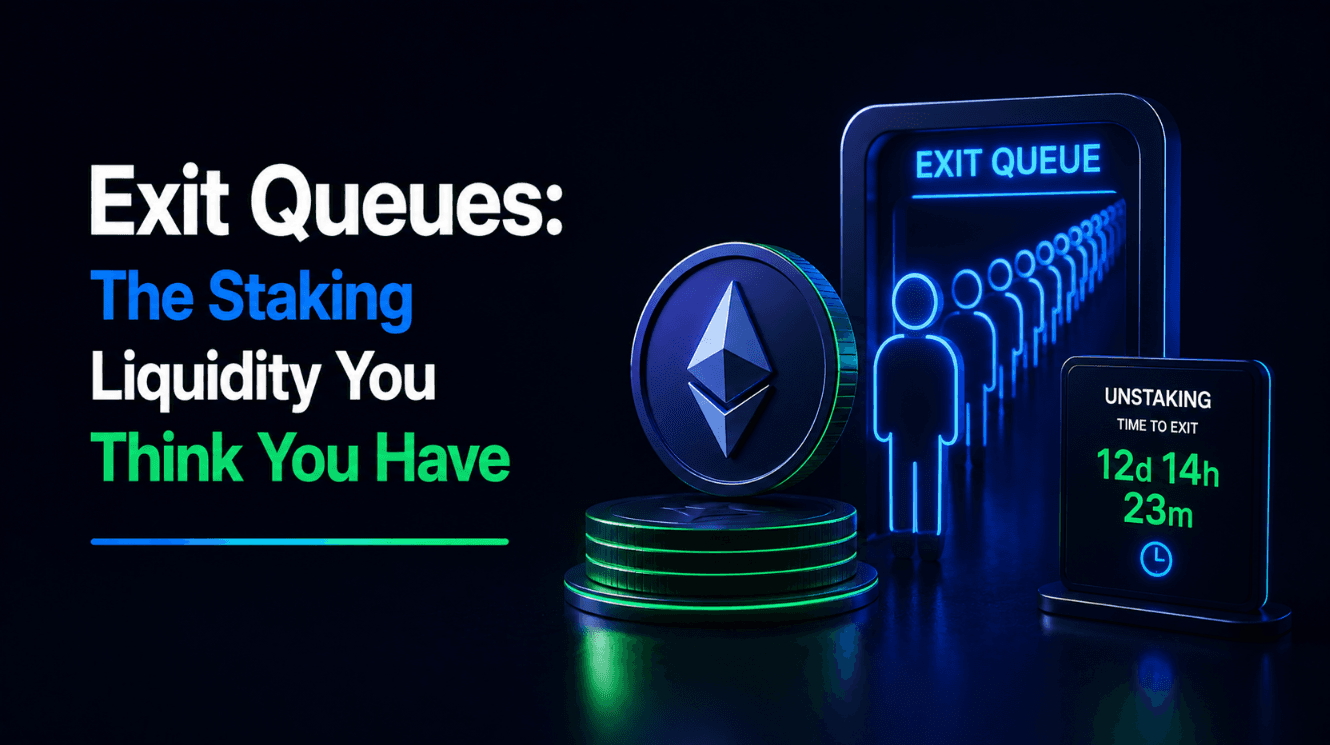
When you unstake, the asset does not come back immediately. Networks impose a waiting period, and on several of them the wait is not fixed — it is a queue whose length depends on how many others are trying to leave at the same time. Both properties are deliberate, and both are routinely discovered by people at the moment they are least welcome.
Why the delay exists at all
Proof of stake secures a network by making misbehaviour expensive. That only works if the stake is still there to be taken when the misbehaviour is discovered. If a validator could attack the chain and withdraw in the same breath, the penalty would be unenforceable and the security model would be decorative.
The exit delay is therefore a window during which the network can still punish you for something it has only just noticed. It is the enforcement mechanism, not a technical limitation, which is why no amount of engineering will shorten it to zero.
A second function is stability. A network that allowed instant mass exit would be vulnerable to a validator set collapsing faster than it could be replaced. Rate-limiting departures keeps the security budget from evaporating in a single session.
Fixed periods and dynamic queues
Two designs are common, and they behave very differently under stress.
A fixed unbonding period is a constant: request an exit and the asset returns after a defined interval regardless of what anyone else is doing. It is predictable, which makes planning simple, and it does not degrade when everybody wants out at once.
A dynamic queue processes a limited number of exits per period. In calm conditions the wait is short. When many validators exit simultaneously, the queue extends, and the extension is precisely correlated with the events that cause people to want out. This is the design property most worth understanding: the queue is shortest when you do not need it and longest when you do.
Networks with dynamic queues generally apply the same rate limiting to entry. That has a subtler consequence — a network cannot rapidly re-secure itself after a mass exit either, which is part of why the limits are set conservatively.
Liquid staking does not remove the queue
Liquid staking is often described as solving this. It does not; it relocates it.
A liquid staking token is a claim on staked capital that you can sell on the open market. Selling it is fast, and the price you get is whatever the secondary market offers. Redeeming it through the protocol still passes through the same exit queue as ordinary unstaking, because the underlying stake is subject to the same rules.
So there are two exits with different properties. Redemption returns the full value and takes as long as the queue takes. Selling is immediate and returns the market price, which under stress is below par — and it is below par precisely because everyone else is also choosing speed over value. The discount is the queue, priced.
This is why secondary market depth matters as much as the redemption mechanism for a liquid staking position. A token with a sound redemption path and a thin market gives you a theoretical exit and a bad practical one.
The failure mode: an exit that is closed rather than slow
There is a worse case than a long queue, and it belongs to protocols built on top of staking rather than to the networks themselves.
If a protocol issues a receipt token before enabling redemptions — during a launch period, for instance — then holders have no protocol exit at all. Their only route out is the secondary market. When a lot of them want out simultaneously, the price of the receipt token can fall far below the value of what it represents, not because the underlying is impaired but because the arbitrage that would normally correct the gap is unavailable. There is no way to buy the cheap token and redeem it for full value if redemption is switched off.
The lesson generalises: before treating a receipt token's peg as a technicality, establish whether redemption is open. A discount with redemption available is a liquidity cost. A discount with redemption closed is an unbounded one.
Planning around it
- Find out whether the network uses a fixed period or a dynamic queue, and treat the published typical wait as a floor rather than an estimate.
- For liquid staking, confirm redemption is open and unrestricted before relying on the peg.
- Size any position you might need quickly against the secondary market, not against the redemption value.
- Remember the queue extends under stress. Plans that assume the calm-market wait are plans for the case where you do not need them.
- Check whether entry is also rate-limited if you intend to re-stake, since the return journey may be slower than the exit.
Staked capital is not liquid capital with an asterisk. It is a different asset with a delay built into its security model, and the delay behaves worst under the conditions that make it matter.
Sources
3 references- 01Staking withdrawals
ethereum.org · accessed August 22, 2026
- 02EIP-7514: Add max epoch churn limit
Ethereum Improvement Proposals · accessed August 22, 2026
- 03Consensus specifications
Ethereum Foundation · accessed August 22, 2026
Frequently asked questions
Why can't I unstake instantly?+
Because the network needs your stake to still be there if it discovers misbehaviour. The exit delay is the window in which a penalty remains enforceable — remove it and slashing becomes unenforceable, which removes the basis of proof-of-stake security. It also rate-limits mass departures so the validator set cannot collapse in one session.
Does liquid staking remove the waiting period?+
No, it gives you a second exit alongside it. Redeeming through the protocol still passes through the queue; selling the receipt token on the secondary market is immediate but returns the market price, which falls below par under exactly the conditions that make people want to sell.
Why do exit queues get longer during market stress?+
Because dynamic queues process a limited number of exits per period, so the wait is a function of how many others are leaving. The events that make people want to unstake are the events that make everyone want to unstake, so the queue is longest exactly when it matters most.
What happens if redemptions are closed?+
The secondary market becomes the only exit, and the arbitrage that normally holds a receipt token near its underlying value stops working — nobody can buy the discounted token and redeem it for full value. That is how a modest exit rush becomes a sharp de-peg, and it is a protocol design question rather than a market one.
Written by
Emily VolkerEditor-in-ChiefEditorial Strategy, Investigative Journalism, Crypto Media, E-E-A-T Standards
Emily Volker is the Editor-in-Chief of CoinRadar Daily, where she leads a multilingual editorial team covering cryptocurrency markets, blockchain innovation, Web3, and global digital asset regulation across eight languages. With more than a decade of experience in financial and technology journalism, she has played a key role in developing high editorial standards and trusted reporting within the digital asset industry. Emily began her career as a financial journalist reporting on commodities, energy markets, and emerging technologies before discovering Bitcoin and decentralized finance in the early 2010s. She later moved to London to join one of Europe's early blockchain-focused media organizations, where she advanced into senior editorial leadership. Her experience reporting through both the rapid expansion of the 2017 ICO boom and the subsequent market correction reinforced her commitment to fact-based, research-driven journalism in an industry often influenced by speculation. She holds a Master's degree in International Journalism from City, University of London, and has completed executive studies in digital media strategy through the Reuters Institute at Oxford. Emily is a strong advocate for editorial transparency, rigorous verification, and responsible financial reporting. She also helped integrate Google's E-E-A-T principles—Experience, Expertise, Authoritativeness, and Trustworthiness—into the editorial standards followed by CoinRadar Daily. Under her leadership, CoinRadar Daily has expanded into a global cryptocurrency news platform publishing content in eight languages with a network of editors, analysts, and contributors across four continents. Emily oversees investigative reporting, editorial policy, content quality, and fact-checking processes to ensure every article meets the publication's standards for accuracy, credibility, and independence. Alongside her editorial responsibilities, Emily mentors aspiring journalists through digital media initiatives and regularly speaks at international conferences focused on journalism, fintech, blockchain technology, and digital assets, where she discusses responsible reporting, combating misinformation, and the evolving future of financial media.

✓Reviewed & edited by
James ParkNFT & Web3 Gaming AnalystNFTs, Web3 Gaming, GameFi, Digital Collectibles, Creator Economy
James Park serves as the NFT & Web3 Gaming Analyst at CoinRadar Daily, where he covers the rapidly evolving worlds of blockchain gaming, digital collectibles, metaverse ecosystems, and creator-driven economies. Combining expertise in interactive media with blockchain technology, he analyzes how NFTs and decentralized gaming continue to reshape digital ownership and online communities. James earned a Master of Fine Arts in Digital Media from NYU Tisch School of the Arts, giving him a unique perspective that blends creative storytelling, digital culture, and emerging technology. Rather than viewing NFTs solely through an investment lens, he examines their broader impact on entertainment, gaming, intellectual property, and community engagement. Prior to joining CoinRadar Daily, James reported on the NFT industry and blockchain gaming for several leading digital media outlets, covering the explosive growth of the NFT market, the transition toward utility-focused collections, and the evolution of GameFi. His close relationships with independent developers, digital artists, and gaming communities allow him to identify important industry trends long before they reach mainstream attention. His reporting places particular emphasis on sustainable Web3 game design, token economies, and the long-term viability of blockchain-powered virtual worlds. James has published extensive research analyzing why certain gaming ecosystems thrive while others struggle with inflationary token models, weak player retention, or unsustainable reward structures. His market analysis is frequently referenced by blockchain startups, investors, and game studios evaluating new Web3 projects. Beyond journalism, James actively participates in NFT and decentralized creator communities while following developments in digital art, virtual economies, and next-generation gaming technologies. He also contributes educational content on blockchain gaming and regularly speaks about the future of digital ownership, helping CoinRadar Daily deliver balanced, research-driven coverage at the intersection of technology, gaming, and crypto innovation.
CoinRadar Daily content is written by named analysts and checked against our editorial standards. Market data is indicative and informational only — nothing here is financial advice.
DeFi services, rated
How we score →Independent, rubric-scored tables covering the services this defi coverage keeps running into.
Best DeFi Protocols
Top rated: Uniswap Protocol 8.9
The base layer everything else is built on.
4rated →
Best Decentralised Exchanges
Top rated: Uniswap 8.7
Swap venues where you never hand over your keys.
5rated →
Best Crypto Lending Platforms
Top rated: Aave 8.0
Borrow against your holdings, or lend them out.
4rated →
Keep Reading
DeFi Risks and How to Stay Safe
DeFi opens powerful financial tools to anyone, but it also removes the safety nets of traditional finance. Here are the main risks and the habits that help you avoid them.
James Park · May 24, 2026→
DEX vs CEX: Decentralized vs Centralized Exchanges
Centralized exchanges hold your funds and feel like apps; decentralized exchanges let you trade from your own wallet. Here is how the two compare and when to use each.
Emily Volker · May 26, 2026→
Stablecoins Explained: USDT, USDC, and DAI
Stablecoins aim to hold a steady value, usually one US dollar, so crypto users can move and store money without volatility. Here is how USDT, USDC, and DAI differ.
Olivia Bennett · June 4, 2026→