Validator Commission: What It Pays For, and What It Does Not
Commission is the single largest controllable variable in staking, it is deducted before you ever see the number, and the range between the cheapest and most expensive route to the same protocol reward is wide enough to dwarf every other decision you make.

By James Park, NFT & Web3 Gaming Analyst
NFTs, Web3 Gaming, GameFi, Digital Collectibles, Creator Economy
✓ Reviewed by Olivia Bennett· Blockchain Security Researcher
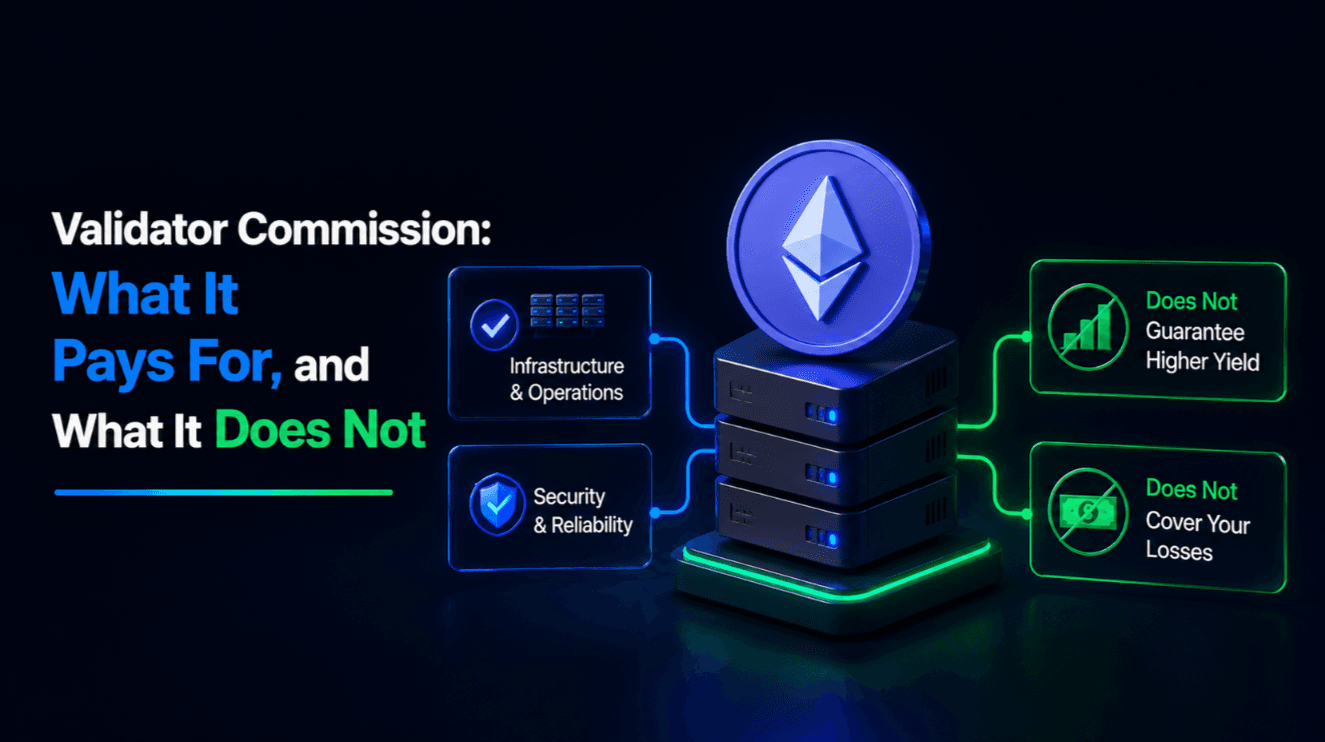
Staking commission is a percentage of your rewards taken by whoever runs the validator. It is deducted before the yield is credited, which means most people never see it as a payment — they see a slightly smaller number and no line item. Over a multi-year hold it is frequently the largest cost of the position, and unlike the protocol reward itself, it is entirely a matter of which provider you chose.
Key takeaways
- Commission is charged on rewards, not on principal, so it compounds against you for as long as you stake.
- The protocol reward is identical for every validator that stays online — commission is what differentiates the outcome.
- Exchange staking programmes generally sit at the expensive end and present the cost least clearly.
- What commission legitimately buys is uptime, key management and, occasionally, an indemnity against slashing.
- An indemnity is worth paying for only if it is written down; almost none are.
Why the compounding matters more than the headline
A commission is quoted as a share of rewards, which makes it sound small next to the size of the position. The framing is misleading in a specific way: the fee applies every reward period, indefinitely, and it applies to the compounding balance if rewards are restaked.
Consider two providers on the same network, one taking a modest share of rewards and one taking several times that. The protocol pays both validators identically. The difference between what reaches you is entirely the commission, it recurs every period, and over a holding period measured in years it accumulates into a meaningful share of everything the position ever earned. Nothing else in the staking decision — not network selection, not timing — is as reliably within your control.
This is why commission deserves more scrutiny than the advertised APR. The APR bundles protocol issuance you cannot change with fee and ordering revenue you can only partly influence. Commission is the one term of the deal that is negotiable by the simple act of choosing somebody else.
What the fee legitimately covers
Running a validator is real operational work. The obligations are continuous rather than occasional: the node must stay online and correctly synced, keys must be held in a way that prevents both loss and unauthorised signing, client software must be updated without introducing the double-signing risk that comes from running two instances of the same key, and someone has to be awake when a network incident happens at an inconvenient hour.
Three things distinguish an operator worth paying: a documented record of uptime through periods when the network itself was under stress, a key management arrangement that does not depend on one person, and a slashing history that is either empty or explained. All three are checkable before you delegate.
A fourth — indemnity against slashing losses — is rare enough to be worth naming separately. Most operators do not offer it, which means a penalty caused by their misconfiguration is absorbed by you. The few that do offer it publish terms, and those terms are the product you are buying with a higher commission.
What it does not cover
Commission does not buy a higher protocol reward. The base issuance is set by rule and paid identically to every validator meeting its duties, so no operator can produce a larger reward from the same stake through skill. Where returns do differ beyond commission, the cause is fee capture and ordering revenue, not superior validation.
It does not buy protection against network-level events. If a protocol changes its issuance schedule or a bug affects a client, no operator's fee shields you from that.
And on custodial platforms it does not buy custody protection either. A commission taken by an exchange is payment for operating the validator; the fact that the exchange also holds your asset is a separate exposure, priced separately, and generally not priced at all.
Custodial and non-custodial, and why the cost differs
Non-custodial delegation leaves the asset with you and delegates only the right to validate. Custodial staking moves the asset to the provider, which then stakes on your behalf. The second is easier, and it is the route most people take because their asset is already sitting on the platform.
Custodial programmes tend to charge more, and the structure of the charge is why it goes unnoticed: the commission is netted off the reward before display, so the user sees a yield figure rather than a fee. A delegated validator charging a fraction of the same rate presents the number the same way, so the comparison requires looking up two published commission rates rather than comparing two displayed yields.
The convenience is real and for small positions it may well be worth the difference. The point is to make that trade deliberately rather than by default, and the arithmetic favours deliberation more the longer you intend to hold.
How to price a staking provider
- Find the published commission rate rather than the displayed yield. One is a term of the deal; the other is an outcome that mixes several variables.
- Confirm whether the rate applies to all reward types or only to base issuance — ordering revenue is sometimes treated separately and retained in full.
- Check for a performance fee stacked on top of commission. Some providers charge both and quote only one.
- Read the slashing terms. If no indemnity is offered, you are the insurer, and that should be reflected in what you are willing to pay.
- Check the operator's uptime and slashing record on-chain rather than on their marketing page. Both are public.
The provider with the lowest commission is not automatically the right choice — an operator with no indemnity, no track record and a thin key management story is cheap for reasons. But the provider with the highest commission is almost never the right choice by default, and default is how most of that business is won.
Sources
2 references- 01Proof-of-stake rewards and penalties
ethereum.org · accessed August 22, 2026
- 02Staking
ethereum.org · accessed August 22, 2026
Frequently asked questions
Is staking commission charged on my principal?+
No. It is charged on rewards. That makes it sound smaller than it is: because it recurs every reward period and applies to a compounding balance, it accumulates over a multi-year hold into a substantial share of everything the position earned.
Why is staking through an exchange usually more expensive?+
Because it is sold on convenience rather than price, and because the fee is netted off rewards before display, so users compare yields rather than commissions. The protocol pays the exchange's validator the same as anyone else's; the difference in what reaches you is the commission.
Can a validator earn me a higher protocol reward?+
Not from base issuance, which is set by rule and paid equally to every validator performing its duties. Differences beyond commission come from transaction fee capture and participation in the market for transaction ordering, not from validating better.
What is slashing indemnity and do I need it?+
It is a written commitment by the operator to cover losses from a slashing penalty caused by their failure. Most operators do not offer one, which means you absorb the loss. It matters in proportion to the size of your position — and it only counts if the terms are published rather than implied.
Written by
James ParkNFT & Web3 Gaming AnalystNFTs, Web3 Gaming, GameFi, Digital Collectibles, Creator Economy
James Park serves as the NFT & Web3 Gaming Analyst at CoinRadar Daily, where he covers the rapidly evolving worlds of blockchain gaming, digital collectibles, metaverse ecosystems, and creator-driven economies. Combining expertise in interactive media with blockchain technology, he analyzes how NFTs and decentralized gaming continue to reshape digital ownership and online communities. James earned a Master of Fine Arts in Digital Media from NYU Tisch School of the Arts, giving him a unique perspective that blends creative storytelling, digital culture, and emerging technology. Rather than viewing NFTs solely through an investment lens, he examines their broader impact on entertainment, gaming, intellectual property, and community engagement. Prior to joining CoinRadar Daily, James reported on the NFT industry and blockchain gaming for several leading digital media outlets, covering the explosive growth of the NFT market, the transition toward utility-focused collections, and the evolution of GameFi. His close relationships with independent developers, digital artists, and gaming communities allow him to identify important industry trends long before they reach mainstream attention. His reporting places particular emphasis on sustainable Web3 game design, token economies, and the long-term viability of blockchain-powered virtual worlds. James has published extensive research analyzing why certain gaming ecosystems thrive while others struggle with inflationary token models, weak player retention, or unsustainable reward structures. His market analysis is frequently referenced by blockchain startups, investors, and game studios evaluating new Web3 projects. Beyond journalism, James actively participates in NFT and decentralized creator communities while following developments in digital art, virtual economies, and next-generation gaming technologies. He also contributes educational content on blockchain gaming and regularly speaks about the future of digital ownership, helping CoinRadar Daily deliver balanced, research-driven coverage at the intersection of technology, gaming, and crypto innovation.

✓Reviewed & edited by
Olivia BennettBlockchain Security ResearcherSmart Contract Security, Audit Reports, Exploits, DeFi Hacks, White-Hat Research
Olivia Bennett is the Blockchain Security Researcher at CoinRadar Daily, where she specializes in smart contract security, DeFi risk analysis, blockchain infrastructure, and protocol vulnerabilities. Drawing on years of hands-on cybersecurity experience, she delivers in-depth reporting that explains both the technical details and the real-world implications of security incidents across the digital asset ecosystem. Before joining CoinRadar Daily, Olivia built her career in cybersecurity, working in penetration testing, blockchain security assessments, and smart contract auditing. She participated in numerous security reviews for decentralized applications and blockchain protocols, helping identify critical vulnerabilities before they could be exploited. Her responsible disclosure work has contributed to improving the security of several major DeFi projects and protecting millions of dollars in digital assets. Olivia earned a Bachelor of Science in Computer Science from the University of Edinburgh and later completed advanced professional training in offensive security and blockchain technologies. Her combination of software security expertise and blockchain knowledge enables her to provide readers with clear, evidence-based analysis of exploits, protocol upgrades, and emerging attack vectors. At CoinRadar Daily, Olivia publishes detailed investigations into blockchain exploits, smart contract audits, cross-chain security, wallet protection, and evolving cyber threats affecting the crypto industry. She is particularly committed to translating highly technical research into practical guidance that helps investors, developers, and blockchain users better understand protocol risk and security best practices. Alongside her editorial work, Olivia contributes educational resources covering secure wallet management, decentralized finance security, and blockchain infrastructure. She also participates in industry events and technical discussions focused on strengthening Web3 security standards, supporting CoinRadar Daily's mission to provide accurate, research-driven coverage of the rapidly evolving digital asset landscape.
CoinRadar Daily content is written by named analysts and checked against our editorial standards. Market data is indicative and informational only — nothing here is financial advice.
DeFi services, rated
How we score →Independent, rubric-scored tables covering the services this defi coverage keeps running into.
Best DeFi Protocols
Top rated: Uniswap Protocol 8.9
The base layer everything else is built on.
4rated →
Best Decentralised Exchanges
Top rated: Uniswap 8.7
Swap venues where you never hand over your keys.
5rated →
Best Crypto Lending Platforms
Top rated: Aave 8.0
Borrow against your holdings, or lend them out.
4rated →
Keep Reading
DeFi Risks and How to Stay Safe
DeFi opens powerful financial tools to anyone, but it also removes the safety nets of traditional finance. Here are the main risks and the habits that help you avoid them.
James Park · May 24, 2026→
DEX vs CEX: Decentralized vs Centralized Exchanges
Centralized exchanges hold your funds and feel like apps; decentralized exchanges let you trade from your own wallet. Here is how the two compare and when to use each.
Emily Volker · May 26, 2026→
Stablecoins Explained: USDT, USDC, and DAI
Stablecoins aim to hold a steady value, usually one US dollar, so crypto users can move and store money without volatility. Here is how USDT, USDC, and DAI differ.
Olivia Bennett · June 4, 2026→