Yield Vaults: What You Underwrite When You Deposit
Depositing into a yield vault outsources a decision, and the thing most depositors miss is which decision. You are not buying a rate; you are underwriting a portfolio you did not select and cannot see, assembled by someone who can change it while your capital is inside.

By James Park, NFT & Web3 Gaming Analyst
NFTs, Web3 Gaming, GameFi, Digital Collectibles, Creator Economy
✓ Reviewed by Olivia Bennett· Blockchain Security Researcher
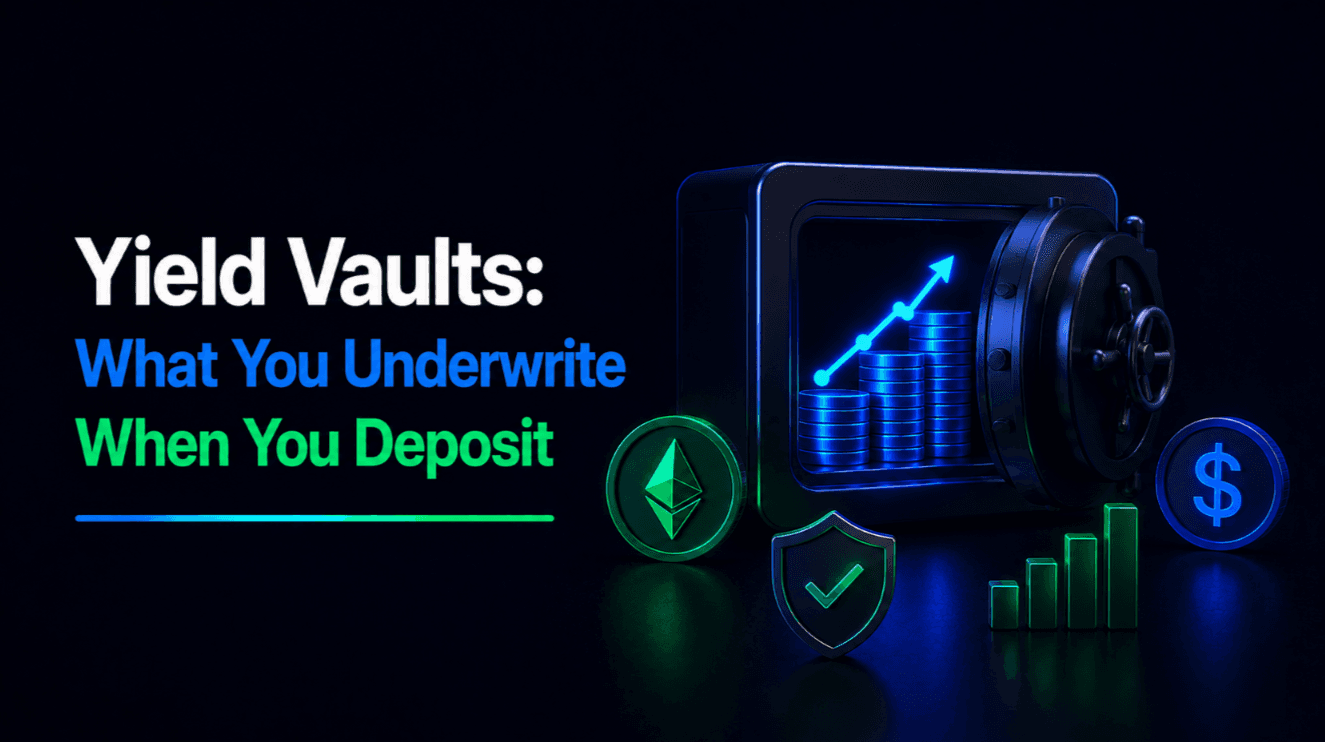
A yield vault takes deposits and routes them through strategies that earn a return, rebalancing as opportunities change. The convenience is genuine: it removes the work of finding, entering and compounding positions. What it does not remove is the risk of those positions, and it adds two of its own — the vault contract itself, and the authority to change the strategy after you are in.
Four layers of exposure
The vault contract is the first. It holds your deposit, and a flaw in it loses the funds regardless of how sound the underlying strategies are.
The strategy contracts are the second: the code that moves capital between venues, each with its own logic and its own bugs.
The underlying protocols are the third, and usually the largest. A vault farming a lending market is exposed to that market's bad debt, its parameters and its governance. A vault across five protocols is exposed to five sets of all of that.
The fourth is the one that gets skipped: the authority to change the strategy. On most vaults, a strategist or governance can redirect capital into protocols you have never assessed, without your consent and without a withdrawal window. You did not underwrite that protocol. Your capital is in it.
On curated lending vaults that authority usually belongs to a curator or risk manager, and those firms have records a depositor can read. Our ranking of DeFi risk managers scores each one on the losses that happened under its mandate and on how it responded.
The composition question
The useful mental model is not a savings account but an actively managed fund with no prospectus. The natural questions follow from that framing.
What does the strategy hold, and can I see it. Some vaults publish current allocations on-chain in a form anyone can read. Others describe the approach and leave the positions opaque. The difference is enormous and rarely reflected in the yield.
Who decides the allocation, and what constrains them. A vault with a published mandate — permitted protocols, maximum concentration, minimum audit standard — is a different instrument from one where a strategist has discretion. Both exist and both are described the same way in the interface.
What is the worst realised drawdown, and how was it handled. A vault that has never lost money has either been well run or been lucky in a benign period, and the way to tell is whether the operator publishes the incidents it has had.
Fees, and why net return is the only number
Vaults charge in two ways and both need to be in the comparison.
A management fee accrues on assets regardless of performance. A performance fee takes a share of the return generated. The second is the larger drag in most cases, and because it applies to the return rather than the balance, it does not appear as a deduction anyone notices.
The comparison that matters is not the vault's advertised rate against another vault's advertised rate. It is the vault's net-of-fee return against the return you would earn holding the underlying position directly, which is the alternative you actually have. On expensive chains, auto-compounding frequently justifies the fee outright because manual compounding costs more in transaction fees than the vault charges. On cheap chains that argument weakens considerably, and what you are paying for is the strategy selection rather than the mechanics.
Where auto-compounding earns its keep
This is worth isolating because it is the one part of the value proposition that is arithmetically checkable.
Compounding a position requires claiming rewards, swapping them and redepositing, each of which costs a transaction fee. Doing this optimally requires knowing the point at which the gain from compounding exceeds the cost, which changes with position size and network conditions. A vault does it across pooled capital, so the fixed cost is shared.
For a small position on a network with meaningful transaction costs, this alone can exceed the vault's fee, and the strategy selection is a free extra. For a large position on a cheap network, the maths inverts and you are paying primarily for convenience.
Before depositing
- List every protocol the strategy touches. If you cannot, you cannot scope the exposure.
- Find out who can change the allocation and whether there is a timelock or a withdrawal window before changes take effect.
- Check whether the vault publishes per-strategy risk assessments rather than only a yield figure.
- Compute the net-of-fee return against holding the underlying directly, including what compounding would cost you manually.
- Look for a record of past losses and how they were handled. Silence is not the same as an unblemished record.
The vaults worth using tend to be the ones that make this analysis easy, because publishing allocations and risk assessments is a choice an operator makes when the answers are defensible. Opacity is rarely an accident of engineering.
Sources
2 references- 01Collateral and borrowing
Compound · accessed September 17, 2026
- 02Liquidation
Compound · accessed September 17, 2026
Frequently asked questions
What am I exposed to when I deposit in a yield vault?+
Four layers: the vault contract holding your funds, the strategy contracts moving them, every underlying protocol the strategy touches, and the authority to change that strategy after you deposit. The last is the one most depositors never consider, and it means your capital can end up in a protocol you never assessed.
Why is the net return lower than the advertised APY?+
Management and performance fees, transaction costs on compounding, and the fact that a headline APY is usually an annualised snapshot of a rate that will not hold. The number worth comparing is net-of-fee return against simply holding the underlying position yourself.
Is auto-compounding worth the fee?+
It depends on position size and network costs. On a network where transactions are expensive, sharing the fixed cost of compounding across pooled capital can save more than the vault charges. On a cheap network with a large position the arithmetic inverts and you are paying mainly for convenience and strategy selection.
Can a vault change its strategy after I deposit?+
On most designs, yes — a strategist or governance can redirect capital without your consent. Whether there is a timelock or a withdrawal window before changes take effect is a specific, checkable property, and it varies enormously between vaults that otherwise look identical.
Written by
James ParkNFT & Web3 Gaming AnalystNFTs, Web3 Gaming, GameFi, Digital Collectibles, Creator Economy
James Park serves as the NFT & Web3 Gaming Analyst at CoinRadar Daily, where he covers the rapidly evolving worlds of blockchain gaming, digital collectibles, metaverse ecosystems, and creator-driven economies. Combining expertise in interactive media with blockchain technology, he analyzes how NFTs and decentralized gaming continue to reshape digital ownership and online communities. James earned a Master of Fine Arts in Digital Media from NYU Tisch School of the Arts, giving him a unique perspective that blends creative storytelling, digital culture, and emerging technology. Rather than viewing NFTs solely through an investment lens, he examines their broader impact on entertainment, gaming, intellectual property, and community engagement. Prior to joining CoinRadar Daily, James reported on the NFT industry and blockchain gaming for several leading digital media outlets, covering the explosive growth of the NFT market, the transition toward utility-focused collections, and the evolution of GameFi. His close relationships with independent developers, digital artists, and gaming communities allow him to identify important industry trends long before they reach mainstream attention. His reporting places particular emphasis on sustainable Web3 game design, token economies, and the long-term viability of blockchain-powered virtual worlds. James has published extensive research analyzing why certain gaming ecosystems thrive while others struggle with inflationary token models, weak player retention, or unsustainable reward structures. His market analysis is frequently referenced by blockchain startups, investors, and game studios evaluating new Web3 projects. Beyond journalism, James actively participates in NFT and decentralized creator communities while following developments in digital art, virtual economies, and next-generation gaming technologies. He also contributes educational content on blockchain gaming and regularly speaks about the future of digital ownership, helping CoinRadar Daily deliver balanced, research-driven coverage at the intersection of technology, gaming, and crypto innovation.

✓Reviewed & edited by
Olivia BennettBlockchain Security ResearcherSmart Contract Security, Audit Reports, Exploits, DeFi Hacks, White-Hat Research
Olivia Bennett is the Blockchain Security Researcher at CoinRadar Daily, where she specializes in smart contract security, DeFi risk analysis, blockchain infrastructure, and protocol vulnerabilities. Drawing on years of hands-on cybersecurity experience, she delivers in-depth reporting that explains both the technical details and the real-world implications of security incidents across the digital asset ecosystem. Before joining CoinRadar Daily, Olivia built her career in cybersecurity, working in penetration testing, blockchain security assessments, and smart contract auditing. She participated in numerous security reviews for decentralized applications and blockchain protocols, helping identify critical vulnerabilities before they could be exploited. Her responsible disclosure work has contributed to improving the security of several major DeFi projects and protecting millions of dollars in digital assets. Olivia earned a Bachelor of Science in Computer Science from the University of Edinburgh and later completed advanced professional training in offensive security and blockchain technologies. Her combination of software security expertise and blockchain knowledge enables her to provide readers with clear, evidence-based analysis of exploits, protocol upgrades, and emerging attack vectors. At CoinRadar Daily, Olivia publishes detailed investigations into blockchain exploits, smart contract audits, cross-chain security, wallet protection, and evolving cyber threats affecting the crypto industry. She is particularly committed to translating highly technical research into practical guidance that helps investors, developers, and blockchain users better understand protocol risk and security best practices. Alongside her editorial work, Olivia contributes educational resources covering secure wallet management, decentralized finance security, and blockchain infrastructure. She also participates in industry events and technical discussions focused on strengthening Web3 security standards, supporting CoinRadar Daily's mission to provide accurate, research-driven coverage of the rapidly evolving digital asset landscape.
CoinRadar Daily content is written by named analysts and checked against our editorial standards. Market data is indicative and informational only — nothing here is financial advice.
DeFi services, rated
How we score →Independent, rubric-scored tables covering the services this defi coverage keeps running into.
Best DeFi Protocols
Top rated: Uniswap Protocol 9.0
The base layer everything else is built on.
4rated →
Best Decentralised Exchanges
Top rated: Uniswap 8.7
Swap venues where you never hand over your keys.
5rated →
Best Crypto Lending Platforms
Top rated: Aave 8.3
Borrow against your holdings, or lend them out.
4rated →
Keep Reading
DeFi Risks and How to Stay Safe
DeFi opens powerful financial tools to anyone, but it also removes the safety nets of traditional finance. Here are the main risks and the habits that help you avoid them.
James Park · May 24, 2026→
DEX vs CEX: Decentralized vs Centralized Exchanges
Centralized exchanges hold your funds and feel like apps; decentralized exchanges let you trade from your own wallet. Here is how the two compare and when to use each.
Emily Volker · May 26, 2026→
Stablecoins Explained: USDT, USDC, and DAI
Stablecoins aim to hold a steady value, usually one US dollar, so crypto users can move and store money without volatility. Here is how USDT, USDC, and DAI differ.
Olivia Bennett · June 4, 2026→