Best Hardware Wallets
Top rated: Trezor Safe 5 8.6
Devices whose only job is to keep a key away from the internet.
5rated →
High-profile platform failures keep reviving the self-custody debate. We explain the trade-offs between holding your own keys and trusting an exchange.

By Olivia Bennett, Blockchain Security Researcher
Smart Contract Security, Audit Reports, Exploits, DeFi Hacks, White-Hat Research
✓ Reviewed by Emily Volker
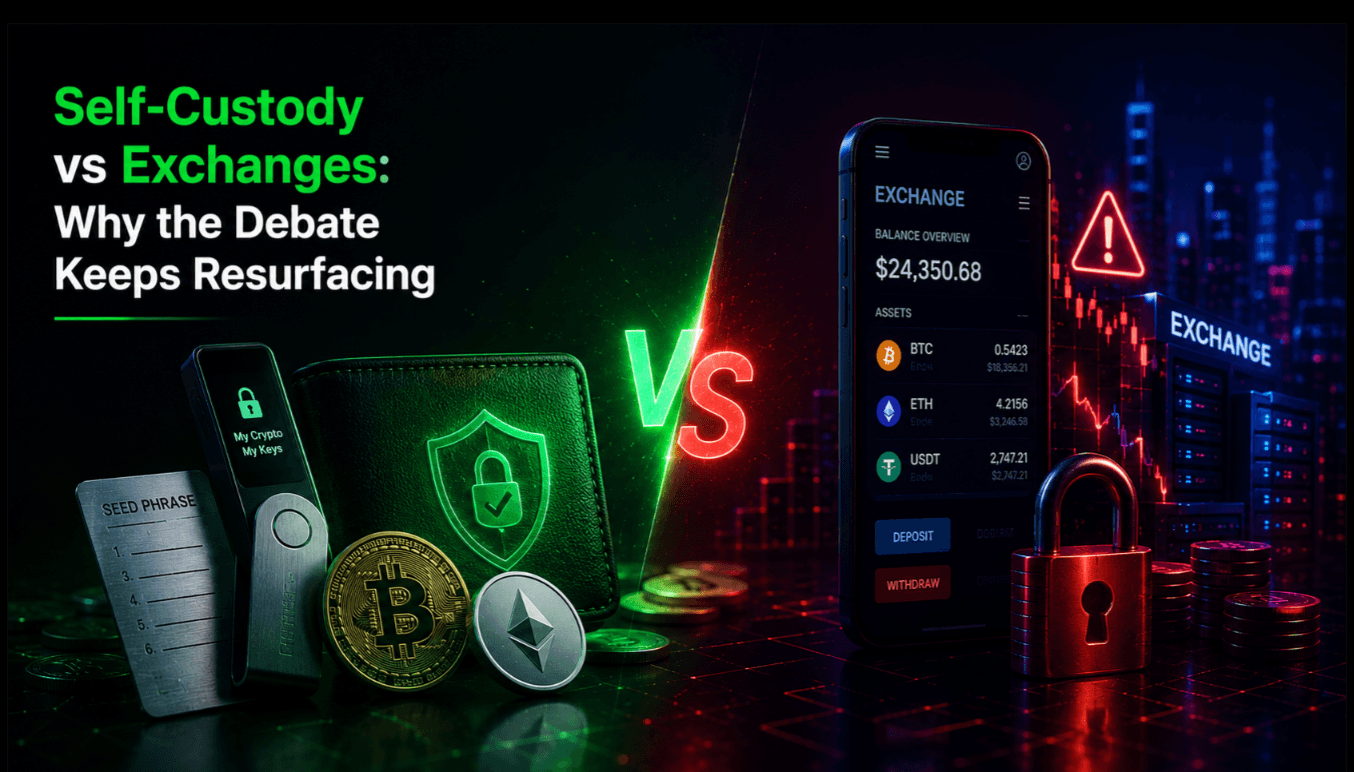
Few debates in Bitcoin resurface as reliably as the question of whether to hold your own keys or leave coins on an exchange. It tends to flare up whenever a custodial platform fails, freezes withdrawals, or suffers a breach, reviving the well-worn phrase not your keys, not your coins. The underlying trade-off has not changed, but each fresh failure pushes more holders to reconsider where their bitcoin actually sits.
The core distinction is who controls the private keys. With a custodial exchange, the platform holds the keys and you hold a balance, much like a bank deposit. It is convenient, easy to recover if you forget a password, and familiar. The cost is dependence: you rely on the platform staying solvent, secure, and accessible. Self-custody removes that dependence by putting the keys in your hands, but it transfers full responsibility to you, including the permanent loss of funds if you misplace your backup.
The debate reignites because the risks on each side are real but very different in shape. Custodial risk is concentrated and occasional: most of the time nothing happens, and then a single platform failure can affect many users at once. Self-custody risk is personal and constant: it depends on your own habits, backups, and discipline rather than a third party's solvency. Neither eliminates risk; they relocate it.
The practical takeaway is less about picking a side and more about matching the method to the amount and time horizon. Small sums actively traded are commonly left on reputable exchanges, while larger, long-term holdings increasingly move to self-custody, often a hardware wallet. As regulation and custody standards evolve, the choice may become less stark, but the fundamental question of who holds the keys is likely to remain at the center of how people think about owning bitcoin.
Written by
Olivia BennettBlockchain Security ResearcherOlivia Bennett is the Blockchain Security Researcher at CoinRadar Daily, where she specializes in smart contract security, DeFi risk analysis, blockchain infrastructure, and protocol vulnerabilities. Drawing on years of hands-on cybersecurity experience, she delivers in-depth reporting that explains both the technical details and the real-world implications of security incidents across the digital asset ecosystem. Before joining CoinRadar Daily, Olivia built her career in cybersecurity, working in penetration testing, blockchain security assessments, and smart contract auditing. She participated in numerous security reviews for decentralized applications and blockchain protocols, helping identify critical vulnerabilities before they could be exploited. Her responsible disclosure work has contributed to improving the security of several major DeFi projects and protecting millions of dollars in digital assets. Olivia earned a Bachelor of Science in Computer Science from the University of Edinburgh and later completed advanced professional training in offensive security and blockchain technologies. Her combination of software security expertise and blockchain knowledge enables her to provide readers with clear, evidence-based analysis of exploits, protocol upgrades, and emerging attack vectors. At CoinRadar Daily, Olivia publishes detailed investigations into blockchain exploits, smart contract audits, cross-chain security, wallet protection, and evolving cyber threats affecting the crypto industry. She is particularly committed to translating highly technical research into practical guidance that helps investors, developers, and blockchain users better understand protocol risk and security best practices. Alongside her editorial work, Olivia contributes educational resources covering secure wallet management, decentralized finance security, and blockchain infrastructure. She also participates in industry events and technical discussions focused on strengthening Web3 security standards, supporting CoinRadar Daily's mission to provide accurate, research-driven coverage of the rapidly evolving digital asset landscape.
✓ Reviewed & edited by Emily Volker
CoinRadar Daily Newsroom · Published June 18, 2026 · Informational, not financial advice.
Independent, rubric-scored tables covering the services this bitcoin coverage keeps running into.
Top rated: Trezor Safe 5 8.6
Devices whose only job is to keep a key away from the internet.
5rated →
Top rated: Rabby 8.4
Software wallets for everyday use.
5rated →
Top rated: Kraken 8.6
Centralised venues that hold your funds while you trade.
6rated →