Air-Gapped Signing: QR, microSD and USB Compared
Every signing device has to receive an unsigned transaction and return a signature. How that data crosses the gap decides what a compromised computer can attempt, and the three common answers differ more than the marketing suggests.

By James Park, NFT & Web3 Gaming Analyst
NFTs, Web3 Gaming, GameFi, Digital Collectibles, Creator Economy
✓ Reviewed by Olivia Bennett· Blockchain Security Researcher
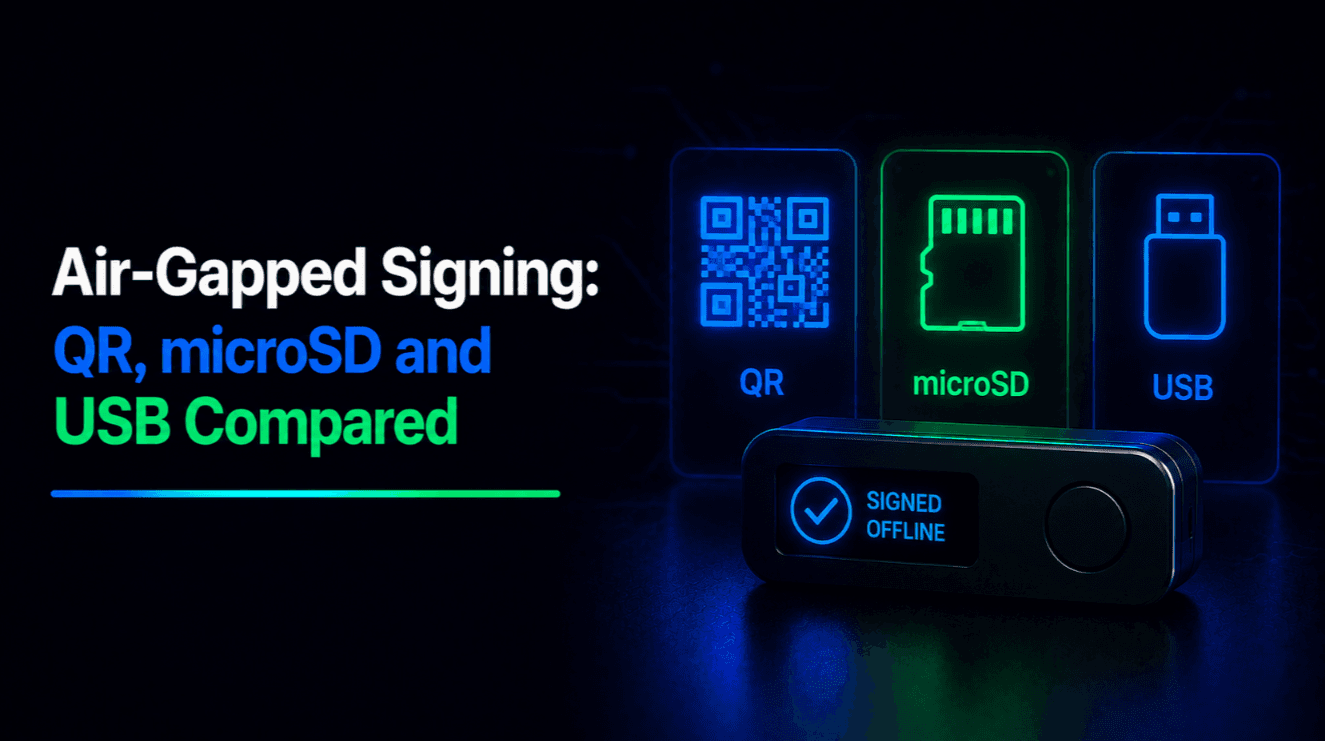
A signing device keeps your key away from an internet-connected machine. But the two still have to communicate: the computer sends a transaction to sign, the device sends back a signature. That channel is the remaining attack surface, and the three common designs — USB cable, microSD card, QR code — expose different amounts of it.
What air-gapped actually means
The term is used loosely. Strictly, it means no electrical or networked connection between the device and any online machine. A cable is a connection. A card carried by hand is not. A camera reading a code is not.
The distinction matters because a connection lets software on the computer address the device directly. Without one, the computer can only produce data that a human physically transports, and the device only ever sees what arrived in that package.
USB: connected, and the difference that makes
USB is the most convenient option and the only one where the host machine can talk to the device. In practice this means firmware updates, address verification and application management all work smoothly, which is why most consumer devices use it.
The exposure is that USB is a rich protocol, and the device's implementation of it is code that processes input from a machine you must assume is hostile. Vulnerabilities in that layer have historically been a productive target, not because the key was reachable but because the parsing was.
The mitigation is the screen. Whatever the host sends, the device displays what it is about to sign, and the user approves on the device. That defence is only as good as the display and the user's habit of reading it — which is why devices with screens too small to show a full address are conceding something real.
microSD: transport by hand, no protocol
With microSD, the computer writes an unsigned transaction file to a card, you move the card to the device, the device signs and writes the result back, and you carry it home. There is no data path at all.
The attack surface shrinks to the file format parser — still code, still processing untrusted input, but far smaller than a USB stack. The card itself is a physical object that could in principle be tampered with, which is a meaningfully different threat model from a remote one.
The cost is friction. Every transaction is a physical round trip, firmware updates arrive the same way, and you need a computer with a card reader. For a device used a few times a year on large amounts, that friction is close to free. For weekly use it is not.
QR: no connection, no removable media
QR signing displays the unsigned transaction as a code on the computer, the device reads it with a camera, and displays the signature as a code the computer reads back. Nothing physical passes between them.
This removes the removable-media question entirely and keeps the parser small — the device processes an image into a known data format and nothing else. It is arguably the cleanest of the three on exposure.
Two practical costs. Large transactions need several codes in sequence, which is slower and occasionally fiddly. And the device needs a decent camera and a large enough screen to display codes reliably, which pushes up the hardware cost.
The screen is the real control
Whichever transport is used, the defence against a compromised computer is the same: the device shows what it is about to sign, and you check it there rather than on the screen that may be lying.
This is why display size is a security property rather than a comfort one. A device that cannot legibly show a destination address, an amount and — for contract interactions — what the call actually does, forces users into approving without reading. At that point the transport barely matters, because the verification step that all three designs rely on has been skipped.
It also means the strongest transport paired with a poor screen is weaker than a cabled device with an excellent one, which is not the ordering the terminology implies.
Choosing
- Infrequent signing on large amounts: air-gapped by microSD or QR. The friction is paid rarely and buys the smallest attack surface.
- Regular signing and multi-chain use: USB, with strict discipline about reading the device screen every time.
- Contract interactions rather than simple transfers: prioritise the largest, clearest display you can get, whatever the transport.
- Any option: confirm the device shows the full destination address, not a truncated version you cannot meaningfully check.
- Any option: assume the computer is compromised when you decide what to verify. That assumption is the reason the device exists.
Sources
2 references- 01BIP-174: Partially Signed Bitcoin Transaction Format
Bitcoin Improvement Proposals · accessed August 22, 2026
- 02Security
ethereum.org · accessed August 22, 2026
Frequently asked questions
Is air-gapped signing meaningfully safer than USB?+
It removes the ability of a compromised computer to address the device directly, which eliminates a class of protocol-parsing attacks. The defence both designs actually rely on is the same — you verify on the device screen — so an air-gapped device with a poor display can be weaker in practice than a cabled one with a clear one.
Can a QR code carry malware to my wallet?+
The device parses the image into a known transaction format and does nothing else with it, so the surface is small — though it is still code processing untrusted input. What a malicious code can attempt is presenting a transaction that is not what you intended, which is exactly what verifying on the device screen catches.
Why does microSD require a physical round trip?+
Because that is the point: there is no data path between the machines, so a human carries the file. The computer writes the unsigned transaction, the device signs and writes back, and you move the card twice. It is the friction that buys the isolation.
Does screen size really matter?+
It is the most underrated property on a signing device. Every design depends on you verifying what you are about to sign on the device rather than on the computer. A screen too small to show a full address or explain a contract call pushes people into approving blind, which removes the defence all three transports rely on.
Written by
James ParkNFT & Web3 Gaming AnalystNFTs, Web3 Gaming, GameFi, Digital Collectibles, Creator Economy
James Park serves as the NFT & Web3 Gaming Analyst at CoinRadar Daily, where he covers the rapidly evolving worlds of blockchain gaming, digital collectibles, metaverse ecosystems, and creator-driven economies. Combining expertise in interactive media with blockchain technology, he analyzes how NFTs and decentralized gaming continue to reshape digital ownership and online communities. James earned a Master of Fine Arts in Digital Media from NYU Tisch School of the Arts, giving him a unique perspective that blends creative storytelling, digital culture, and emerging technology. Rather than viewing NFTs solely through an investment lens, he examines their broader impact on entertainment, gaming, intellectual property, and community engagement. Prior to joining CoinRadar Daily, James reported on the NFT industry and blockchain gaming for several leading digital media outlets, covering the explosive growth of the NFT market, the transition toward utility-focused collections, and the evolution of GameFi. His close relationships with independent developers, digital artists, and gaming communities allow him to identify important industry trends long before they reach mainstream attention. His reporting places particular emphasis on sustainable Web3 game design, token economies, and the long-term viability of blockchain-powered virtual worlds. James has published extensive research analyzing why certain gaming ecosystems thrive while others struggle with inflationary token models, weak player retention, or unsustainable reward structures. His market analysis is frequently referenced by blockchain startups, investors, and game studios evaluating new Web3 projects. Beyond journalism, James actively participates in NFT and decentralized creator communities while following developments in digital art, virtual economies, and next-generation gaming technologies. He also contributes educational content on blockchain gaming and regularly speaks about the future of digital ownership, helping CoinRadar Daily deliver balanced, research-driven coverage at the intersection of technology, gaming, and crypto innovation.

✓Reviewed & edited by
Olivia BennettBlockchain Security ResearcherSmart Contract Security, Audit Reports, Exploits, DeFi Hacks, White-Hat Research
Olivia Bennett is the Blockchain Security Researcher at CoinRadar Daily, where she specializes in smart contract security, DeFi risk analysis, blockchain infrastructure, and protocol vulnerabilities. Drawing on years of hands-on cybersecurity experience, she delivers in-depth reporting that explains both the technical details and the real-world implications of security incidents across the digital asset ecosystem. Before joining CoinRadar Daily, Olivia built her career in cybersecurity, working in penetration testing, blockchain security assessments, and smart contract auditing. She participated in numerous security reviews for decentralized applications and blockchain protocols, helping identify critical vulnerabilities before they could be exploited. Her responsible disclosure work has contributed to improving the security of several major DeFi projects and protecting millions of dollars in digital assets. Olivia earned a Bachelor of Science in Computer Science from the University of Edinburgh and later completed advanced professional training in offensive security and blockchain technologies. Her combination of software security expertise and blockchain knowledge enables her to provide readers with clear, evidence-based analysis of exploits, protocol upgrades, and emerging attack vectors. At CoinRadar Daily, Olivia publishes detailed investigations into blockchain exploits, smart contract audits, cross-chain security, wallet protection, and evolving cyber threats affecting the crypto industry. She is particularly committed to translating highly technical research into practical guidance that helps investors, developers, and blockchain users better understand protocol risk and security best practices. Alongside her editorial work, Olivia contributes educational resources covering secure wallet management, decentralized finance security, and blockchain infrastructure. She also participates in industry events and technical discussions focused on strengthening Web3 security standards, supporting CoinRadar Daily's mission to provide accurate, research-driven coverage of the rapidly evolving digital asset landscape.
CoinRadar Daily content is written by named analysts and checked against our editorial standards. Market data is indicative and informational only — nothing here is financial advice.
Bitcoin services, rated
How we score →Independent, rubric-scored tables covering the services this bitcoin coverage keeps running into.
Best Hardware Wallets
Top rated: Trezor Safe 5 8.6
Devices whose only job is to keep a key away from the internet.
5rated →
Best Crypto Wallets
Top rated: Rabby 8.3
Software wallets for everyday use.
5rated →
Best Crypto Exchanges
Top rated: Kraken 8.4
Centralised venues that hold your funds while you trade.
6rated →
Keep Reading
Bitcoin Self-Custody: Hardware Wallets, Seed Phrases & Security
Self-custody means holding your own keys. Here is how hardware wallets and seed phrases protect Bitcoin, and the security habits that prevent loss.
James Park · May 25, 2026→
What Is a Spot Bitcoin ETF and How Does It Work?
A spot Bitcoin ETF holds actual bitcoin and lets investors gain exposure through a brokerage account. Here is how it works and what you give up.
Emily Volker · June 1, 2026→

Bitcoin vs Gold: Which Is the Better Store of Value?
Bitcoin is often called digital gold, but the two assets store value very differently. Here is how they compare on scarcity, volatility, and risk.
Olivia Bennett · June 5, 2026→