How to Buy Bitcoin Safely: A Beginner's Step-by-Step Guide
Buying Bitcoin safely means using a regulated exchange, verifying your identity, paying through secure methods, and moving your coins into a wallet you control.

By Emily Volker, Editor-in-Chief
Editorial Strategy, Investigative Journalism, Crypto Media, E-E-A-T Standards
✓ Reviewed by James Park· NFT & Web3 Gaming Analyst
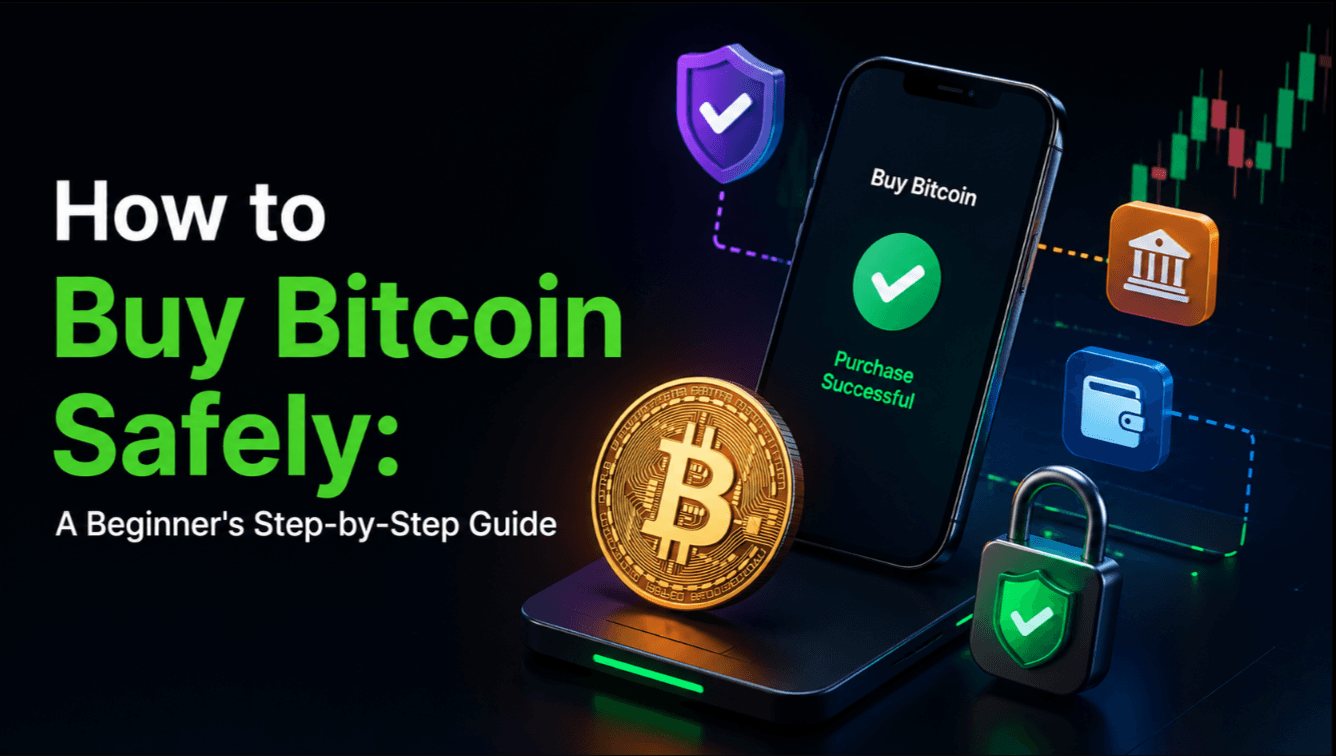
To buy Bitcoin safely, choose a reputable, regulated exchange, complete identity verification, fund your account through a secure payment method, place your order, and then withdraw the coins to a wallet whose keys you control. The most common mistakes beginners make are using unverified platforms, falling for scams that promise guaranteed returns, and leaving large balances on an exchange indefinitely. Getting these basics right protects you from the situations that cause most first-time losses.
Key takeaways
- Use a regulated, well-established exchange rather than an unknown app or a stranger's offer.
- Expect to verify your identity; legitimate platforms are legally required to ask for it.
- Start with a small test amount before committing money you cannot afford to lose.
- Withdraw meaningful holdings to a wallet you control instead of leaving them on the exchange.
- Treat any promise of guaranteed profits or doubled coins as a scam, without exception.
Step one: pick a trustworthy exchange
Your first decision matters most. A cryptocurrency exchange is where you swap regular money for Bitcoin, and the quality of that platform shapes how safe the whole process is. Look for one that is registered or licensed in your country, has operated for several years, publishes clear fee schedules, and is widely reviewed by independent sources. Avoid platforms you discovered through a social media advertisement or a message from someone you do not know.
Be especially cautious of any service that lets you buy without any verification, offers prices that seem too good, or pressures you to act quickly. Those are common features of fraudulent operations rather than legitimate exchanges.
What to compare between platforms
- Regulatory status and the jurisdictions where the platform is permitted to operate.
- Total fees, including trading fees, spreads, and deposit or withdrawal charges.
- Security features such as two-factor authentication and withdrawal address controls.
- Whether you can withdraw your Bitcoin to an external wallet, not just hold it in-app.
Step two: verify your identity
Regulated exchanges follow know-your-customer rules, which means you will be asked for identification, usually a government ID and sometimes a photo. This can feel intrusive, but it is a good sign: platforms that skip it entirely are often operating outside the law and offer you no recourse if something goes wrong. Use the platform's official website or app to upload documents, and never send your ID through a chat message or to a third party who claims they can speed up the process.
Step three: fund your account securely
Once verified, you add money to buy with. Bank transfers and debit cards are the most common options. Bank transfers are usually cheaper, while cards are faster but may carry higher fees. Whichever you choose, make sure you are on the genuine site by checking the web address carefully, and enable two-factor authentication before moving any money. Avoid funding methods you cannot reverse if you later discover the platform was fraudulent.
The safest first purchase is a small one. A test amount teaches you the whole process before any serious money is on the line. — CoinRadar Daily analysis
Step four: place your order
Most beginners use a simple market order, which buys Bitcoin immediately at the current price. You do not need to buy a whole coin; Bitcoin is divisible into tiny fractions, so you can spend a modest, fixed amount of your local currency. Some people prefer to buy a little at regular intervals rather than all at once, a habit known as dollar-cost averaging, which spreads out the price you pay over time and removes the pressure of trying to time the market.
Understanding what you actually paid
After the order fills, check the confirmation. The amount of Bitcoin you receive reflects the market price plus any fees, so the effective cost is slightly higher than the headline price. Knowing this upfront prevents the common surprise of receiving a little less than expected on a first purchase.
Step five: move your Bitcoin somewhere you control
Leaving coins on an exchange is convenient, but it means the platform holds the keys that control your Bitcoin. If you are buying more than a trivial amount or holding for the long term, the safer practice is to withdraw to a wallet you control. A reputable mobile wallet is fine for small sums, while a hardware wallet is the standard choice for larger holdings because it keeps your keys offline and away from internet-based attacks.
- For spending money or small amounts: a well-reviewed mobile wallet app.
- For savings or larger amounts: a hardware wallet kept offline.
- Always send a small test transaction first to confirm the address works before moving everything.
Scams every beginner should recognize
Most people who lose money buying Bitcoin are not hacked through the network; they are tricked. Recognizing the common patterns is one of the most valuable safety skills you can build. Fraudsters often impersonate exchanges, celebrities, or support staff, and they rely on urgency and the fear of missing out to push you into acting before you think.
- Giveaway scams that promise to send back double whatever you send first.
- Fake support agents who ask for your password or recovery phrase.
- Investment platforms guaranteeing fixed daily or weekly returns.
- Romance or friendship contacts who eventually steer you toward an unfamiliar trading app.
Good habits after your first purchase
Safety is ongoing, not a one-time setup. Keep two-factor authentication switched on, use a unique and strong password for your exchange account, and be skeptical of unsolicited messages even when they appear to come from a service you use. If you have moved coins to self-custody, back up your recovery phrase offline and never type it into any website. The discipline of verifying before acting is what separates people who hold Bitcoin safely from those who learn the hard way.
This article is for general information only and is not financial, investment, or tax advice. Bitcoin is volatile and you can lose money; only buy what you can afford to lose and consider a licensed professional before making decisions.
Frequently asked questions
How much Bitcoin should a beginner buy first?+
Start with a small amount you would be comfortable losing entirely, just to learn the process of buying, withdrawing, and storing it. You do not need to buy a whole coin, since Bitcoin is divisible into tiny fractions and you can spend any amount you choose.
Is it safe to leave Bitcoin on an exchange after buying?+
For small amounts and short periods it is generally fine on a reputable exchange. For larger or long-term holdings it is safer to withdraw to a wallet you control, because the exchange holds the keys and could be hacked, freeze withdrawals, or become insolvent.
What is the safest way to pay for Bitcoin?+
Bank transfers from your own verified account on a regulated exchange are usually the safest and cheapest method. Avoid paying through irreversible channels to unknown sellers, and never send money to someone who contacted you first promising guaranteed returns.
Do I have to verify my identity to buy Bitcoin?+
On any regulated exchange, yes. Identity verification is a legal requirement and a sign the platform is legitimate. Services that let you buy with no verification at all often operate outside the law and leave you with no protection if something goes wrong.
Written by
Emily VolkerEditor-in-ChiefEditorial Strategy, Investigative Journalism, Crypto Media, E-E-A-T Standards
Emily Volker is the Editor-in-Chief of CoinRadar Daily, where she leads a multilingual editorial team covering cryptocurrency markets, blockchain innovation, Web3, and global digital asset regulation across eight languages. With more than a decade of experience in financial and technology journalism, she has played a key role in developing high editorial standards and trusted reporting within the digital asset industry. Emily began her career as a financial journalist reporting on commodities, energy markets, and emerging technologies before discovering Bitcoin and decentralized finance in the early 2010s. She later moved to London to join one of Europe's early blockchain-focused media organizations, where she advanced into senior editorial leadership. Her experience reporting through both the rapid expansion of the 2017 ICO boom and the subsequent market correction reinforced her commitment to fact-based, research-driven journalism in an industry often influenced by speculation. She holds a Master's degree in International Journalism from City, University of London, and has completed executive studies in digital media strategy through the Reuters Institute at Oxford. Emily is a strong advocate for editorial transparency, rigorous verification, and responsible financial reporting. She also helped integrate Google's E-E-A-T principles—Experience, Expertise, Authoritativeness, and Trustworthiness—into the editorial standards followed by CoinRadar Daily. Under her leadership, CoinRadar Daily has expanded into a global cryptocurrency news platform publishing content in eight languages with a network of editors, analysts, and contributors across four continents. Emily oversees investigative reporting, editorial policy, content quality, and fact-checking processes to ensure every article meets the publication's standards for accuracy, credibility, and independence. Alongside her editorial responsibilities, Emily mentors aspiring journalists through digital media initiatives and regularly speaks at international conferences focused on journalism, fintech, blockchain technology, and digital assets, where she discusses responsible reporting, combating misinformation, and the evolving future of financial media.

✓Reviewed & edited by
James ParkNFT & Web3 Gaming AnalystNFTs, Web3 Gaming, GameFi, Digital Collectibles, Creator Economy
James Park serves as the NFT & Web3 Gaming Analyst at CoinRadar Daily, where he covers the rapidly evolving worlds of blockchain gaming, digital collectibles, metaverse ecosystems, and creator-driven economies. Combining expertise in interactive media with blockchain technology, he analyzes how NFTs and decentralized gaming continue to reshape digital ownership and online communities. James earned a Master of Fine Arts in Digital Media from NYU Tisch School of the Arts, giving him a unique perspective that blends creative storytelling, digital culture, and emerging technology. Rather than viewing NFTs solely through an investment lens, he examines their broader impact on entertainment, gaming, intellectual property, and community engagement. Prior to joining CoinRadar Daily, James reported on the NFT industry and blockchain gaming for several leading digital media outlets, covering the explosive growth of the NFT market, the transition toward utility-focused collections, and the evolution of GameFi. His close relationships with independent developers, digital artists, and gaming communities allow him to identify important industry trends long before they reach mainstream attention. His reporting places particular emphasis on sustainable Web3 game design, token economies, and the long-term viability of blockchain-powered virtual worlds. James has published extensive research analyzing why certain gaming ecosystems thrive while others struggle with inflationary token models, weak player retention, or unsustainable reward structures. His market analysis is frequently referenced by blockchain startups, investors, and game studios evaluating new Web3 projects. Beyond journalism, James actively participates in NFT and decentralized creator communities while following developments in digital art, virtual economies, and next-generation gaming technologies. He also contributes educational content on blockchain gaming and regularly speaks about the future of digital ownership, helping CoinRadar Daily deliver balanced, research-driven coverage at the intersection of technology, gaming, and crypto innovation.
CoinRadar Daily content is written by named analysts and checked against our editorial standards. Market data is indicative and informational only — nothing here is financial advice.
Bitcoin services, rated
How we score →Independent, rubric-scored tables covering the services this bitcoin coverage keeps running into.
Best Hardware Wallets
Top rated: Trezor Safe 5 8.6
Devices whose only job is to keep a key away from the internet.
5rated →
Best Crypto Wallets
Top rated: Rabby 8.4
Software wallets for everyday use.
5rated →
Best Crypto Exchanges
Top rated: Kraken 8.6
Centralised venues that hold your funds while you trade.
6rated →
Keep Reading
Bitcoin Self-Custody: Hardware Wallets, Seed Phrases & Security
Self-custody means holding your own keys. Here is how hardware wallets and seed phrases protect Bitcoin, and the security habits that prevent loss.
James Park · May 25, 2026→
What Is a Spot Bitcoin ETF and How Does It Work?
A spot Bitcoin ETF holds actual bitcoin and lets investors gain exposure through a brokerage account. Here is how it works and what you give up.
Emily Volker · June 1, 2026→

Bitcoin vs Gold: Which Is the Better Store of Value?
Bitcoin is often called digital gold, but the two assets store value very differently. Here is how they compare on scarcity, volatility, and risk.
Olivia Bennett · June 5, 2026→