Liquidation Engines: Partial, Full and Auction Designs
Every leveraged venue has a mechanism for closing positions that can no longer support themselves. The design of that mechanism decides whether a sharp move costs you your position, part of it, or more than you deposited.

By Emily Volker, Editor-in-Chief
Editorial Strategy, Investigative Journalism, Crypto Media, E-E-A-T Standards
✓ Reviewed by James Park· NFT & Web3 Gaming Analyst
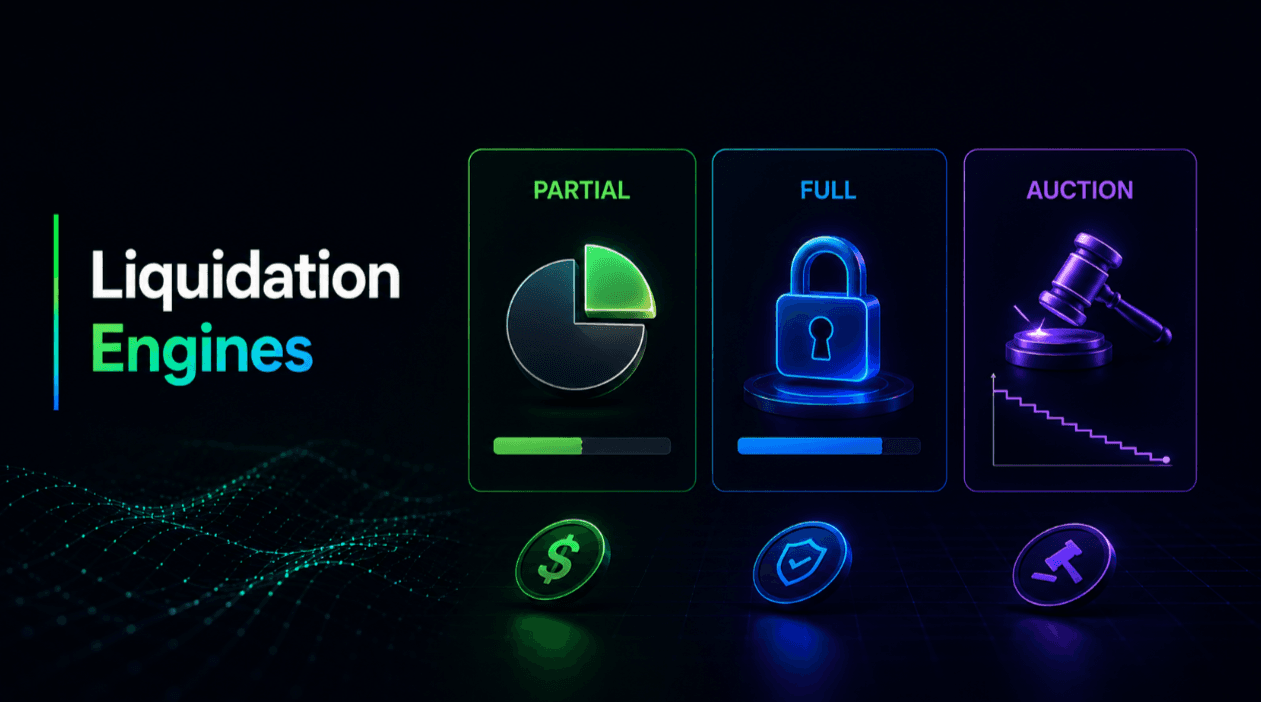
When margin falls below a maintenance level, the venue closes the position rather than allowing a loss it cannot collect. How it does that — how much it closes, at what price, and who takes the other side — is the difference between an orderly loss and a cascade, and between a bad day for one trader and socialised losses for everyone.
Full liquidation
The simplest design closes the entire position the moment it breaches maintenance margin. It is easy to implement, easy to reason about, and it is the harshest for the trader: a brief wick that touches the threshold closes everything, including the portion that would have been fine a minute later.
It is also the most destabilising at market level, because it puts the maximum possible size onto the market at the worst moment. A cluster of positions liquidating fully in the same price band produces exactly the feedback loop that turns a fall into a cascade.
Partial liquidation
A partial engine closes only enough of the position to restore the required margin ratio. The trader keeps a reduced position and can recover if the price does; the market absorbs less selling per liquidation event.
This is better on both counts and harder to build. The engine must calculate the minimum size that restores health, execute it, and re-evaluate — repeatedly, under load, while prices move. Doing that badly produces repeated partial liquidations that cost more in fees and slippage than a single full close would have.
It also fails differently: if the price keeps falling, partial liquidation buys time rather than solving anything, and a position can be whittled down through several rounds to almost nothing. Whether that is better than one clean close is a matter of preference rather than of design quality.
Auction-based liquidation
Rather than executing directly against the market, the engine offers the collateral to third parties who bid to take it on. The winning bidder repays the debt and keeps the collateral, profiting from the discount.
The advantage is that liquidation does not require immediate market depth — a bidder with capital can absorb the position and unwind it at their own pace. That decouples the venue's solvency from momentary liquidity, which is precisely what fails during a cascade.
The dependency is that bidders must show up. An auction with no participants clears at nothing, and the venue takes the loss. The design's most famous failure mode is exactly this: network congestion raising transaction costs so far that bidding was unattractive, auctions clearing at near zero, and the protocol absorbing bad debt it had assumed the auction would prevent.
The parameter that decides everything
Whatever the design, the liquidation incentive — the discount or bonus the liquidator receives — determines whether anyone acts.
Set too low, liquidators do not participate during congestion, when transaction costs rise and the price may move before their transaction confirms. Positions then fall below the value of their debt and the shortfall lands on the venue or its users. Every large bad-debt event in this category traces to liquidation not happening rather than to liquidation happening.
Set too high, the incentive itself accelerates the damage: more value transferred out of borrowers per event, more collateral onto the market than the debt required, and a faster cascade.
The parameter is a judgement made in advance about which failure the venue fears more, and it is tested only under conditions nobody can simulate honestly.
Setting that parameter is the job of a protocol's risk manager, and the results are observable after the fact: our risk manager ranking scores each firm on the liquidation failures that happened on its watch.
Where the shortfall goes
When liquidation fails to cover the debt, someone absorbs the difference, and venues answer this differently.
An insurance fund built from liquidation penalties absorbs it first, which is the cleanest arrangement while the fund holds.
Socialised loss mechanisms spread the shortfall across profitable traders on the other side — meaning a trader who was right can be paid less than they earned because someone else was wrong and the engine could not close them in time.
Protocol reserves and, ultimately, token issuance are the on-chain equivalents. All of these are worth knowing about before they are used, and all of them are published.
- Which design does the venue use, and does it close positions fully or partially.
- What is the liquidation penalty, and is it large enough to attract liquidators when transaction costs spike.
- Where does a shortfall land — an insurance fund, socialised losses, or protocol reserves.
- How large is the insurance fund relative to open interest, which is public on most venues.
- What happened during the last severe drawdown. The record exists and is the only real test.
Sources
2 references- 01Liquidation
Compound · accessed September 17, 2026
- 02Collateral and borrowing
Compound · accessed September 17, 2026
Frequently asked questions
What is the difference between partial and full liquidation?+
Full liquidation closes the entire position when margin breaches maintenance, which is simple and harsh — a brief wick can close everything. Partial liquidation closes only enough to restore the required ratio, leaving a reduced position that can recover and putting less selling onto the market per event.
Why do protocols end up with bad debt?+
Almost always because liquidation did not happen, not because it did. During congestion, transaction costs rise and prices move mid-execution, so liquidators stop participating unless the incentive compensates them. Positions then fall below the value of their debt and the shortfall lands on the venue.
What is a socialised loss?+
A mechanism that spreads a liquidation shortfall across profitable traders on the other side of the market, so a trader who was right receives less than they earned. It is one of several answers to where an uncovered loss goes, alongside insurance funds and protocol reserves, and venues publish which they use.
How do auction-based liquidations fail?+
By attracting no bidders. The design decouples solvency from momentary market depth, which is its strength, but it depends on third parties finding it worth participating. When congestion makes bidding expensive, auctions can clear near zero and the protocol absorbs the debt the auction was meant to prevent.
Written by
Emily VolkerEditor-in-ChiefEditorial Strategy, Investigative Journalism, Crypto Media, E-E-A-T Standards
Emily Volker is the Editor-in-Chief of CoinRadar Daily, where she leads a multilingual editorial team covering cryptocurrency markets, blockchain innovation, Web3, and global digital asset regulation across eight languages. With more than a decade of experience in financial and technology journalism, she has played a key role in developing high editorial standards and trusted reporting within the digital asset industry. Emily began her career as a financial journalist reporting on commodities, energy markets, and emerging technologies before discovering Bitcoin and decentralized finance in the early 2010s. She later moved to London to join one of Europe's early blockchain-focused media organizations, where she advanced into senior editorial leadership. Her experience reporting through both the rapid expansion of the 2017 ICO boom and the subsequent market correction reinforced her commitment to fact-based, research-driven journalism in an industry often influenced by speculation. She holds a Master's degree in International Journalism from City, University of London, and has completed executive studies in digital media strategy through the Reuters Institute at Oxford. Emily is a strong advocate for editorial transparency, rigorous verification, and responsible financial reporting. She also helped integrate Google's E-E-A-T principles—Experience, Expertise, Authoritativeness, and Trustworthiness—into the editorial standards followed by CoinRadar Daily. Under her leadership, CoinRadar Daily has expanded into a global cryptocurrency news platform publishing content in eight languages with a network of editors, analysts, and contributors across four continents. Emily oversees investigative reporting, editorial policy, content quality, and fact-checking processes to ensure every article meets the publication's standards for accuracy, credibility, and independence. Alongside her editorial responsibilities, Emily mentors aspiring journalists through digital media initiatives and regularly speaks at international conferences focused on journalism, fintech, blockchain technology, and digital assets, where she discusses responsible reporting, combating misinformation, and the evolving future of financial media.

✓Reviewed & edited by
James ParkNFT & Web3 Gaming AnalystNFTs, Web3 Gaming, GameFi, Digital Collectibles, Creator Economy
James Park serves as the NFT & Web3 Gaming Analyst at CoinRadar Daily, where he covers the rapidly evolving worlds of blockchain gaming, digital collectibles, metaverse ecosystems, and creator-driven economies. Combining expertise in interactive media with blockchain technology, he analyzes how NFTs and decentralized gaming continue to reshape digital ownership and online communities. James earned a Master of Fine Arts in Digital Media from NYU Tisch School of the Arts, giving him a unique perspective that blends creative storytelling, digital culture, and emerging technology. Rather than viewing NFTs solely through an investment lens, he examines their broader impact on entertainment, gaming, intellectual property, and community engagement. Prior to joining CoinRadar Daily, James reported on the NFT industry and blockchain gaming for several leading digital media outlets, covering the explosive growth of the NFT market, the transition toward utility-focused collections, and the evolution of GameFi. His close relationships with independent developers, digital artists, and gaming communities allow him to identify important industry trends long before they reach mainstream attention. His reporting places particular emphasis on sustainable Web3 game design, token economies, and the long-term viability of blockchain-powered virtual worlds. James has published extensive research analyzing why certain gaming ecosystems thrive while others struggle with inflationary token models, weak player retention, or unsustainable reward structures. His market analysis is frequently referenced by blockchain startups, investors, and game studios evaluating new Web3 projects. Beyond journalism, James actively participates in NFT and decentralized creator communities while following developments in digital art, virtual economies, and next-generation gaming technologies. He also contributes educational content on blockchain gaming and regularly speaks about the future of digital ownership, helping CoinRadar Daily deliver balanced, research-driven coverage at the intersection of technology, gaming, and crypto innovation.
CoinRadar Daily content is written by named analysts and checked against our editorial standards. Market data is indicative and informational only — nothing here is financial advice.
Markets services, rated
How we score →Independent, rubric-scored tables covering the services this markets coverage keeps running into.
Best Crypto Exchanges
Top rated: Kraken 8.4
Centralised venues that hold your funds while you trade.
6rated →
Best Perpetual DEXs
Top rated: GMX 7.2
On-chain leverage.
4rated →
Best Crypto Trading Tools
Top rated: TradingView 8.5
Terminals, bots, screeners and portfolio trackers.
4rated →
Keep Reading

Risk Management for Crypto Investors: Sizing and Stops
Returns get the attention, but risk management decides who survives. Here is how position sizing, stop-losses, and sensible limits keep you in the game.
James Park · May 19, 2026→

Bull vs Bear Market: The Signals Worth Watching
Telling a bull market from a bear is easy in hindsight and hard in the moment. These are the signals that help you read the broader trend without chasing noise.
Emily Volker · May 26, 2026→
Crypto Market Cap Explained, and Why It Matters
Market cap is the headline number everyone quotes, but few use it correctly. Here is how it is calculated, what it really tells you, and where it can be misleading.
Olivia Bennett · June 1, 2026→