Exchange Insurance Funds: How They Are Built and When They Fail
Derivatives venues advertise an insurance fund as though it were deposit protection. It is a buffer against one specific accounting problem, it is funded by the traders it protects, and the number that matters is not its size but its size relative to what could hit it.

By Emily Volker, Editor-in-Chief
Editorial Strategy, Investigative Journalism, Crypto Media, E-E-A-T Standards
✓ Reviewed by James Park· NFT & Web3 Gaming Analyst
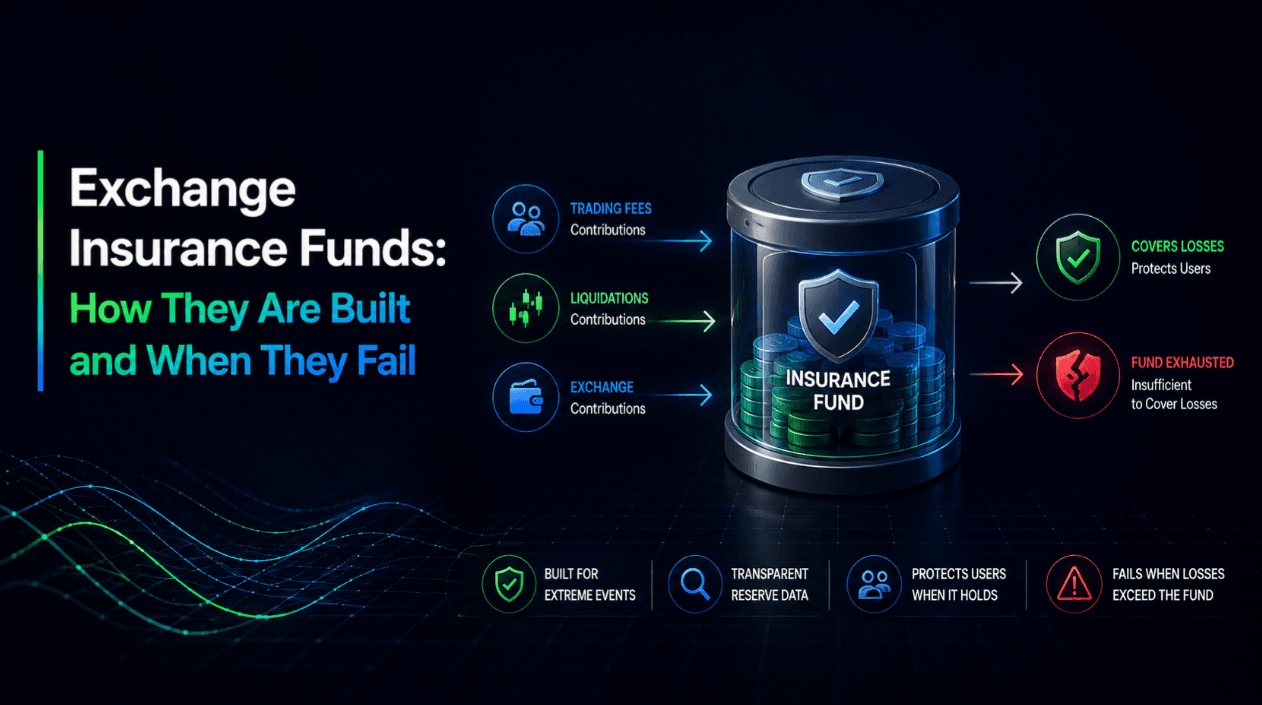
When a leveraged position is closed at a price worse than its bankruptcy price, the loss exceeds the margin posted and someone must cover the difference. The insurance fund exists for that gap. It is not protection against a hack, an insolvency or a withdrawal freeze, and the name invites all three misreadings.
Where the money comes from
The fund is built from liquidations that go well. When a position is closed at a price better than its bankruptcy price, the surplus goes to the fund rather than back to the trader.
So the fund is capitalised by liquidated traders, in aggregate, and it grows during ordinary volatility when liquidations are frequent and orderly. That has an important implication: it is largest after periods that resemble the ones it is meant to survive, and smallest after periods that have already drained it.
Some venues seed it initially and top it up from revenue. Whether they are obliged to is a matter of policy rather than of contract, and policies are revised.
What it does not cover
It does not cover custody failure. Funds stolen in a breach are not a liquidation shortfall, and the insurance fund has nothing to do with them.
It does not cover insolvency. If the venue as a business fails, the insurance fund is an asset of that business, and its status in the resulting proceedings depends entirely on how it is held.
It does not cover a withdrawal freeze, an operational error, or losses from a venue's own trading.
And it is not insurance in the regulated sense. There is no insurer, no policy, no regulator supervising reserves against claims. It is a balance the venue maintains and describes.
What happens when it empties
The fallback is the part worth reading in advance, and venues differ.
Auto-deleveraging closes profitable positions on the opposite side to absorb the shortfall, ranked by profit and leverage. A trader who was correct has their position closed early and at a price they did not choose — the loss is transferred to the people who were right.
Socialised loss spreads the shortfall proportionally across profitable accounts, so gains are reduced rather than positions closed.
Both mean the same thing for a trader: being right is not sufficient, because the venue's ability to pay you depends on the losing side having been closed successfully. That is a counterparty exposure most participants never price.
Sizing it honestly
The published figure is meaningless in isolation. A large fund on a venue with enormous open interest may be thinner than a small fund on a quiet one.
The comparison worth making is the fund against open interest, and specifically against open interest in the most volatile contracts at the highest leverage tiers, which is where shortfalls originate. Both numbers are usually public.
The second comparison is the fund's trajectory. A fund growing steadily through ordinary conditions is functioning. One that fell sharply during the last dislocation and has not recovered is telling you what the next one will do.
- Compare fund size to open interest rather than reading it as an absolute number.
- Find the historical chart. A single drawdown reveals more than the current balance.
- Read the fallback mechanism — auto-deleveraging or socialised loss — before you need to know it.
- Check whether the venue is contractually obliged to replenish the fund or merely says it does.
- Remember it covers liquidation shortfalls only. Custody, insolvency and freezes are separate exposures with separate answers.
Used properly it is a genuine risk signal, because it is one of very few figures a derivatives venue publishes that maps directly onto whether it can pay you.
Sources
2 references- 01Liquidation
Compound · accessed September 17, 2026
- 02Collateral and borrowing
Compound · accessed September 17, 2026
Frequently asked questions
What does an exchange insurance fund actually cover?+
Liquidation shortfalls — the gap when a position is closed at a price worse than its bankruptcy price and the loss exceeds the margin posted. It does not cover hacks, insolvency, withdrawal freezes or operational errors, despite a name that suggests broader protection.
Where does the money come from?+
From liquidations that close better than the bankruptcy price, where the surplus goes to the fund rather than back to the trader. It is capitalised by liquidated traders in aggregate, which means it grows during ordinary volatility and is smallest immediately after the events it exists for.
What happens if the fund runs out?+
The venue falls back to auto-deleveraging, which closes profitable positions on the other side, or to socialised loss, which reduces profitable accounts proportionally. Either way the shortfall is transferred to traders who were right — a counterparty exposure most participants never price.
How do I judge whether a fund is big enough?+
Compare it to open interest rather than reading the absolute figure, and look specifically at the most volatile contracts at high leverage where shortfalls originate. Then look at its history: a fund that fell sharply in the last dislocation and has not recovered is a forecast.
Written by
Emily VolkerEditor-in-ChiefEditorial Strategy, Investigative Journalism, Crypto Media, E-E-A-T Standards
Emily Volker is the Editor-in-Chief of CoinRadar Daily, where she leads a multilingual editorial team covering cryptocurrency markets, blockchain innovation, Web3, and global digital asset regulation across eight languages. With more than a decade of experience in financial and technology journalism, she has played a key role in developing high editorial standards and trusted reporting within the digital asset industry. Emily began her career as a financial journalist reporting on commodities, energy markets, and emerging technologies before discovering Bitcoin and decentralized finance in the early 2010s. She later moved to London to join one of Europe's early blockchain-focused media organizations, where she advanced into senior editorial leadership. Her experience reporting through both the rapid expansion of the 2017 ICO boom and the subsequent market correction reinforced her commitment to fact-based, research-driven journalism in an industry often influenced by speculation. She holds a Master's degree in International Journalism from City, University of London, and has completed executive studies in digital media strategy through the Reuters Institute at Oxford. Emily is a strong advocate for editorial transparency, rigorous verification, and responsible financial reporting. She also helped integrate Google's E-E-A-T principles—Experience, Expertise, Authoritativeness, and Trustworthiness—into the editorial standards followed by CoinRadar Daily. Under her leadership, CoinRadar Daily has expanded into a global cryptocurrency news platform publishing content in eight languages with a network of editors, analysts, and contributors across four continents. Emily oversees investigative reporting, editorial policy, content quality, and fact-checking processes to ensure every article meets the publication's standards for accuracy, credibility, and independence. Alongside her editorial responsibilities, Emily mentors aspiring journalists through digital media initiatives and regularly speaks at international conferences focused on journalism, fintech, blockchain technology, and digital assets, where she discusses responsible reporting, combating misinformation, and the evolving future of financial media.

✓Reviewed & edited by
James ParkNFT & Web3 Gaming AnalystNFTs, Web3 Gaming, GameFi, Digital Collectibles, Creator Economy
James Park serves as the NFT & Web3 Gaming Analyst at CoinRadar Daily, where he covers the rapidly evolving worlds of blockchain gaming, digital collectibles, metaverse ecosystems, and creator-driven economies. Combining expertise in interactive media with blockchain technology, he analyzes how NFTs and decentralized gaming continue to reshape digital ownership and online communities. James earned a Master of Fine Arts in Digital Media from NYU Tisch School of the Arts, giving him a unique perspective that blends creative storytelling, digital culture, and emerging technology. Rather than viewing NFTs solely through an investment lens, he examines their broader impact on entertainment, gaming, intellectual property, and community engagement. Prior to joining CoinRadar Daily, James reported on the NFT industry and blockchain gaming for several leading digital media outlets, covering the explosive growth of the NFT market, the transition toward utility-focused collections, and the evolution of GameFi. His close relationships with independent developers, digital artists, and gaming communities allow him to identify important industry trends long before they reach mainstream attention. His reporting places particular emphasis on sustainable Web3 game design, token economies, and the long-term viability of blockchain-powered virtual worlds. James has published extensive research analyzing why certain gaming ecosystems thrive while others struggle with inflationary token models, weak player retention, or unsustainable reward structures. His market analysis is frequently referenced by blockchain startups, investors, and game studios evaluating new Web3 projects. Beyond journalism, James actively participates in NFT and decentralized creator communities while following developments in digital art, virtual economies, and next-generation gaming technologies. He also contributes educational content on blockchain gaming and regularly speaks about the future of digital ownership, helping CoinRadar Daily deliver balanced, research-driven coverage at the intersection of technology, gaming, and crypto innovation.
CoinRadar Daily content is written by named analysts and checked against our editorial standards. Market data is indicative and informational only — nothing here is financial advice.
Markets services, rated
How we score →Independent, rubric-scored tables covering the services this markets coverage keeps running into.
Best Crypto Exchanges
Top rated: Kraken 8.4
Centralised venues that hold your funds while you trade.
6rated →
Best Perpetual DEXs
Top rated: GMX 7.2
On-chain leverage.
4rated →
Best Crypto Trading Tools
Top rated: TradingView 8.5
Terminals, bots, screeners and portfolio trackers.
4rated →
Keep Reading
Risk Management for Crypto Investors: Sizing and Stops
Returns get the attention, but risk management decides who survives. Here is how position sizing, stop-losses, and sensible limits keep you in the game.
James Park · May 19, 2026→
Bull vs Bear Market: The Signals Worth Watching
Telling a bull market from a bear is easy in hindsight and hard in the moment. These are the signals that help you read the broader trend without chasing noise.
Emily Volker · May 26, 2026→
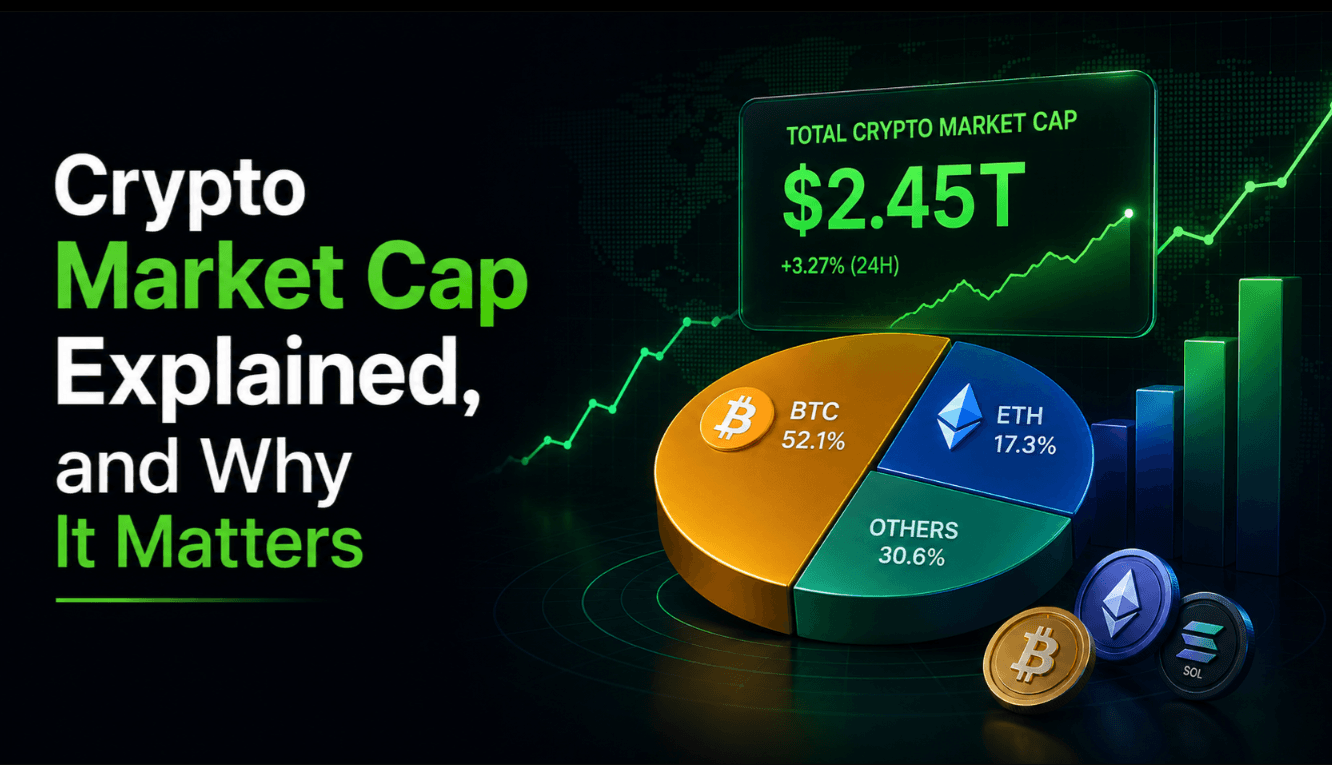
Crypto Market Cap Explained, and Why It Matters
Market cap is the headline number everyone quotes, but few use it correctly. Here is how it is calculated, what it really tells you, and where it can be misleading.
Olivia Bennett · June 1, 2026→