The Passphrase: What the 25th Word Actually Buys
The passphrase is the most misunderstood feature on a signing device. It is genuinely powerful, it is the only defence against someone who has found your seed, and it is responsible for a large share of permanent self-custody losses.

By Emily Volker, Editor-in-Chief
Editorial Strategy, Investigative Journalism, Crypto Media, E-E-A-T Standards
✓ Reviewed by James Park· NFT & Web3 Gaming Analyst
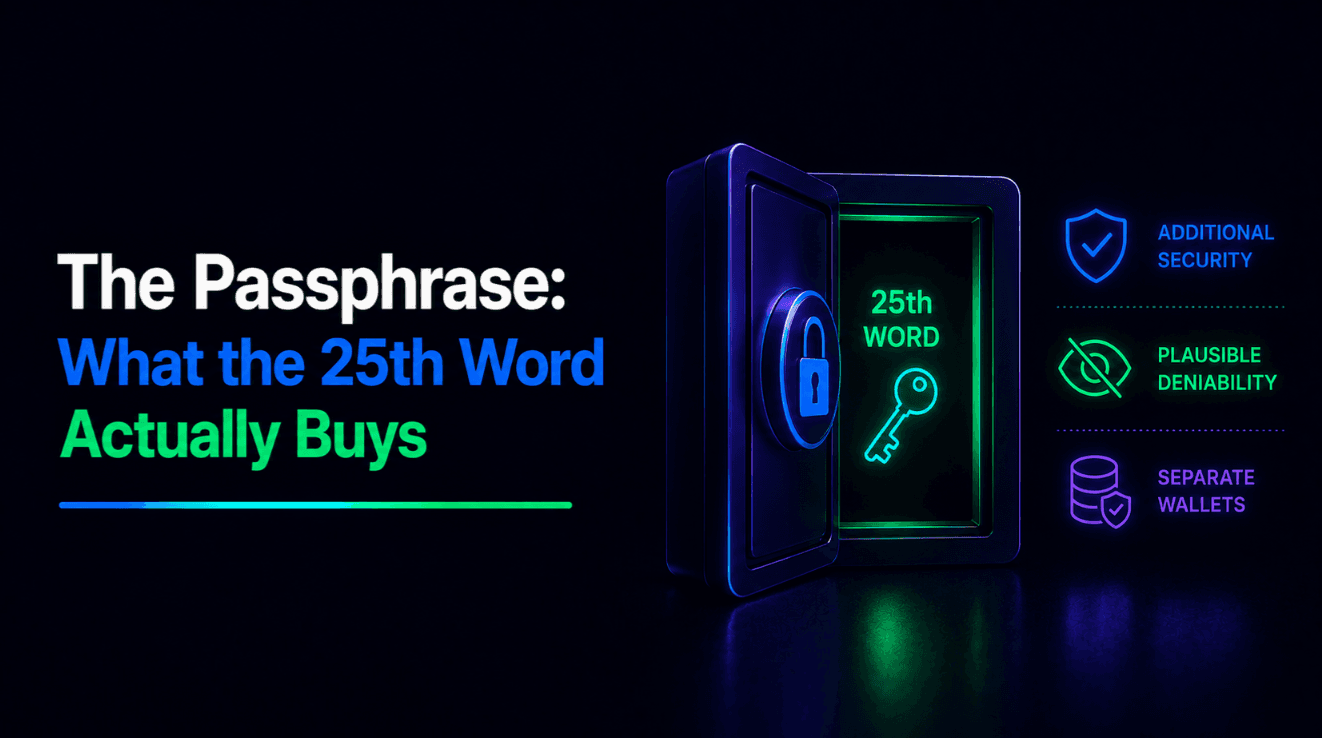
A passphrase is an additional secret combined with your seed phrase to produce the wallet. It is sometimes called a 25th word, which is a poor name: it is not drawn from a wordlist, it has no checksum, and it can be any text at all. Every distinct passphrase produces a completely separate, equally valid wallet from the same seed.
What it defends against
There is one threat it addresses and it addresses it completely: someone has your seed phrase and you do not know it.
Seed phrases are written on paper and paper is found. It is discovered in a house move, photographed by a visitor, uncovered in a burglary, or read by whoever opens the safe deposit box. Without a passphrase, discovery is loss — the funds move the moment the finder types the words in.
With one, the seed alone opens a wallet the attacker can see, and it is the wrong wallet. The real funds sit behind a secret that was never written next to the words.
The related use is coercion. A device can be set up so the seed with no passphrase opens a wallet holding a modest amount. Someone forcing you to unlock it gets a plausible, working wallet with real funds in it, and no way to establish that another exists. Whether that is a good idea depends on circumstances that most people should hope never to face — but the mechanism is real and it is the only version of plausible deniability that actually works.
What it costs
The passphrase has no checksum. Type it slightly differently — a capital letter, a trailing space, a different keyboard layout producing a different character — and the device does not object. It opens a different, empty wallet, silently, exactly as designed. There is no error state because there is no wrong answer.
It cannot be recovered. If you forget it, or the medium holding it is lost, the funds are gone with the same finality as losing the seed. No amount of holding the seed phrase helps.
And it doubles the backup problem. You now have two secrets that must both survive and must not be stored together — because storing them together recreates the situation the passphrase existed to prevent. Solving that properly is harder than solving it for a seed alone, and the difficulty is the reason so many passphrase setups end badly.
The failure that keeps happening
The characteristic loss is not dramatic. Someone sets a passphrase, funds the wallet, uses it for a while, and then goes months without needing to restore. When they eventually do, they enter what they are certain is the passphrase and see an empty wallet.
At that point there is nothing diagnostic to work with. The device cannot tell them they are close. There is no partial credit. A passphrase remembered as a phrase but stored as a phrase with a full stop is a different wallet, permanently.
The second characteristic loss is the estate case: the holder dies, the family finds the seed phrase, restores it, sees a wallet with a small balance or none, and concludes there was nothing there.
Doing it properly if you do it
- Store the passphrase durably and separately from the seed. Memory alone is not storage — the losses are dominated by people who were sure they would remember.
- Record it exactly, including case and any punctuation, and prefer something with no ambiguous characters over something clever.
- Verify by restoring on a second device before funding, and confirm the first receiving address matches.
- Test the restore again after some months have passed. The point is to discover a problem while it is still fixable.
- Write down that a passphrase exists somewhere your heirs will find it, even if the passphrase itself is stored elsewhere.
Whether to use one at all
The honest assessment is that for most holders the answer is no. The threat it defends against — an attacker who finds the seed — is real but less likely than the threat it introduces, which is you losing an unrecoverable secret. A well-hidden seed with no passphrase has a better expected outcome than a mediocre passphrase setup.
It becomes worth it when the amount justifies a genuinely engineered backup arrangement, when the seed is stored somewhere you do not fully control, or when coercion is a realistic scenario rather than a hypothetical. Those cases exist. The default should be to leave the feature alone until you are in one.
Sources
2 references- 01BIP-39: Mnemonic code for generating deterministic keys
Bitcoin Improvement Proposals · accessed August 22, 2026
- 02BIP-32: Hierarchical Deterministic Wallets
Bitcoin Improvement Proposals · accessed August 22, 2026
Frequently asked questions
Is a passphrase the same as a 25th word?+
No, and the nickname causes real losses. It is not drawn from the wordlist, has no checksum and can be any text. Every distinct passphrase — including one differing by a capital letter or a trailing space — produces a completely separate valid wallet with no error.
What happens if I forget my passphrase?+
The funds are unrecoverable, exactly as if you had lost the seed. Holding the seed phrase does not help, and there is no way to search or brute-force a reasonable passphrase in practice. The device cannot tell you that you are close, because there is no wrong answer to be close to.
Should I use a passphrase?+
For most holders, no. It defends against someone finding your seed, which is real but rarer than the risk it adds — losing an unrecoverable second secret. It earns its place when the amount justifies a properly engineered backup, when the seed is stored somewhere you do not control, or when coercion is a genuine concern.
How does the decoy wallet work?+
The seed with no passphrase opens one wallet; the seed plus your passphrase opens another. Keeping a modest balance in the first gives anyone forcing you to unlock the device a plausible working wallet, with no way to establish that a second exists. It is the only version of plausible deniability that functions in practice.
Written by
Emily VolkerEditor-in-ChiefEditorial Strategy, Investigative Journalism, Crypto Media, E-E-A-T Standards
Emily Volker is the Editor-in-Chief of CoinRadar Daily, where she leads a multilingual editorial team covering cryptocurrency markets, blockchain innovation, Web3, and global digital asset regulation across eight languages. With more than a decade of experience in financial and technology journalism, she has played a key role in developing high editorial standards and trusted reporting within the digital asset industry. Emily began her career as a financial journalist reporting on commodities, energy markets, and emerging technologies before discovering Bitcoin and decentralized finance in the early 2010s. She later moved to London to join one of Europe's early blockchain-focused media organizations, where she advanced into senior editorial leadership. Her experience reporting through both the rapid expansion of the 2017 ICO boom and the subsequent market correction reinforced her commitment to fact-based, research-driven journalism in an industry often influenced by speculation. She holds a Master's degree in International Journalism from City, University of London, and has completed executive studies in digital media strategy through the Reuters Institute at Oxford. Emily is a strong advocate for editorial transparency, rigorous verification, and responsible financial reporting. She also helped integrate Google's E-E-A-T principles—Experience, Expertise, Authoritativeness, and Trustworthiness—into the editorial standards followed by CoinRadar Daily. Under her leadership, CoinRadar Daily has expanded into a global cryptocurrency news platform publishing content in eight languages with a network of editors, analysts, and contributors across four continents. Emily oversees investigative reporting, editorial policy, content quality, and fact-checking processes to ensure every article meets the publication's standards for accuracy, credibility, and independence. Alongside her editorial responsibilities, Emily mentors aspiring journalists through digital media initiatives and regularly speaks at international conferences focused on journalism, fintech, blockchain technology, and digital assets, where she discusses responsible reporting, combating misinformation, and the evolving future of financial media.

✓Reviewed & edited by
James ParkNFT & Web3 Gaming AnalystNFTs, Web3 Gaming, GameFi, Digital Collectibles, Creator Economy
James Park serves as the NFT & Web3 Gaming Analyst at CoinRadar Daily, where he covers the rapidly evolving worlds of blockchain gaming, digital collectibles, metaverse ecosystems, and creator-driven economies. Combining expertise in interactive media with blockchain technology, he analyzes how NFTs and decentralized gaming continue to reshape digital ownership and online communities. James earned a Master of Fine Arts in Digital Media from NYU Tisch School of the Arts, giving him a unique perspective that blends creative storytelling, digital culture, and emerging technology. Rather than viewing NFTs solely through an investment lens, he examines their broader impact on entertainment, gaming, intellectual property, and community engagement. Prior to joining CoinRadar Daily, James reported on the NFT industry and blockchain gaming for several leading digital media outlets, covering the explosive growth of the NFT market, the transition toward utility-focused collections, and the evolution of GameFi. His close relationships with independent developers, digital artists, and gaming communities allow him to identify important industry trends long before they reach mainstream attention. His reporting places particular emphasis on sustainable Web3 game design, token economies, and the long-term viability of blockchain-powered virtual worlds. James has published extensive research analyzing why certain gaming ecosystems thrive while others struggle with inflationary token models, weak player retention, or unsustainable reward structures. His market analysis is frequently referenced by blockchain startups, investors, and game studios evaluating new Web3 projects. Beyond journalism, James actively participates in NFT and decentralized creator communities while following developments in digital art, virtual economies, and next-generation gaming technologies. He also contributes educational content on blockchain gaming and regularly speaks about the future of digital ownership, helping CoinRadar Daily deliver balanced, research-driven coverage at the intersection of technology, gaming, and crypto innovation.
CoinRadar Daily content is written by named analysts and checked against our editorial standards. Market data is indicative and informational only — nothing here is financial advice.
Bitcoin services, rated
How we score →Independent, rubric-scored tables covering the services this bitcoin coverage keeps running into.
Best Hardware Wallets
Top rated: Trezor Safe 5 8.6
Devices whose only job is to keep a key away from the internet.
5rated →
Best Crypto Wallets
Top rated: Rabby 8.3
Software wallets for everyday use.
5rated →
Best Crypto Exchanges
Top rated: Kraken 8.4
Centralised venues that hold your funds while you trade.
6rated →
Keep Reading
Bitcoin Self-Custody: Hardware Wallets, Seed Phrases & Security
Self-custody means holding your own keys. Here is how hardware wallets and seed phrases protect Bitcoin, and the security habits that prevent loss.
James Park · May 25, 2026→
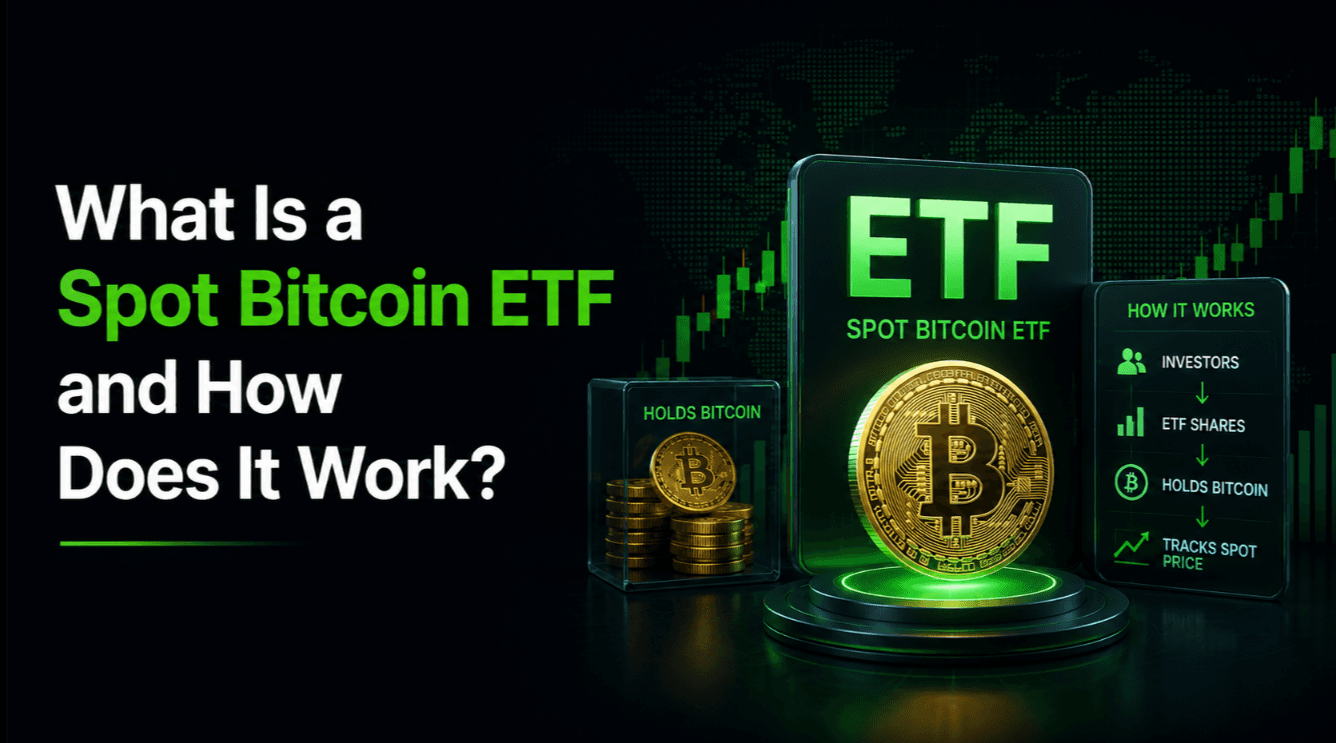
What Is a Spot Bitcoin ETF and How Does It Work?
A spot Bitcoin ETF holds actual bitcoin and lets investors gain exposure through a brokerage account. Here is how it works and what you give up.
Emily Volker · June 1, 2026→

Bitcoin vs Gold: Which Is the Better Store of Value?
Bitcoin is often called digital gold, but the two assets store value very differently. Here is how they compare on scarcity, volatility, and risk.
Olivia Bennett · June 5, 2026→