Institutional Custody: Qualified Custodian, MPC and Self-Managed
Institutional custody is often discussed as a single product. It is three arrangements with different legal consequences, and the difference that matters is not technical — it is who owns the asset when the custodian fails.

By Emily Volker, Editor-in-Chief
Editorial Strategy, Investigative Journalism, Crypto Media, E-E-A-T Standards
✓ Reviewed by James Park· NFT & Web3 Gaming Analyst
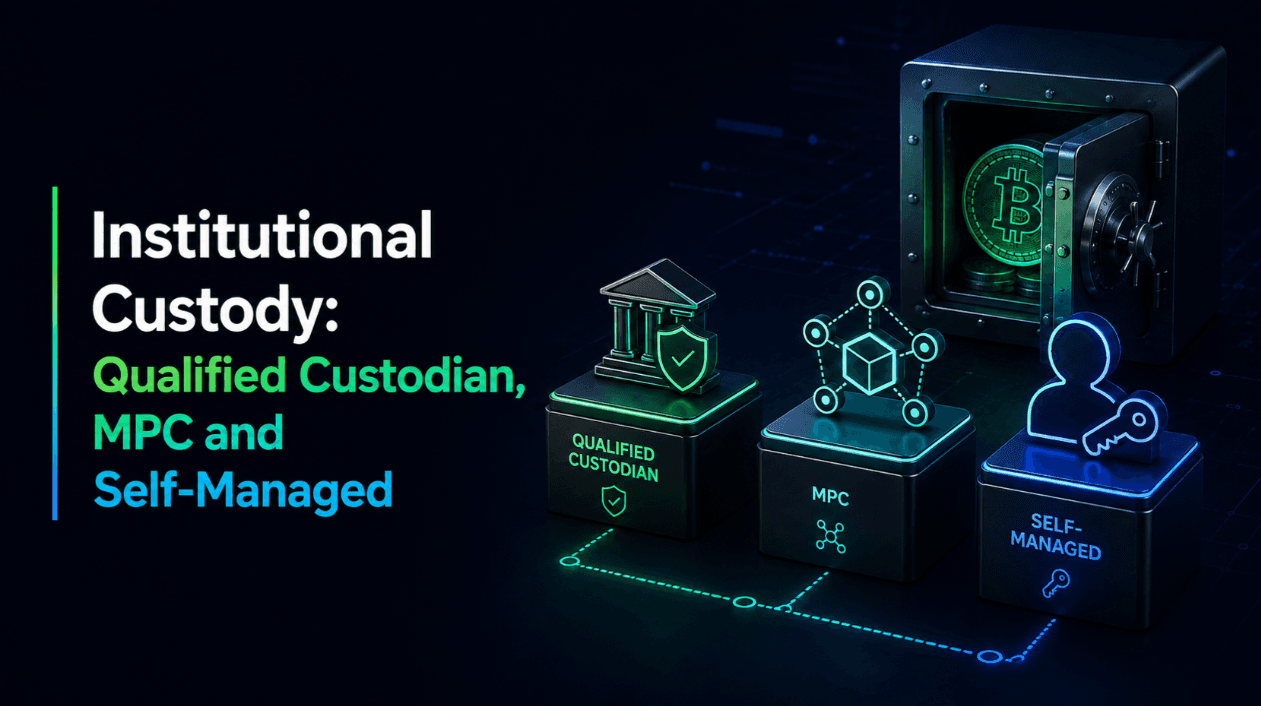
An institution holding digital assets on behalf of others faces a question retail holders can answer with a device in a drawer: how do you hold a bearer instrument in a way that satisfies a regulator, an auditor and a mandate. Three models have emerged, and they differ less on cryptography than on law.
The qualified custodian model
A regulated entity — typically a trust company or a bank — holds the assets, and the client's claim is a custodial one recognised in law. The custodian is supervised, examined, and subject to capital and segregation requirements written for custody rather than for payments.
The advantage is regulatory and legal rather than technical. Many mandates require assets to sit with a qualified custodian, which makes this the only permissible option regardless of how good the alternatives are. A supervised trust charter also brings examination and reporting that produce evidence an auditor can use.
The trade is counterparty exposure and control. The client does not hold keys, movements happen at the custodian's operational pace, and the strength of the arrangement in an insolvency depends on how the assets are titled — whether they are held in trust for clients or sit on the custodian's balance sheet. That distinction is a contractual and jurisdictional matter, and it is the single most important question to ask.
The MPC model
Multi-party computation splits the signing capability across several parties so that a threshold must cooperate to sign, and no complete key ever exists in one place. There is no moment at which a private key is assembled.
This is a genuine improvement over holding a key in one location, and it maps well onto institutional controls: shares can be held by different teams, with different approval requirements and enforceable policies about what can be signed.
Two cautions. The security depends on the specific protocol and its implementation, and this is specialist cryptography where subtle errors are not visible to a buyer — an independent review of the implementation matters more than the fact that MPC is used. And a shared-share arrangement with a provider still leaves you dependent on that provider's availability and solvency, which is a counterparty question even though the marketing describes it as self-custody.
The self-managed model
The institution holds keys itself, typically in hardware security modules under multi-person control, with documented procedures and its own audit trail.
It removes counterparty risk entirely — no third party can fail, freeze or be compelled. It also relocates every operational burden inward: key ceremonies, geographic distribution, personnel vetting, continuity planning for staff departures, and an audit function that has to be satisfied by evidence you produce yourself.
The reason this is less common than its security profile suggests is not that it is weaker. It is that many mandates do not permit it, and that operating it competently requires a capability most institutions would rather buy than build.
The question that separates them
Everything above reduces to one question that a technical comparison will not surface: if the entity holding the assets fails, what does the client own.
Under a properly structured custodial arrangement, client assets are held in trust or otherwise segregated, and are not available to the failed entity's creditors. Under a weaker one, the client is an unsecured creditor with a claim rather than an asset — which is the position that has repeatedly turned out to be worth a fraction of what holders assumed.
The answer is not in the security architecture. It is in the custody agreement, the entity's regulatory status and the insolvency law of its jurisdiction, and it is legible before you sign rather than after.
A due diligence sequence
- How are assets titled, and does the agreement place them in trust for clients or on the provider's balance sheet.
- Which entity is the counterparty, in which jurisdiction, and under which supervisory regime — group marketing frequently obscures this.
- What does the insolvency analysis say, and has anyone external produced one.
- What independent assurance exists over controls, and does its scope cover key management rather than only the surrounding IT.
- What are the operational limits: withdrawal timeframes, approval workflows, and behaviour during periods of stress.
- What happens on exit — how assets are returned, on what timescale, and at whose cost.
The pattern across institutional custody failures is not that the cryptography was broken. It is that the legal arrangement was weaker than the technical one, and nobody had read it closely enough to notice the gap until it mattered.
Sources
2 references- 01FIPS 140-3: Security Requirements for Cryptographic Modules
NIST · accessed August 22, 2026
- 02Security
ethereum.org · accessed August 22, 2026
Frequently asked questions
What is a qualified custodian?+
A regulated entity — typically a trust company or bank — permitted to hold client assets under a supervisory regime built for custody rather than payments, with capital, segregation and examination requirements attached. Many institutional mandates require one, which frequently settles the choice regardless of the alternatives.
Is MPC the same as self-custody?+
Not usually. MPC splits signing capability so no complete key exists in one place, which is a real improvement over a single key. But if a provider holds shares, you depend on their availability and solvency — a counterparty relationship, whatever the marketing calls it.
Why don't more institutions run custody themselves?+
Rarely because it is less secure. Mandates often do not permit it, and operating it competently requires key ceremonies, geographic distribution, personnel controls, continuity planning and an audit function satisfied by evidence you produce — a capability most would rather buy than build.
What is the most important question to ask a custodian?+
How the assets are titled. If the agreement places them in trust for clients they are generally beyond the reach of the custodian's creditors; if not, you are an unsecured creditor with a claim rather than an owner with an asset. That answer lives in the custody agreement and the relevant insolvency law, not in the security architecture.
Written by
Emily VolkerEditor-in-ChiefEditorial Strategy, Investigative Journalism, Crypto Media, E-E-A-T Standards
Emily Volker is the Editor-in-Chief of CoinRadar Daily, where she leads a multilingual editorial team covering cryptocurrency markets, blockchain innovation, Web3, and global digital asset regulation across eight languages. With more than a decade of experience in financial and technology journalism, she has played a key role in developing high editorial standards and trusted reporting within the digital asset industry. Emily began her career as a financial journalist reporting on commodities, energy markets, and emerging technologies before discovering Bitcoin and decentralized finance in the early 2010s. She later moved to London to join one of Europe's early blockchain-focused media organizations, where she advanced into senior editorial leadership. Her experience reporting through both the rapid expansion of the 2017 ICO boom and the subsequent market correction reinforced her commitment to fact-based, research-driven journalism in an industry often influenced by speculation. She holds a Master's degree in International Journalism from City, University of London, and has completed executive studies in digital media strategy through the Reuters Institute at Oxford. Emily is a strong advocate for editorial transparency, rigorous verification, and responsible financial reporting. She also helped integrate Google's E-E-A-T principles—Experience, Expertise, Authoritativeness, and Trustworthiness—into the editorial standards followed by CoinRadar Daily. Under her leadership, CoinRadar Daily has expanded into a global cryptocurrency news platform publishing content in eight languages with a network of editors, analysts, and contributors across four continents. Emily oversees investigative reporting, editorial policy, content quality, and fact-checking processes to ensure every article meets the publication's standards for accuracy, credibility, and independence. Alongside her editorial responsibilities, Emily mentors aspiring journalists through digital media initiatives and regularly speaks at international conferences focused on journalism, fintech, blockchain technology, and digital assets, where she discusses responsible reporting, combating misinformation, and the evolving future of financial media.

✓Reviewed & edited by
James ParkNFT & Web3 Gaming AnalystNFTs, Web3 Gaming, GameFi, Digital Collectibles, Creator Economy
James Park serves as the NFT & Web3 Gaming Analyst at CoinRadar Daily, where he covers the rapidly evolving worlds of blockchain gaming, digital collectibles, metaverse ecosystems, and creator-driven economies. Combining expertise in interactive media with blockchain technology, he analyzes how NFTs and decentralized gaming continue to reshape digital ownership and online communities. James earned a Master of Fine Arts in Digital Media from NYU Tisch School of the Arts, giving him a unique perspective that blends creative storytelling, digital culture, and emerging technology. Rather than viewing NFTs solely through an investment lens, he examines their broader impact on entertainment, gaming, intellectual property, and community engagement. Prior to joining CoinRadar Daily, James reported on the NFT industry and blockchain gaming for several leading digital media outlets, covering the explosive growth of the NFT market, the transition toward utility-focused collections, and the evolution of GameFi. His close relationships with independent developers, digital artists, and gaming communities allow him to identify important industry trends long before they reach mainstream attention. His reporting places particular emphasis on sustainable Web3 game design, token economies, and the long-term viability of blockchain-powered virtual worlds. James has published extensive research analyzing why certain gaming ecosystems thrive while others struggle with inflationary token models, weak player retention, or unsustainable reward structures. His market analysis is frequently referenced by blockchain startups, investors, and game studios evaluating new Web3 projects. Beyond journalism, James actively participates in NFT and decentralized creator communities while following developments in digital art, virtual economies, and next-generation gaming technologies. He also contributes educational content on blockchain gaming and regularly speaks about the future of digital ownership, helping CoinRadar Daily deliver balanced, research-driven coverage at the intersection of technology, gaming, and crypto innovation.
CoinRadar Daily content is written by named analysts and checked against our editorial standards. Market data is indicative and informational only — nothing here is financial advice.
Bitcoin services, rated
How we score →Independent, rubric-scored tables covering the services this bitcoin coverage keeps running into.
Best Hardware Wallets
Top rated: Trezor Safe 5 8.6
Devices whose only job is to keep a key away from the internet.
5rated →
Best Crypto Wallets
Top rated: Rabby 8.3
Software wallets for everyday use.
5rated →
Best Crypto Exchanges
Top rated: Kraken 8.4
Centralised venues that hold your funds while you trade.
6rated →
Keep Reading
Bitcoin Self-Custody: Hardware Wallets, Seed Phrases & Security
Self-custody means holding your own keys. Here is how hardware wallets and seed phrases protect Bitcoin, and the security habits that prevent loss.
James Park · May 25, 2026→

What Is a Spot Bitcoin ETF and How Does It Work?
A spot Bitcoin ETF holds actual bitcoin and lets investors gain exposure through a brokerage account. Here is how it works and what you give up.
Emily Volker · June 1, 2026→

Bitcoin vs Gold: Which Is the Better Store of Value?
Bitcoin is often called digital gold, but the two assets store value very differently. Here is how they compare on scarcity, volatility, and risk.
Olivia Bennett · June 5, 2026→