MEV for Traders: What It Costs You and What Helps
On a public chain, a transaction is visible to everyone before it is final. That visibility has a price, most traders pay it without noticing, and the amount they pay is partly set by a wallet setting they were told to increase when transactions failed.

By James Park, NFT & Web3 Gaming Analyst
NFTs, Web3 Gaming, GameFi, Digital Collectibles, Creator Economy
✓ Reviewed by Olivia Bennett· Blockchain Security Researcher
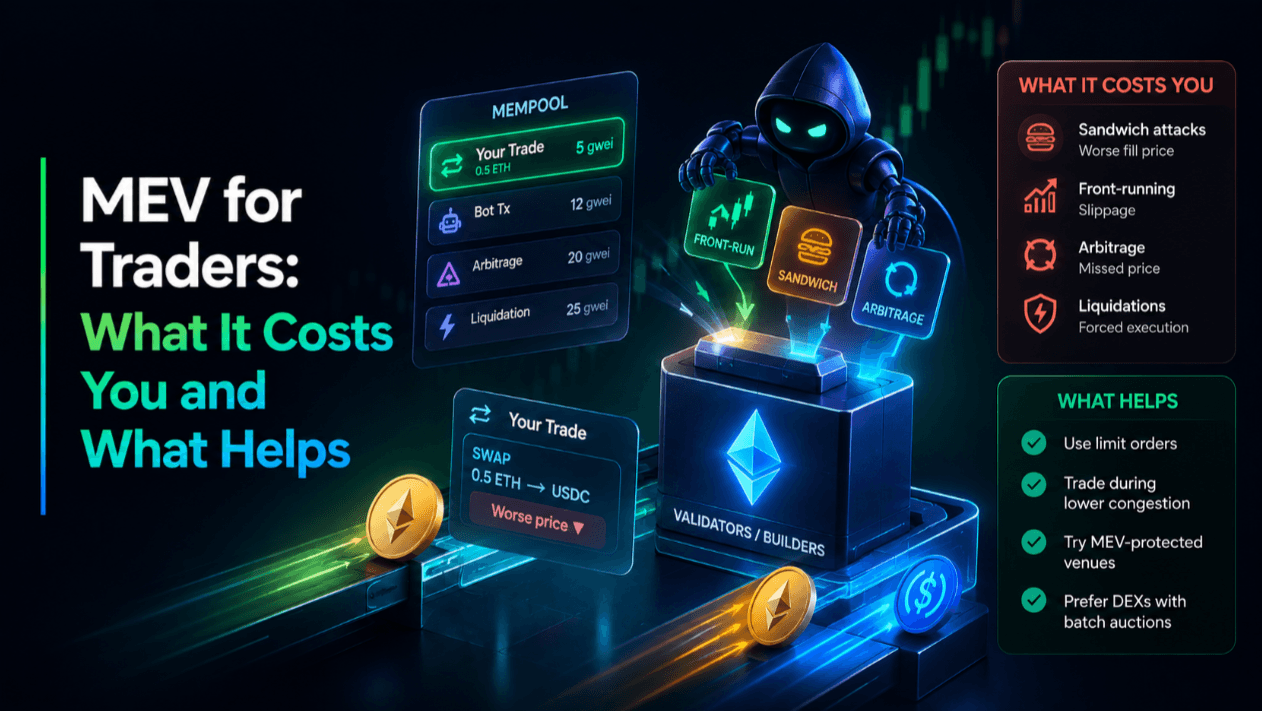
Maximal extractable value is the profit available to whoever decides the order of transactions in a block. Some of it is benign — arbitrage between venues keeps prices consistent and is a service. Some of it is taken directly from the traders whose transactions are being reordered, and that portion is a cost worth understanding because it is partly controllable.
The sandwich, precisely
You submit a swap. Before it executes it sits in a public queue where anyone can read it, including your declared maximum acceptable price.
An observer places a buy immediately before yours, pushing the price up. Your trade then executes against the worse price, pushing it up further. They sell immediately after, into the price your own trade created. Their profit is your worse fill, and everything about it is ordinary, valid, on-chain activity.
The mechanism has one property that matters more than the rest: the profit available is bounded by your slippage tolerance. That setting is a declaration of how much worse a price you will accept, and it is read by the people deciding whether the attack is worth performing.
Why the standard advice makes it worse
When a transaction reverts for slippage, every interface and every guide suggests raising the tolerance. It works, in the sense that the transaction then succeeds.
It also widens the window. A trade with a generous tolerance is a more attractive target than the same trade with a tight one, because the extractable amount is larger. The user has responded to a failed transaction by making the next one more expensive, and nothing in the interface tells them so.
The correct response to repeated reverts is usually smaller orders, a deeper pool, or private routing — not a wider tolerance. A tight tolerance that occasionally fails is cheaper over time than a wide one that always succeeds.
Defences that work
Private transaction routing sends the transaction directly to block builders rather than to the public queue, so it is not visible to observers before inclusion. This eliminates the class rather than mitigating it, and it is available through several wallets as an ordinary setting. The trade is a dependency on the relay you route through.
Tight slippage tolerance bounds the extractable amount directly. Set it as low as the market allows and accept occasional failure.
Smaller orders reduce the price movement your trade creates, and the profit available scales with that movement. Splitting a large trade helps for this reason as well as for price impact.
Deeper pools mean less movement for the same size, so venue selection is itself a defence.
Batch and intent-based venues change the model entirely: rather than broadcasting an order, you express a desired outcome and solvers compete to fill it, with settlement at a uniform price for the batch. That removes the ordering advantage that makes the attack possible.
What the defences do not cover
Private routing hides the transaction from the public queue and not from the builder receiving it. That relocates the trust rather than removing it, and the relevant question becomes the builder's policy rather than the queue's visibility.
Nothing addresses arbitrage that follows your trade legitimately. If your order moves a price out of line with other venues, someone will correct it and profit. That is the market functioning, and the cost is your price impact rather than an extraction from you.
Working out what you are paying
- Compare your realised price against the pool price immediately before your transaction. Consistent adverse difference is the signal.
- Check whether your losses scale with your slippage setting. If they do, it is ordering rather than market movement.
- Try the same trade through a private route and compare outcomes across several attempts.
- Watch whether the pool price returns to roughly its prior level immediately after your trade — that reversion is the shape of a sandwich.
- For anything large enough to matter, use private routing by default rather than as a response to having been hit.
The uncomfortable summary is that transacting in public has a price, it is not disclosed anywhere, and the wallet setting most people adjust to fix a different problem is the one that sets it.
Sources
2 references- 01Maximal extractable value (MEV)
ethereum.org · accessed August 22, 2026
- 02Flashbots documentation
Flashbots · accessed August 22, 2026
Frequently asked questions
What is a sandwich attack?+
Someone reads your pending swap, buys immediately before it to push the price up, lets your trade execute at the worse price, then sells into the movement your trade created. Their profit is your worse fill, and the transactions involved are ordinary valid activity.
Why does raising slippage tolerance make it worse?+
Because the profit available is bounded by how much worse a price you have declared you will accept. A wide tolerance is a larger target, so the trade becomes more attractive to extract from. Raising it is the standard advice when transactions fail, and it makes the next one more expensive.
How do I actually protect myself?+
Private transaction routing removes the class rather than mitigating it, by sending the trade to builders instead of the public queue. Beyond that: keep tolerance tight and accept occasional failure, trade smaller, use deeper pools, and consider batch or intent-based venues where uniform settlement removes the ordering advantage.
Is all MEV harmful?+
No. Arbitrage that keeps prices consistent between venues is a service and is paid for by the price gaps it closes. What comes out of your pocket specifically is extraction that depends on reading and reordering your transaction, and that is the part the defences address.
Written by
James ParkNFT & Web3 Gaming AnalystNFTs, Web3 Gaming, GameFi, Digital Collectibles, Creator Economy
James Park serves as the NFT & Web3 Gaming Analyst at CoinRadar Daily, where he covers the rapidly evolving worlds of blockchain gaming, digital collectibles, metaverse ecosystems, and creator-driven economies. Combining expertise in interactive media with blockchain technology, he analyzes how NFTs and decentralized gaming continue to reshape digital ownership and online communities. James earned a Master of Fine Arts in Digital Media from NYU Tisch School of the Arts, giving him a unique perspective that blends creative storytelling, digital culture, and emerging technology. Rather than viewing NFTs solely through an investment lens, he examines their broader impact on entertainment, gaming, intellectual property, and community engagement. Prior to joining CoinRadar Daily, James reported on the NFT industry and blockchain gaming for several leading digital media outlets, covering the explosive growth of the NFT market, the transition toward utility-focused collections, and the evolution of GameFi. His close relationships with independent developers, digital artists, and gaming communities allow him to identify important industry trends long before they reach mainstream attention. His reporting places particular emphasis on sustainable Web3 game design, token economies, and the long-term viability of blockchain-powered virtual worlds. James has published extensive research analyzing why certain gaming ecosystems thrive while others struggle with inflationary token models, weak player retention, or unsustainable reward structures. His market analysis is frequently referenced by blockchain startups, investors, and game studios evaluating new Web3 projects. Beyond journalism, James actively participates in NFT and decentralized creator communities while following developments in digital art, virtual economies, and next-generation gaming technologies. He also contributes educational content on blockchain gaming and regularly speaks about the future of digital ownership, helping CoinRadar Daily deliver balanced, research-driven coverage at the intersection of technology, gaming, and crypto innovation.

✓Reviewed & edited by
Olivia BennettBlockchain Security ResearcherSmart Contract Security, Audit Reports, Exploits, DeFi Hacks, White-Hat Research
Olivia Bennett is the Blockchain Security Researcher at CoinRadar Daily, where she specializes in smart contract security, DeFi risk analysis, blockchain infrastructure, and protocol vulnerabilities. Drawing on years of hands-on cybersecurity experience, she delivers in-depth reporting that explains both the technical details and the real-world implications of security incidents across the digital asset ecosystem. Before joining CoinRadar Daily, Olivia built her career in cybersecurity, working in penetration testing, blockchain security assessments, and smart contract auditing. She participated in numerous security reviews for decentralized applications and blockchain protocols, helping identify critical vulnerabilities before they could be exploited. Her responsible disclosure work has contributed to improving the security of several major DeFi projects and protecting millions of dollars in digital assets. Olivia earned a Bachelor of Science in Computer Science from the University of Edinburgh and later completed advanced professional training in offensive security and blockchain technologies. Her combination of software security expertise and blockchain knowledge enables her to provide readers with clear, evidence-based analysis of exploits, protocol upgrades, and emerging attack vectors. At CoinRadar Daily, Olivia publishes detailed investigations into blockchain exploits, smart contract audits, cross-chain security, wallet protection, and evolving cyber threats affecting the crypto industry. She is particularly committed to translating highly technical research into practical guidance that helps investors, developers, and blockchain users better understand protocol risk and security best practices. Alongside her editorial work, Olivia contributes educational resources covering secure wallet management, decentralized finance security, and blockchain infrastructure. She also participates in industry events and technical discussions focused on strengthening Web3 security standards, supporting CoinRadar Daily's mission to provide accurate, research-driven coverage of the rapidly evolving digital asset landscape.
CoinRadar Daily content is written by named analysts and checked against our editorial standards. Market data is indicative and informational only — nothing here is financial advice.
Markets services, rated
How we score →Independent, rubric-scored tables covering the services this markets coverage keeps running into.
Best Crypto Exchanges
Top rated: Kraken 8.4
Centralised venues that hold your funds while you trade.
6rated →
Best Perpetual DEXs
Top rated: GMX 7.2
On-chain leverage.
4rated →
Best Crypto Trading Tools
Top rated: TradingView 8.5
Terminals, bots, screeners and portfolio trackers.
4rated →
Keep Reading
Risk Management for Crypto Investors: Sizing and Stops
Returns get the attention, but risk management decides who survives. Here is how position sizing, stop-losses, and sensible limits keep you in the game.
James Park · May 19, 2026→
Bull vs Bear Market: The Signals Worth Watching
Telling a bull market from a bear is easy in hindsight and hard in the moment. These are the signals that help you read the broader trend without chasing noise.
Emily Volker · May 26, 2026→
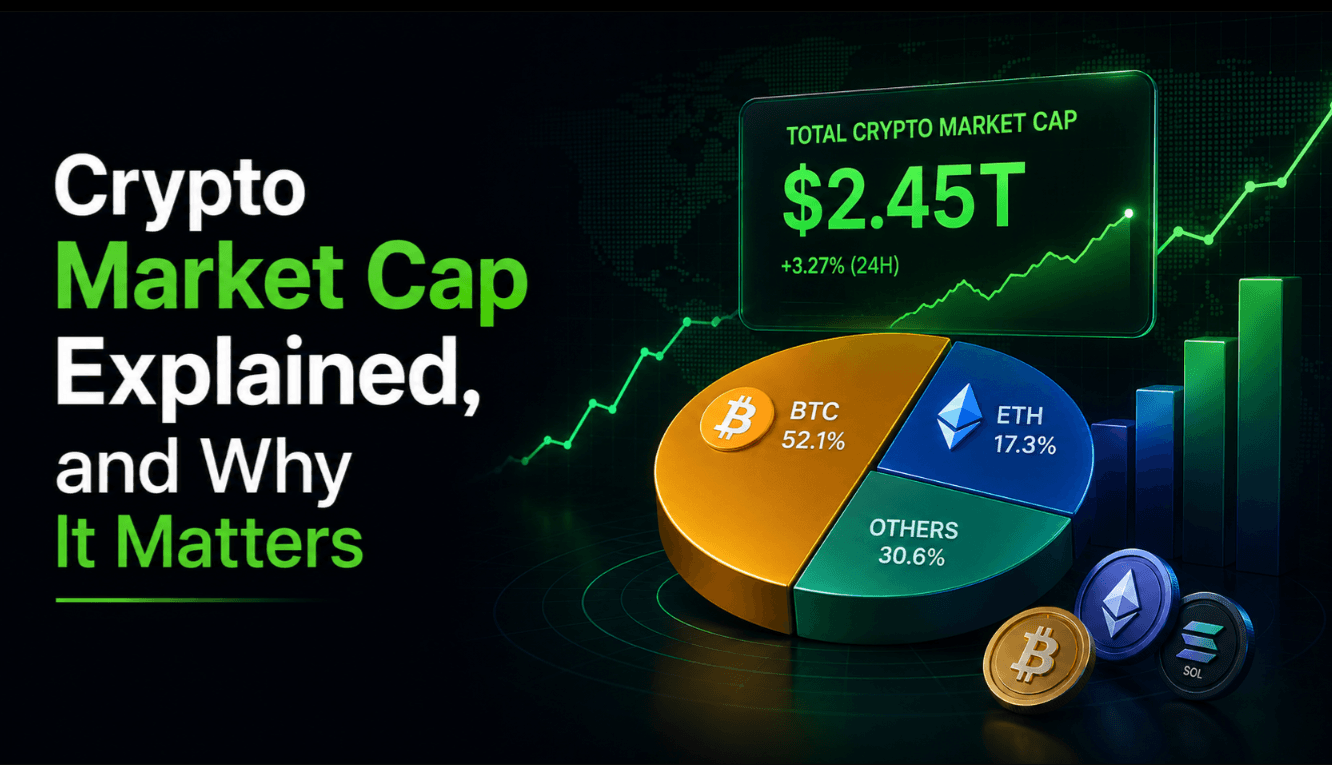
Crypto Market Cap Explained, and Why It Matters
Market cap is the headline number everyone quotes, but few use it correctly. Here is how it is calculated, what it really tells you, and where it can be misleading.
Olivia Bennett · June 1, 2026→