Multisig vs Single-Key Custody: Where a Threshold Helps
Multisig is sold as strictly safer than holding one key, which is not what a threshold scheme does. It trades one failure mode for a different set, and whether that trade is good depends on which failure you are actually trying to survive.

By James Park, NFT & Web3 Gaming Analyst
NFTs, Web3 Gaming, GameFi, Digital Collectibles, Creator Economy
✓ Reviewed by Olivia Bennett· Blockchain Security Researcher
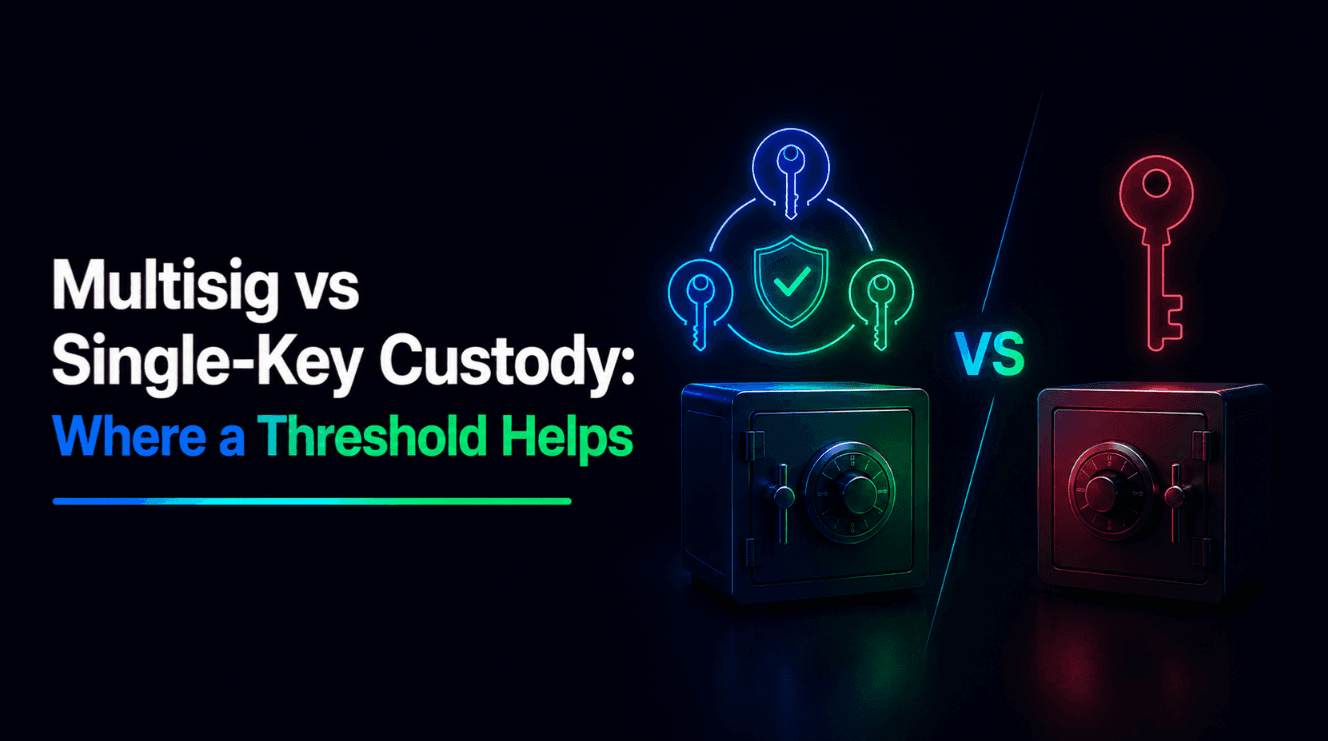
A multisig arrangement requires several keys to authorise a transaction — two of three, three of five, whichever threshold is chosen. The obvious benefit is that no single key compromise loses the funds. The less obvious cost is that the arrangement introduces coordination, more backup surface and more ways to be locked out permanently. Both sides need to be on the table.
What a threshold genuinely removes
Single-key theft stops being fatal. An attacker who obtains one key of a two-of-three cannot move anything, and you have time to move funds to a new arrangement before they find a second.
Single-key loss stops being fatal in the same way. Lose one key of three and you still control the funds with the remaining two, which converts a catastrophe into an inconvenience.
Coercion becomes harder in a specific configuration: keys held in different places, by different people or under different jurisdictions mean the person in front of an attacker genuinely cannot comply alone.
And it enables shared control. Two people, or a person and an institution, can hold funds where neither can act unilaterally — which is not a security property so much as a governance one, and is the reason most organisational treasuries use it.
What it adds
More keys means more backups, and each backup is a thing that can be lost, found by the wrong person, or degraded. A two-of-three has three seeds to store securely rather than one, and the storage problem is where most self-custody actually fails.
Recovery becomes procedural rather than simple. Restoring a single-key wallet needs one seed. Restoring a multisig needs the threshold of keys plus the wallet descriptor — the record of which keys, in what order, under which script type. Lose the descriptor and holding enough keys may not be sufficient to reconstruct the arrangement, which is a failure mode single-key custody does not have at all.
Compatibility narrows. Fewer wallets support multisig, support varies in quality, and moving between them is harder. A setup that depends on one piece of software is a dependency you did not have before.
And routine use gets slower. Every transaction requires assembling signatures from multiple devices. That friction is protective against mistakes and corrosive to discipline: setups that are annoying to use get shortcuts, and shortcuts are where the security went.
Choosing the threshold
The two numbers encode two different fears, and they trade against each other directly.
Raising the threshold — three of five rather than two of five — makes compromise harder and lockout easier. Lowering it does the reverse.
Adding keys at a fixed threshold — two of five rather than two of three — makes lockout harder and compromise easier, because there are more keys an attacker could reach.
Two of three is the common default because it survives one loss and one theft, which covers the realistic scenarios for an individual without becoming unwieldy. Larger schemes belong to organisations, where the governance requirement rather than the security one is doing the work.
The mistake that undoes it
The most common way a multisig fails is that the keys are not actually independent.
Three keys generated on the same device, at the same time, and backed up in the same safe, produce a scheme with the security properties of a single key and the complexity of three. The same applies to keys held on three devices from the same manufacturer with the same firmware, or in three cloud accounts secured by the same email.
Independence is the entire premise. Different devices, different physical locations, different recovery paths — and, where the scheme is meant to survive coercion or jurisdictional risk, different people or countries. A multisig where a single event can reach the threshold is decoration.
When single-key is the better answer
For most individuals holding an amount they could rebuild, a single well-protected key on a good signing device with a carefully stored backup is the stronger practical choice — not because it is more secure in theory, but because it is simple enough to be executed correctly and recovered under stress.
Multisig earns its complexity when the amount justifies the operational burden, when several parties must share control, or when the specific threats you face are coercion and single-point compromise rather than your own error. Those are real situations. They are not everyone's.
- Are your keys generated on different devices, stored in different places, with different recovery paths.
- Is the wallet descriptor backed up alongside the keys, and would a non-expert know what to do with it.
- Could one event — a fire, a burglary, a subpoena, a manufacturer bug — reach the threshold.
- Have you performed a full recovery from backups, on different hardware, without the original setup available.
- Is the arrangement simple enough that whoever inherits it can execute it.
That last question is the one that most often converts a multisig from protection into a trap, and it belongs in the design rather than in the aftermath.
Sources
2 references- 01BIP-32: Hierarchical Deterministic Wallets
Bitcoin Improvement Proposals · accessed August 22, 2026
- 02BIP-174: Partially Signed Bitcoin Transaction Format
Bitcoin Improvement Proposals · accessed August 22, 2026
Frequently asked questions
Is multisig safer than a single key?+
Against theft and loss of one key, yes. Against your own error it is often worse: more backups to lose, a wallet descriptor that must survive alongside the keys, and a recovery procedure complex enough to fail under stress. It trades one failure mode for a different set rather than being strictly better.
What threshold should I use?+
Two of three is the common individual default because it survives one loss and one theft without becoming unwieldy. Raising the threshold resists compromise and increases lockout risk; adding keys at a fixed threshold does the reverse. Larger schemes usually reflect a governance requirement rather than a security one.
What is a wallet descriptor and why does it matter?+
The record of which keys form the arrangement, in what order, under which script type. Without it, holding enough keys may not be enough to reconstruct the wallet. It must be backed up alongside the keys — this is a failure mode single-key custody simply does not have.
Can I generate all my multisig keys on one device?+
You can, and doing so defeats the point. Keys created on one device, at one time, backed up in one place have the security of a single key with the complexity of several. Independence across devices, locations and recovery paths is the premise the whole scheme rests on.
Written by
James ParkNFT & Web3 Gaming AnalystNFTs, Web3 Gaming, GameFi, Digital Collectibles, Creator Economy
James Park serves as the NFT & Web3 Gaming Analyst at CoinRadar Daily, where he covers the rapidly evolving worlds of blockchain gaming, digital collectibles, metaverse ecosystems, and creator-driven economies. Combining expertise in interactive media with blockchain technology, he analyzes how NFTs and decentralized gaming continue to reshape digital ownership and online communities. James earned a Master of Fine Arts in Digital Media from NYU Tisch School of the Arts, giving him a unique perspective that blends creative storytelling, digital culture, and emerging technology. Rather than viewing NFTs solely through an investment lens, he examines their broader impact on entertainment, gaming, intellectual property, and community engagement. Prior to joining CoinRadar Daily, James reported on the NFT industry and blockchain gaming for several leading digital media outlets, covering the explosive growth of the NFT market, the transition toward utility-focused collections, and the evolution of GameFi. His close relationships with independent developers, digital artists, and gaming communities allow him to identify important industry trends long before they reach mainstream attention. His reporting places particular emphasis on sustainable Web3 game design, token economies, and the long-term viability of blockchain-powered virtual worlds. James has published extensive research analyzing why certain gaming ecosystems thrive while others struggle with inflationary token models, weak player retention, or unsustainable reward structures. His market analysis is frequently referenced by blockchain startups, investors, and game studios evaluating new Web3 projects. Beyond journalism, James actively participates in NFT and decentralized creator communities while following developments in digital art, virtual economies, and next-generation gaming technologies. He also contributes educational content on blockchain gaming and regularly speaks about the future of digital ownership, helping CoinRadar Daily deliver balanced, research-driven coverage at the intersection of technology, gaming, and crypto innovation.

✓Reviewed & edited by
Olivia BennettBlockchain Security ResearcherSmart Contract Security, Audit Reports, Exploits, DeFi Hacks, White-Hat Research
Olivia Bennett is the Blockchain Security Researcher at CoinRadar Daily, where she specializes in smart contract security, DeFi risk analysis, blockchain infrastructure, and protocol vulnerabilities. Drawing on years of hands-on cybersecurity experience, she delivers in-depth reporting that explains both the technical details and the real-world implications of security incidents across the digital asset ecosystem. Before joining CoinRadar Daily, Olivia built her career in cybersecurity, working in penetration testing, blockchain security assessments, and smart contract auditing. She participated in numerous security reviews for decentralized applications and blockchain protocols, helping identify critical vulnerabilities before they could be exploited. Her responsible disclosure work has contributed to improving the security of several major DeFi projects and protecting millions of dollars in digital assets. Olivia earned a Bachelor of Science in Computer Science from the University of Edinburgh and later completed advanced professional training in offensive security and blockchain technologies. Her combination of software security expertise and blockchain knowledge enables her to provide readers with clear, evidence-based analysis of exploits, protocol upgrades, and emerging attack vectors. At CoinRadar Daily, Olivia publishes detailed investigations into blockchain exploits, smart contract audits, cross-chain security, wallet protection, and evolving cyber threats affecting the crypto industry. She is particularly committed to translating highly technical research into practical guidance that helps investors, developers, and blockchain users better understand protocol risk and security best practices. Alongside her editorial work, Olivia contributes educational resources covering secure wallet management, decentralized finance security, and blockchain infrastructure. She also participates in industry events and technical discussions focused on strengthening Web3 security standards, supporting CoinRadar Daily's mission to provide accurate, research-driven coverage of the rapidly evolving digital asset landscape.
CoinRadar Daily content is written by named analysts and checked against our editorial standards. Market data is indicative and informational only — nothing here is financial advice.
Bitcoin services, rated
How we score →Independent, rubric-scored tables covering the services this bitcoin coverage keeps running into.
Best Hardware Wallets
Top rated: Trezor Safe 5 8.6
Devices whose only job is to keep a key away from the internet.
5rated →
Best Crypto Wallets
Top rated: Rabby 8.3
Software wallets for everyday use.
5rated →
Best Crypto Exchanges
Top rated: Kraken 8.4
Centralised venues that hold your funds while you trade.
6rated →
Keep Reading
Bitcoin Self-Custody: Hardware Wallets, Seed Phrases & Security
Self-custody means holding your own keys. Here is how hardware wallets and seed phrases protect Bitcoin, and the security habits that prevent loss.
James Park · May 25, 2026→

What Is a Spot Bitcoin ETF and How Does It Work?
A spot Bitcoin ETF holds actual bitcoin and lets investors gain exposure through a brokerage account. Here is how it works and what you give up.
Emily Volker · June 1, 2026→

Bitcoin vs Gold: Which Is the Better Store of Value?
Bitcoin is often called digital gold, but the two assets store value very differently. Here is how they compare on scarcity, volatility, and risk.
Olivia Bennett · June 5, 2026→