Oracle Latency: How a Price Feed Decides Who Gets Liquidated
A lending protocol cannot see the market. It sees whatever its oracle last told it, and every liquidation, every borrow limit and every solvency check runs on that figure. The gap between the reported price and the real one is where a specific and expensive class of failure lives.

By James Park, NFT & Web3 Gaming Analyst
NFTs, Web3 Gaming, GameFi, Digital Collectibles, Creator Economy
✓ Reviewed by Olivia Bennett· Blockchain Security Researcher
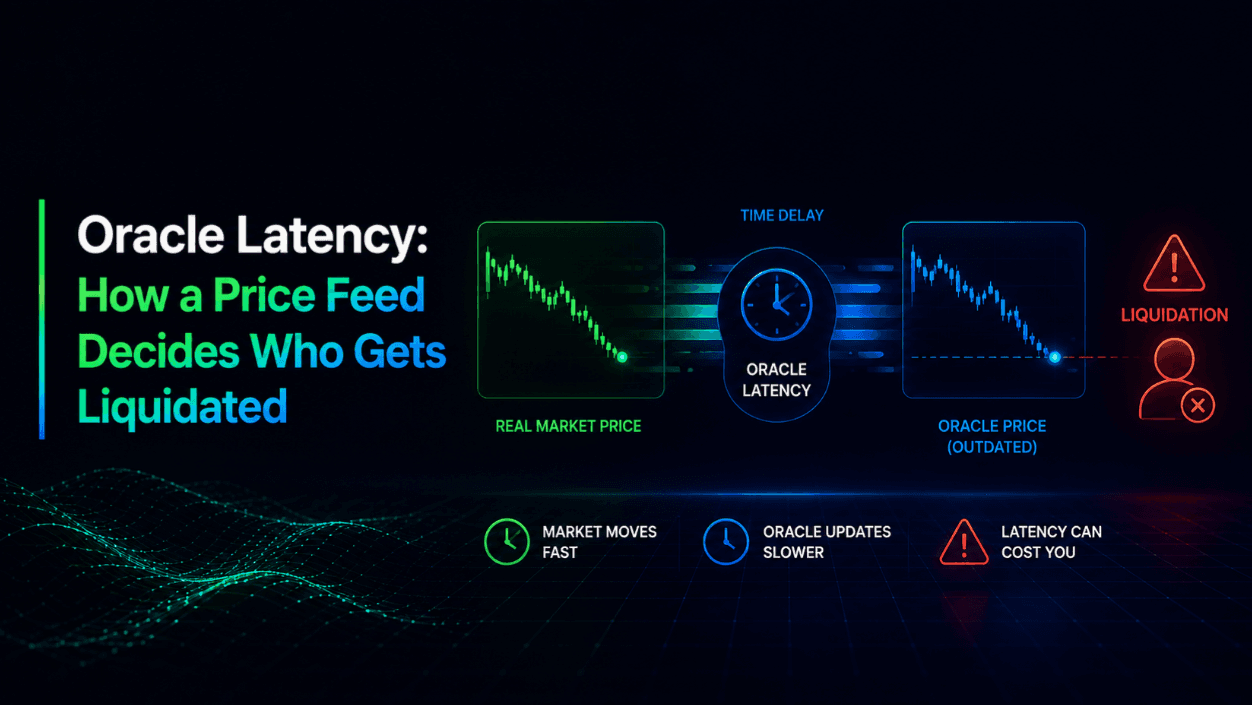
Smart contracts have no access to outside data. A protocol that needs to know what an asset is worth must be told, by an oracle, and it then treats that figure as truth. Whether the figure is current, whether it can be moved by someone with capital, and how long it lags reality are not incidental details — they determine who is liquidated and when.
Why feeds are not continuous
Publishing a price on-chain costs a transaction, so no feed updates constantly. Instead, oracles use two triggers.
A deviation threshold publishes when the price has moved more than a set percentage since the last update. A heartbeat publishes after a fixed interval regardless. Between updates, the protocol is using a stale figure, and how stale depends on which threshold is set and how volatile the market has been.
This is not laziness; it is a cost trade-off, and the parameters are published. A feed with a wide deviation threshold is cheap to operate and can be meaningfully behind during a fast move. A tight one is expensive and closer to real.
The practical consequence for a borrower is that liquidation runs on the oracle's clock rather than the market's. A position can appear safe on an exchange while already being liquidatable on-chain, or the reverse, and the difference is a parameter you can look up.
The manipulation surface
If a feed derives its price from a market, moving that market moves the feed.
The cheapest version uses a venue with thin liquidity as the source. Someone with enough capital — borrowed for a single transaction if the design permits — pushes the price on that venue, the oracle reports it, and a protocol acts on a figure that reflects the attacker's trade rather than the market. Positions get liquidated, or the attacker borrows against collateral valued at a price they created.
The defences are all about making the reported number harder to move. Aggregating across many venues means an attacker must move all of them. Using a volume-weighted average over time means a momentary spike does not register. Requiring multiple independent reporters to agree removes any single compromised source.
Time-weighted averaging is the most common on-chain defence, and it has a cost worth naming: an average over a window is by construction behind the market, so a design that resists manipulation is also a design that liquidates late. Resistance and responsiveness trade directly against each other, and there is no parameter that gives both.
Aggregation, and what it hides
A feed that aggregates across venues is stronger, and it introduces a question about what happens when the venues disagree.
During a genuine dislocation, prices diverge. An aggregate is then a number that exists nowhere — no venue is trading there, and a liquidator acting on it may be unable to execute at anything close. That is how liquidations execute at prices that leave a shortfall even when the aggregate looked adequate.
The other failure is a source going stale or offline. A well-built feed detects this and excludes the source; a poorly built one keeps averaging in a frozen number and reports something increasingly detached from reality.
Checking a protocol's exposure
- Which oracle does it use, and is that documented on-chain rather than in a blog post.
- What are the deviation threshold and heartbeat for the specific asset you hold, since parameters differ per feed.
- Is the price aggregated across venues, and is it time-weighted — and if so, over what window.
- What happens if the feed stops updating: does the protocol pause, or keep acting on the last figure.
- Is there a fallback source, and who decides when to switch to it.
Oracle configuration is one of the parameters an appointed risk manager answers for, and mispriced feeds recur in our incident ledger of DeFi risk managers.
What it means for a borrower
The operational conclusion is that a safety buffer measured against the market price is measured against the wrong number. The figure that matters is the one your protocol will act on, and it can differ from the market by more than a comfortable margin during exactly the conditions that put a position at risk.
Borrowers who size their buffer from what they see on an exchange, and who are liquidated while that exchange showed them safe, have usually met a deviation threshold rather than bad luck.
Sources
3 references- 01Oracles
ethereum.org · accessed August 22, 2026
- 02Data feeds
Chainlink · accessed August 22, 2026
- 03Liquidation
Compound · accessed September 17, 2026
Frequently asked questions
Why don't price feeds update continuously?+
Because each update costs a transaction. Oracles publish when the price moves beyond a deviation threshold or when a heartbeat interval elapses, whichever comes first. Between updates the protocol acts on a stale figure, and how stale depends on parameters that are published per feed.
How does oracle manipulation work?+
If a feed derives its price from a market, moving that market moves the feed. An attacker pushes the price on a thin venue, the oracle reports it, and the protocol acts on a number the attacker created — liquidating positions or borrowing against inflated collateral.
Does time-weighted averaging solve it?+
It makes manipulation much more expensive, since a momentary spike barely registers. The cost is that an average over a window is by construction behind the market, so the same design that resists manipulation also liquidates late. Resistance and responsiveness trade directly.
Why was I liquidated when the exchange showed a safe price?+
Because the protocol acts on its oracle's figure, not the exchange's. A deviation threshold, an averaging window or a divergence between venues can put the reported price meaningfully away from what you were watching. A buffer sized against the market price is sized against the wrong number.
Written by
James ParkNFT & Web3 Gaming AnalystNFTs, Web3 Gaming, GameFi, Digital Collectibles, Creator Economy
James Park serves as the NFT & Web3 Gaming Analyst at CoinRadar Daily, where he covers the rapidly evolving worlds of blockchain gaming, digital collectibles, metaverse ecosystems, and creator-driven economies. Combining expertise in interactive media with blockchain technology, he analyzes how NFTs and decentralized gaming continue to reshape digital ownership and online communities. James earned a Master of Fine Arts in Digital Media from NYU Tisch School of the Arts, giving him a unique perspective that blends creative storytelling, digital culture, and emerging technology. Rather than viewing NFTs solely through an investment lens, he examines their broader impact on entertainment, gaming, intellectual property, and community engagement. Prior to joining CoinRadar Daily, James reported on the NFT industry and blockchain gaming for several leading digital media outlets, covering the explosive growth of the NFT market, the transition toward utility-focused collections, and the evolution of GameFi. His close relationships with independent developers, digital artists, and gaming communities allow him to identify important industry trends long before they reach mainstream attention. His reporting places particular emphasis on sustainable Web3 game design, token economies, and the long-term viability of blockchain-powered virtual worlds. James has published extensive research analyzing why certain gaming ecosystems thrive while others struggle with inflationary token models, weak player retention, or unsustainable reward structures. His market analysis is frequently referenced by blockchain startups, investors, and game studios evaluating new Web3 projects. Beyond journalism, James actively participates in NFT and decentralized creator communities while following developments in digital art, virtual economies, and next-generation gaming technologies. He also contributes educational content on blockchain gaming and regularly speaks about the future of digital ownership, helping CoinRadar Daily deliver balanced, research-driven coverage at the intersection of technology, gaming, and crypto innovation.

✓Reviewed & edited by
Olivia BennettBlockchain Security ResearcherSmart Contract Security, Audit Reports, Exploits, DeFi Hacks, White-Hat Research
Olivia Bennett is the Blockchain Security Researcher at CoinRadar Daily, where she specializes in smart contract security, DeFi risk analysis, blockchain infrastructure, and protocol vulnerabilities. Drawing on years of hands-on cybersecurity experience, she delivers in-depth reporting that explains both the technical details and the real-world implications of security incidents across the digital asset ecosystem. Before joining CoinRadar Daily, Olivia built her career in cybersecurity, working in penetration testing, blockchain security assessments, and smart contract auditing. She participated in numerous security reviews for decentralized applications and blockchain protocols, helping identify critical vulnerabilities before they could be exploited. Her responsible disclosure work has contributed to improving the security of several major DeFi projects and protecting millions of dollars in digital assets. Olivia earned a Bachelor of Science in Computer Science from the University of Edinburgh and later completed advanced professional training in offensive security and blockchain technologies. Her combination of software security expertise and blockchain knowledge enables her to provide readers with clear, evidence-based analysis of exploits, protocol upgrades, and emerging attack vectors. At CoinRadar Daily, Olivia publishes detailed investigations into blockchain exploits, smart contract audits, cross-chain security, wallet protection, and evolving cyber threats affecting the crypto industry. She is particularly committed to translating highly technical research into practical guidance that helps investors, developers, and blockchain users better understand protocol risk and security best practices. Alongside her editorial work, Olivia contributes educational resources covering secure wallet management, decentralized finance security, and blockchain infrastructure. She also participates in industry events and technical discussions focused on strengthening Web3 security standards, supporting CoinRadar Daily's mission to provide accurate, research-driven coverage of the rapidly evolving digital asset landscape.
CoinRadar Daily content is written by named analysts and checked against our editorial standards. Market data is indicative and informational only — nothing here is financial advice.
Markets services, rated
How we score →Independent, rubric-scored tables covering the services this markets coverage keeps running into.
Best Crypto Exchanges
Top rated: Kraken 8.4
Centralised venues that hold your funds while you trade.
6rated →
Best Perpetual DEXs
Top rated: GMX 7.2
On-chain leverage.
4rated →
Best Crypto Trading Tools
Top rated: TradingView 8.5
Terminals, bots, screeners and portfolio trackers.
4rated →
Keep Reading
Risk Management for Crypto Investors: Sizing and Stops
Returns get the attention, but risk management decides who survives. Here is how position sizing, stop-losses, and sensible limits keep you in the game.
James Park · May 19, 2026→
Bull vs Bear Market: The Signals Worth Watching
Telling a bull market from a bear is easy in hindsight and hard in the moment. These are the signals that help you read the broader trend without chasing noise.
Emily Volker · May 26, 2026→
Crypto Market Cap Explained, and Why It Matters
Market cap is the headline number everyone quotes, but few use it correctly. Here is how it is calculated, what it really tells you, and where it can be misleading.
Olivia Bennett · June 1, 2026→