Sequencers: The Trust Assumption Inside On-Chain Trading
Trading on a rollup is described as on-chain, and settlement genuinely is. Ordering usually is not. A single operator decides what goes into each block and in what order, and the protections against that are real but narrower than the phrase suggests.

By James Park, NFT & Web3 Gaming Analyst
NFTs, Web3 Gaming, GameFi, Digital Collectibles, Creator Economy
✓ Reviewed by Olivia Bennett· Blockchain Security Researcher
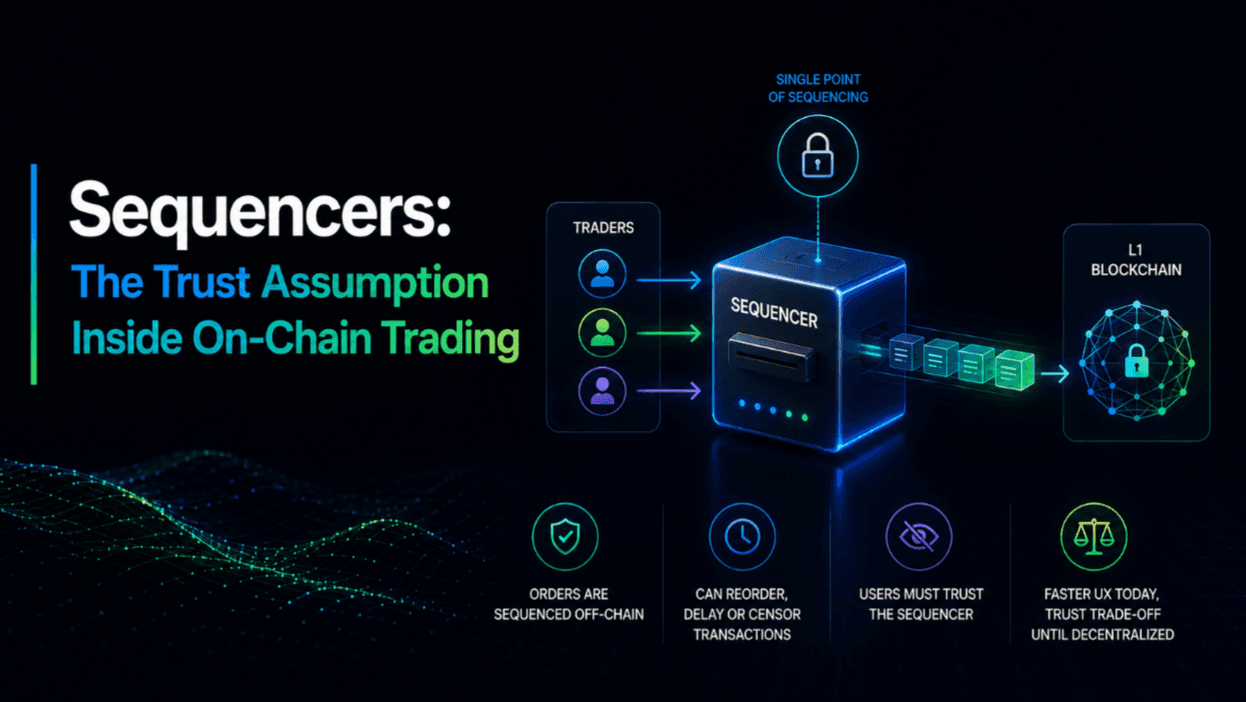
A rollup executes transactions off the base chain and posts the results to it, inheriting the base chain's security for settlement. Someone has to decide which transactions are included and in what order, and on most rollups that someone is a single operator called the sequencer, usually run by the team behind the chain.
What a sequencer can do
It can order transactions as it chooses, which is the same power that makes transaction ordering valuable anywhere — with the difference that here it belongs to one party by default rather than being contested.
It can delay or refuse to include a transaction. Not permanently, if the design includes an escape hatch, but for as long as that hatch takes to use.
It can stop entirely. A sequencer outage halts the chain: no trades, no liquidations, no withdrawals through the normal path, for the duration.
What it cannot do is forge state. It cannot take your funds or produce an invalid result, because settlement is verified against the base chain — by fraud proofs in optimistic designs or by validity proofs in others. That constraint is real and it is the reason rollups are meaningfully different from a database with an audit log.
Forced inclusion, and why it is the number that matters
Well-designed rollups let a user submit a transaction directly to the base chain, bypassing the sequencer, which must then include it within a defined window or the chain is considered invalid.
That mechanism is what turns censorship from a permanent risk into a bounded delay. Its value depends entirely on the length of the window, and the windows are long — long enough that a leveraged position can be liquidated several times over before a forced transaction lands.
So for a trader the honest reading is: your funds cannot be taken and your ability to act can be suspended for a period measured in hours. Whether that is acceptable depends on what you are holding while it happens.
Why a leveraged venue is the worst case
A sequencer outage on a chain used for payments is an inconvenience. On a leveraged trading venue it is a specific hazard, because positions continue to exist while the mechanism for managing them does not.
You cannot add margin. You cannot close. Liquidations may not execute either, which sounds protective and is not — the venue emerges from the outage with positions that should have been closed and prices that have moved, and the resulting shortfalls are exactly the ones the insurance fund and its fallbacks are for.
This is why the sequencer question belongs in a venue assessment rather than in a chain assessment. The same architecture is a minor consideration for one use and the dominant one for another.
What decentralised sequencing changes
Several designs distribute sequencing across multiple parties, so no single operator can censor or halt the chain alone.
This removes the single point of failure and adds coordination overhead, which usually costs latency — and latency is what a trading venue is optimising for. That tension is why the fastest venues tend to have the most centralised sequencing, and it is a genuine engineering trade rather than negligence.
The useful question is not whether sequencing is decentralised but whether the venue is honest about the arrangement, and whether the escape hatch works and has been tested.
- Who operates the sequencer, and is it a single party.
- Does forced inclusion via the base chain exist, and what is the window before a bypassed transaction must be included.
- What is the outage record, and how did the venue handle positions during it.
- Are proofs validity-based or fraud-based, and what is the challenge period for withdrawals.
- For a leveraged position specifically: what happens to margin calls and liquidations during a halt.
Sources
2 references- 01Optimistic rollups
ethereum.org · accessed August 22, 2026
- 02Scaling
ethereum.org · accessed August 22, 2026
Frequently asked questions
Can a sequencer steal my funds?+
No. It orders transactions but cannot produce invalid state — settlement is verified against the base chain by fraud or validity proofs. What it can do is reorder, delay, censor for a bounded period, or halt the chain entirely by going offline.
What is forced inclusion?+
A mechanism letting you submit a transaction directly to the base chain, bypassing the sequencer, which must then include it within a defined window. It converts censorship from a permanent risk into a bounded delay — and the windows are long enough that a leveraged position can be liquidated before the transaction lands.
What happens to my position during a sequencer outage?+
It continues to exist while your ability to manage it does not. You cannot add margin or close, and liquidations may not execute either — so the venue emerges with positions that should have been closed at prices that have since moved, which is how shortfalls are created.
Is decentralised sequencing better?+
It removes the single point of failure and costs latency, which is what a trading venue optimises for. That is why the fastest venues tend to have the most centralised sequencing. The more useful questions are whether the venue is honest about the arrangement and whether the escape hatch has been tested.
Written by
James ParkNFT & Web3 Gaming AnalystNFTs, Web3 Gaming, GameFi, Digital Collectibles, Creator Economy
James Park serves as the NFT & Web3 Gaming Analyst at CoinRadar Daily, where he covers the rapidly evolving worlds of blockchain gaming, digital collectibles, metaverse ecosystems, and creator-driven economies. Combining expertise in interactive media with blockchain technology, he analyzes how NFTs and decentralized gaming continue to reshape digital ownership and online communities. James earned a Master of Fine Arts in Digital Media from NYU Tisch School of the Arts, giving him a unique perspective that blends creative storytelling, digital culture, and emerging technology. Rather than viewing NFTs solely through an investment lens, he examines their broader impact on entertainment, gaming, intellectual property, and community engagement. Prior to joining CoinRadar Daily, James reported on the NFT industry and blockchain gaming for several leading digital media outlets, covering the explosive growth of the NFT market, the transition toward utility-focused collections, and the evolution of GameFi. His close relationships with independent developers, digital artists, and gaming communities allow him to identify important industry trends long before they reach mainstream attention. His reporting places particular emphasis on sustainable Web3 game design, token economies, and the long-term viability of blockchain-powered virtual worlds. James has published extensive research analyzing why certain gaming ecosystems thrive while others struggle with inflationary token models, weak player retention, or unsustainable reward structures. His market analysis is frequently referenced by blockchain startups, investors, and game studios evaluating new Web3 projects. Beyond journalism, James actively participates in NFT and decentralized creator communities while following developments in digital art, virtual economies, and next-generation gaming technologies. He also contributes educational content on blockchain gaming and regularly speaks about the future of digital ownership, helping CoinRadar Daily deliver balanced, research-driven coverage at the intersection of technology, gaming, and crypto innovation.

✓Reviewed & edited by
Olivia BennettBlockchain Security ResearcherSmart Contract Security, Audit Reports, Exploits, DeFi Hacks, White-Hat Research
Olivia Bennett is the Blockchain Security Researcher at CoinRadar Daily, where she specializes in smart contract security, DeFi risk analysis, blockchain infrastructure, and protocol vulnerabilities. Drawing on years of hands-on cybersecurity experience, she delivers in-depth reporting that explains both the technical details and the real-world implications of security incidents across the digital asset ecosystem. Before joining CoinRadar Daily, Olivia built her career in cybersecurity, working in penetration testing, blockchain security assessments, and smart contract auditing. She participated in numerous security reviews for decentralized applications and blockchain protocols, helping identify critical vulnerabilities before they could be exploited. Her responsible disclosure work has contributed to improving the security of several major DeFi projects and protecting millions of dollars in digital assets. Olivia earned a Bachelor of Science in Computer Science from the University of Edinburgh and later completed advanced professional training in offensive security and blockchain technologies. Her combination of software security expertise and blockchain knowledge enables her to provide readers with clear, evidence-based analysis of exploits, protocol upgrades, and emerging attack vectors. At CoinRadar Daily, Olivia publishes detailed investigations into blockchain exploits, smart contract audits, cross-chain security, wallet protection, and evolving cyber threats affecting the crypto industry. She is particularly committed to translating highly technical research into practical guidance that helps investors, developers, and blockchain users better understand protocol risk and security best practices. Alongside her editorial work, Olivia contributes educational resources covering secure wallet management, decentralized finance security, and blockchain infrastructure. She also participates in industry events and technical discussions focused on strengthening Web3 security standards, supporting CoinRadar Daily's mission to provide accurate, research-driven coverage of the rapidly evolving digital asset landscape.
CoinRadar Daily content is written by named analysts and checked against our editorial standards. Market data is indicative and informational only — nothing here is financial advice.
Markets services, rated
How we score →Independent, rubric-scored tables covering the services this markets coverage keeps running into.
Best Crypto Exchanges
Top rated: Kraken 8.4
Centralised venues that hold your funds while you trade.
6rated →
Best Perpetual DEXs
Top rated: GMX 7.2
On-chain leverage.
4rated →
Best Crypto Trading Tools
Top rated: TradingView 8.5
Terminals, bots, screeners and portfolio trackers.
4rated →
Keep Reading
Risk Management for Crypto Investors: Sizing and Stops
Returns get the attention, but risk management decides who survives. Here is how position sizing, stop-losses, and sensible limits keep you in the game.
James Park · May 19, 2026→
Bull vs Bear Market: The Signals Worth Watching
Telling a bull market from a bear is easy in hindsight and hard in the moment. These are the signals that help you read the broader trend without chasing noise.
Emily Volker · May 26, 2026→
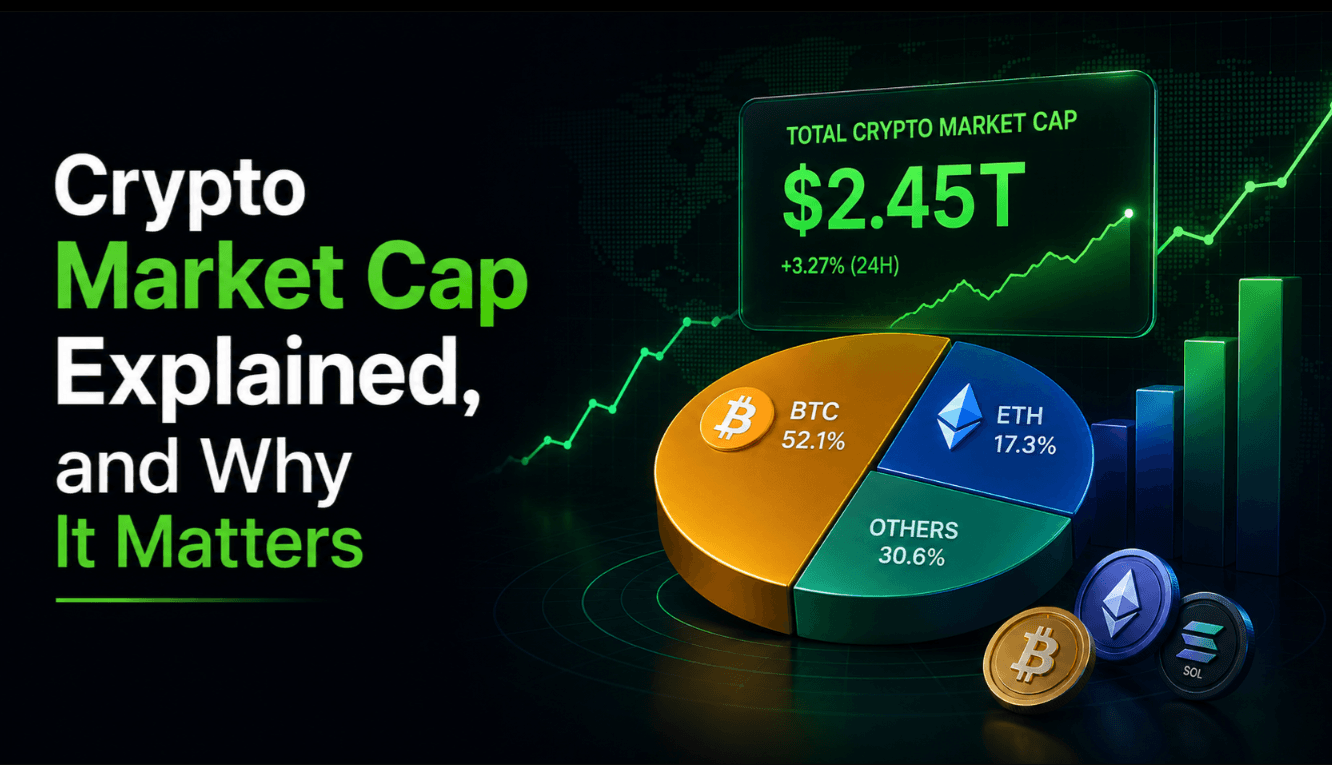
Crypto Market Cap Explained, and Why It Matters
Market cap is the headline number everyone quotes, but few use it correctly. Here is how it is calculated, what it really tells you, and where it can be misleading.
Olivia Bennett · June 1, 2026→