Transaction Simulation: What a Preview Can and Cannot Catch
The most useful safety feature in a software wallet answers a question the interface never used to: not what are you signing, but what will happen if you do. It catches the dominant loss vector, and it has blind spots worth knowing before you rely on it.

By James Park, NFT & Web3 Gaming Analyst
NFTs, Web3 Gaming, GameFi, Digital Collectibles, Creator Economy
✓ Reviewed by Olivia Bennett· Blockchain Security Researcher
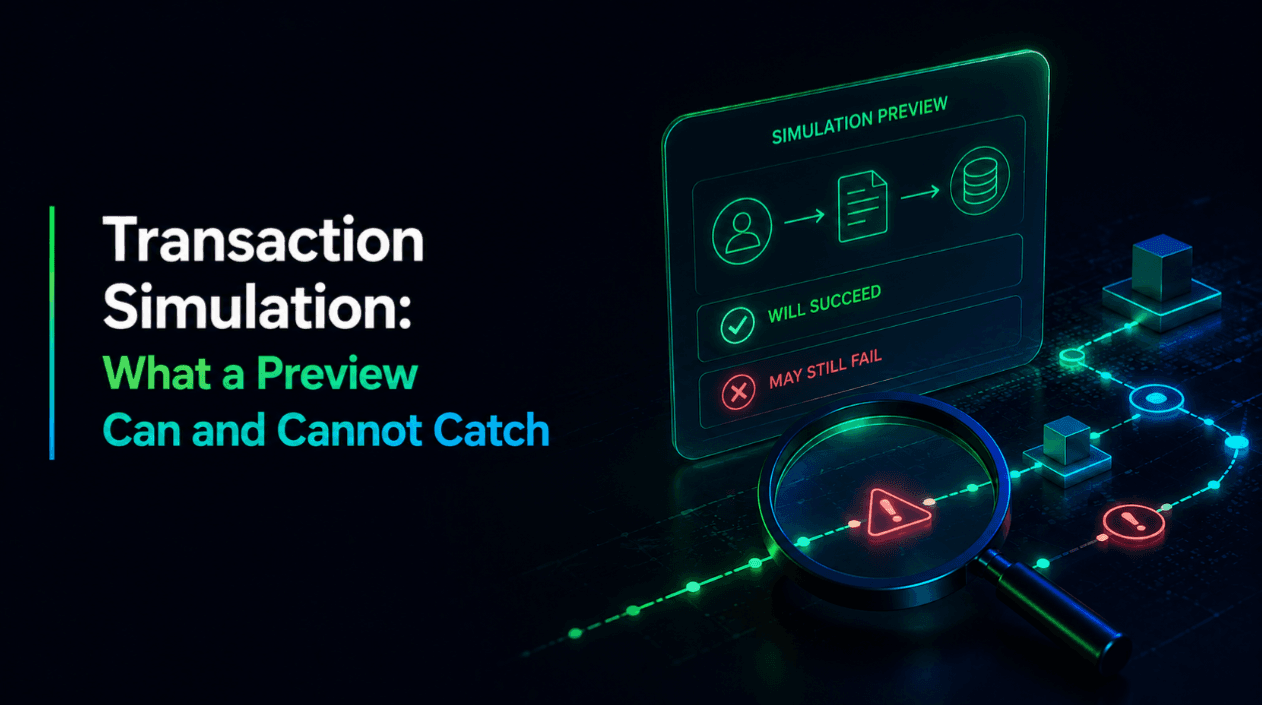
Transaction simulation executes a transaction against current chain state without broadcasting it, then reports what would change. Instead of a hex payload and a contract address, you see that your balance would fall by a specific amount and an unfamiliar address would gain it. That translation, from what you are authorising to what it does, is the single most valuable thing a wallet can put between a user and a signature.
Why it beats reading the transaction
Wallets historically showed a destination address, a value and a data blob. Every one of those is accurate and none of them answers the question the user actually has.
A contract call's meaning lives in the interaction between the payload and the contract's code, which a user cannot evaluate by inspection. A malicious approval and a legitimate one look identical at that level — both are a function call with an address and a number.
Simulation changes the question from interpretation to observation. It does not ask you to understand the call; it runs it and reports the outcome. That is a categorically easier thing for a person to check.
What it reliably catches
Drainer contracts. A transaction presented as a mint that would in fact transfer your holdings shows up as exactly that: your balance down, an unknown address up. The mismatch between what you expected and what is shown is the alarm.
Unexpected approvals. A simulation that reports a new unlimited allowance being granted to an address, when you believed you were claiming a token, surfaces the mechanism described in every guide about approval drains at the moment it is still preventable.
Wrong-asset and wrong-amount errors. Ordinary mistakes — the wrong token, a decimal misplaced, the wrong recipient — are visible in the projected outcome even when the transaction is entirely legitimate.
Known-malicious counterparties. Most implementations pair simulation with reputation data, so an address already associated with drains is flagged regardless of what the simulation shows.
Where it does not help
State-dependent behaviour. A contract can behave differently depending on when it is called, who calls it, or what the chain state is at execution. A simulation runs against state at the moment of preview, and a transaction that lands in a different state can do something else. Contracts written specifically to pass simulation and behave differently on execution are a known technique.
Delayed effects. Simulation reports the immediate result. A transaction whose damage arrives later — granting a role, setting a parameter, queuing an action for execution after a delay — shows a benign immediate outcome because the immediate outcome is benign.
Off-chain signatures. Signing a message is not a transaction, so there is nothing to simulate in the ordinary sense. Some tokens allow allowances to be granted this way, and a simulation-first wallet is weakest exactly where users are most conditioned to click through.
Everything outside the chain. If you are being socially engineered into a transaction that does precisely what you intended, simulation confirms it accurately and you still lose the funds.
How to use it well
The value is in the comparison, not the display. A simulation you glance at is decoration; a simulation you check against what you expected is a control.
Form the expectation before you open the preview — I am swapping this for that, I should end up with roughly this much — and then read the projection against it. Any difference, including one you cannot explain rather than one that looks wrong, is a reason to stop.
- Decide what you expect the transaction to do before you look at the simulation.
- Treat an unexplained difference as a stop, not as something to reason around.
- Give message signing the same scrutiny as transactions, since it is the gap in the model.
- Do not treat a clean simulation as permission to interact with an unknown contract — it reports outcomes, not intentions.
- Prefer wallets where simulation is on by default rather than a feature you must find.
Simulation is the largest single improvement in retail wallet safety available, and it is a control rather than a guarantee. The distinction matters most for people who, having installed it, stop reading.
Sources
2 references- 01Security
ethereum.org · accessed August 22, 2026
- 02EIP-2612: Permit — signed approvals
Ethereum Improvement Proposals · accessed August 22, 2026
Frequently asked questions
What does transaction simulation do?+
It executes the transaction against current chain state without broadcasting it and shows the balance changes that would result. Instead of asking you to interpret a contract call, it shows you the outcome — which is a much easier thing for a person to check against what they expected.
Does simulation make a wallet safe?+
It closes the dominant loss vector, which is approving something that does not do what you thought. It cannot catch state-dependent contracts written to behave differently on execution, delayed effects that look benign immediately, or off-chain message signing. It is a strong control, not a guarantee.
Why does message signing slip past it?+
Because a signature is not a transaction, so there is no execution to simulate. Some tokens allow allowances to be granted by signed message rather than by transaction, which means a permission can be given without a transaction confirmation appearing at all.
How should I actually use the preview?+
Form your expectation first — what you think the transaction will do — then read the projection against it. The value is in the comparison. A difference you cannot explain is a reason to stop, even if nothing about it looks obviously wrong.
Written by
James ParkNFT & Web3 Gaming AnalystNFTs, Web3 Gaming, GameFi, Digital Collectibles, Creator Economy
James Park serves as the NFT & Web3 Gaming Analyst at CoinRadar Daily, where he covers the rapidly evolving worlds of blockchain gaming, digital collectibles, metaverse ecosystems, and creator-driven economies. Combining expertise in interactive media with blockchain technology, he analyzes how NFTs and decentralized gaming continue to reshape digital ownership and online communities. James earned a Master of Fine Arts in Digital Media from NYU Tisch School of the Arts, giving him a unique perspective that blends creative storytelling, digital culture, and emerging technology. Rather than viewing NFTs solely through an investment lens, he examines their broader impact on entertainment, gaming, intellectual property, and community engagement. Prior to joining CoinRadar Daily, James reported on the NFT industry and blockchain gaming for several leading digital media outlets, covering the explosive growth of the NFT market, the transition toward utility-focused collections, and the evolution of GameFi. His close relationships with independent developers, digital artists, and gaming communities allow him to identify important industry trends long before they reach mainstream attention. His reporting places particular emphasis on sustainable Web3 game design, token economies, and the long-term viability of blockchain-powered virtual worlds. James has published extensive research analyzing why certain gaming ecosystems thrive while others struggle with inflationary token models, weak player retention, or unsustainable reward structures. His market analysis is frequently referenced by blockchain startups, investors, and game studios evaluating new Web3 projects. Beyond journalism, James actively participates in NFT and decentralized creator communities while following developments in digital art, virtual economies, and next-generation gaming technologies. He also contributes educational content on blockchain gaming and regularly speaks about the future of digital ownership, helping CoinRadar Daily deliver balanced, research-driven coverage at the intersection of technology, gaming, and crypto innovation.

✓Reviewed & edited by
Olivia BennettBlockchain Security ResearcherSmart Contract Security, Audit Reports, Exploits, DeFi Hacks, White-Hat Research
Olivia Bennett is the Blockchain Security Researcher at CoinRadar Daily, where she specializes in smart contract security, DeFi risk analysis, blockchain infrastructure, and protocol vulnerabilities. Drawing on years of hands-on cybersecurity experience, she delivers in-depth reporting that explains both the technical details and the real-world implications of security incidents across the digital asset ecosystem. Before joining CoinRadar Daily, Olivia built her career in cybersecurity, working in penetration testing, blockchain security assessments, and smart contract auditing. She participated in numerous security reviews for decentralized applications and blockchain protocols, helping identify critical vulnerabilities before they could be exploited. Her responsible disclosure work has contributed to improving the security of several major DeFi projects and protecting millions of dollars in digital assets. Olivia earned a Bachelor of Science in Computer Science from the University of Edinburgh and later completed advanced professional training in offensive security and blockchain technologies. Her combination of software security expertise and blockchain knowledge enables her to provide readers with clear, evidence-based analysis of exploits, protocol upgrades, and emerging attack vectors. At CoinRadar Daily, Olivia publishes detailed investigations into blockchain exploits, smart contract audits, cross-chain security, wallet protection, and evolving cyber threats affecting the crypto industry. She is particularly committed to translating highly technical research into practical guidance that helps investors, developers, and blockchain users better understand protocol risk and security best practices. Alongside her editorial work, Olivia contributes educational resources covering secure wallet management, decentralized finance security, and blockchain infrastructure. She also participates in industry events and technical discussions focused on strengthening Web3 security standards, supporting CoinRadar Daily's mission to provide accurate, research-driven coverage of the rapidly evolving digital asset landscape.
CoinRadar Daily content is written by named analysts and checked against our editorial standards. Market data is indicative and informational only — nothing here is financial advice.
Bitcoin services, rated
How we score →Independent, rubric-scored tables covering the services this bitcoin coverage keeps running into.
Best Hardware Wallets
Top rated: Trezor Safe 5 8.6
Devices whose only job is to keep a key away from the internet.
5rated →
Best Crypto Wallets
Top rated: Rabby 8.3
Software wallets for everyday use.
5rated →
Best Crypto Exchanges
Top rated: Kraken 8.4
Centralised venues that hold your funds while you trade.
6rated →
Keep Reading
Bitcoin Self-Custody: Hardware Wallets, Seed Phrases & Security
Self-custody means holding your own keys. Here is how hardware wallets and seed phrases protect Bitcoin, and the security habits that prevent loss.
James Park · May 25, 2026→
What Is a Spot Bitcoin ETF and How Does It Work?
A spot Bitcoin ETF holds actual bitcoin and lets investors gain exposure through a brokerage account. Here is how it works and what you give up.
Emily Volker · June 1, 2026→

Bitcoin vs Gold: Which Is the Better Store of Value?
Bitcoin is often called digital gold, but the two assets store value very differently. Here is how they compare on scarcity, volatility, and risk.
Olivia Bennett · June 5, 2026→