Best Crypto Exchanges
Top rated: Kraken 8.6
Centralised venues that hold your funds while you trade.
6rated →
Liquidity is the quiet force behind how smoothly crypto trades fill and how violently prices can move. Here is why it deserves more attention.

By Olivia Bennett, Blockchain Security Researcher
Smart Contract Security, Audit Reports, Exploits, DeFi Hacks, White-Hat Research
✓ Reviewed by James Park
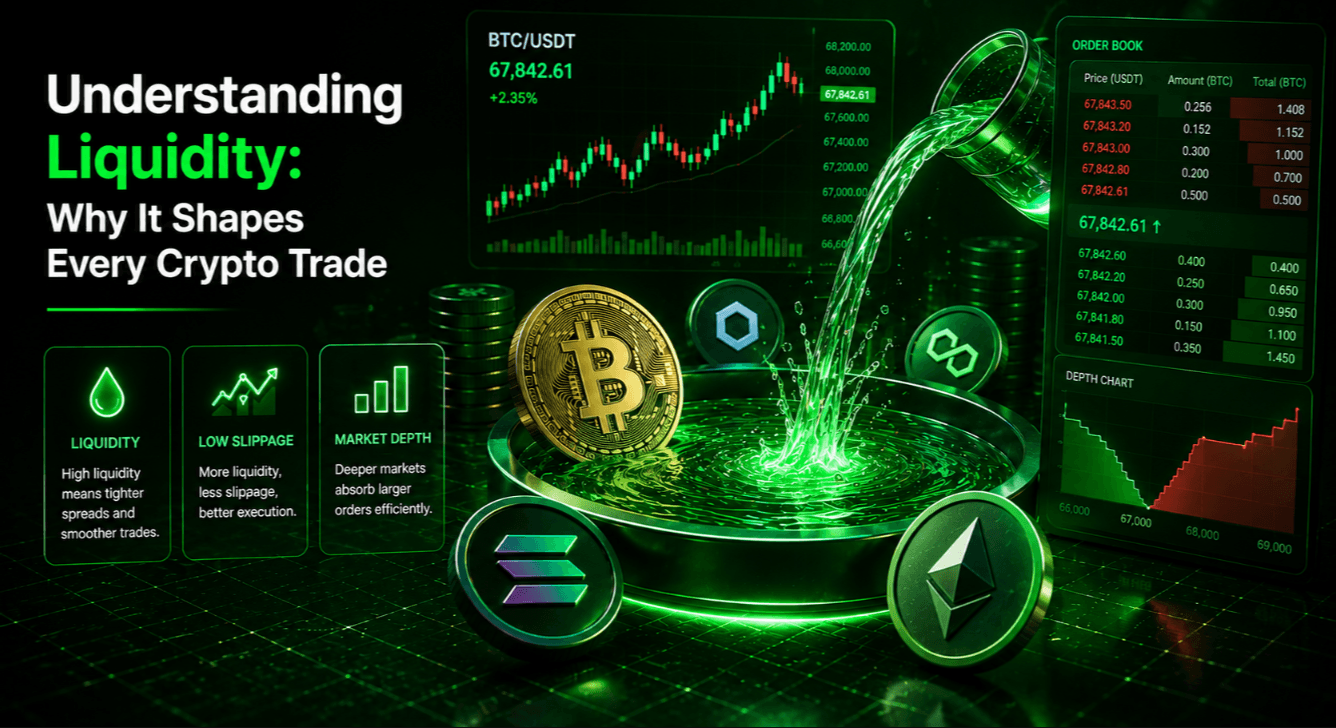
Liquidity describes how easily an asset can be bought or sold without significantly moving its price, and it is one of the most underappreciated factors in crypto. A deeply liquid market absorbs large orders with little disturbance, while a thin one can lurch on relatively modest trades. Understanding liquidity helps explain why some assets feel stable and others swing wildly on news that should barely register.
In practical terms, liquidity reflects the depth of buy and sell orders sitting in the market. When the order book is deep, there are plenty of willing counterparties at prices close to the current level, so trades fill smoothly. When it is shallow, even a moderately sized order has to reach further into the book to be filled, pushing the price as it goes. That gap between the expected and actual fill price is known as slippage.
Thin liquidity and high volatility tend to travel together. In a shallow market, there are simply fewer orders to absorb pressure, so the same flow of buying or selling produces a larger price reaction. This is a common reason smaller assets move so dramatically: it does not always take large amounts of capital to swing them, only a market with little depth. Liquidity can also evaporate precisely when it is most needed, during periods of stress, which makes sharp moves worse.
Liquidity matters most when you actually need to transact. An asset that looks attractive on paper can be costly to enter or exit if its market is thin, and that cost is easy to underestimate until you face it. Paying attention to how deep and active a market is can be as important as any view on the asset itself.
This explainer is general information, not financial advice. Liquidity conditions change over time and vary widely between assets, so consider them as part of your own research rather than relying on any single snapshot.
Written by
Olivia BennettBlockchain Security ResearcherOlivia Bennett is the Blockchain Security Researcher at CoinRadar Daily, where she specializes in smart contract security, DeFi risk analysis, blockchain infrastructure, and protocol vulnerabilities. Drawing on years of hands-on cybersecurity experience, she delivers in-depth reporting that explains both the technical details and the real-world implications of security incidents across the digital asset ecosystem. Before joining CoinRadar Daily, Olivia built her career in cybersecurity, working in penetration testing, blockchain security assessments, and smart contract auditing. She participated in numerous security reviews for decentralized applications and blockchain protocols, helping identify critical vulnerabilities before they could be exploited. Her responsible disclosure work has contributed to improving the security of several major DeFi projects and protecting millions of dollars in digital assets. Olivia earned a Bachelor of Science in Computer Science from the University of Edinburgh and later completed advanced professional training in offensive security and blockchain technologies. Her combination of software security expertise and blockchain knowledge enables her to provide readers with clear, evidence-based analysis of exploits, protocol upgrades, and emerging attack vectors. At CoinRadar Daily, Olivia publishes detailed investigations into blockchain exploits, smart contract audits, cross-chain security, wallet protection, and evolving cyber threats affecting the crypto industry. She is particularly committed to translating highly technical research into practical guidance that helps investors, developers, and blockchain users better understand protocol risk and security best practices. Alongside her editorial work, Olivia contributes educational resources covering secure wallet management, decentralized finance security, and blockchain infrastructure. She also participates in industry events and technical discussions focused on strengthening Web3 security standards, supporting CoinRadar Daily's mission to provide accurate, research-driven coverage of the rapidly evolving digital asset landscape.
✓ Reviewed & edited by James Park
CoinRadar Daily Newsroom · Published June 19, 2026 · Informational, not financial advice.
Independent, rubric-scored tables covering the services this markets coverage keeps running into.
Top rated: Kraken 8.6
Centralised venues that hold your funds while you trade.
6rated →
Top rated: Hyperliquid 8.3
On-chain leverage.
5rated →
Top rated: DefiLlama 8.7
Terminals, bots, screeners and portfolio trackers.
4rated →