Best Stablecoins
Top rated: USDC 8.4
A stablecoin is a promise about redemption.
4rated →
Borrowed from banking, the travel rule pushes crypto firms to exchange identifying information on transfers. We explain the mechanics and the friction it creates.

By Olivia Bennett, Blockchain Security Researcher
Smart Contract Security, Audit Reports, Exploits, DeFi Hacks, White-Hat Research
✓ Reviewed by James Park
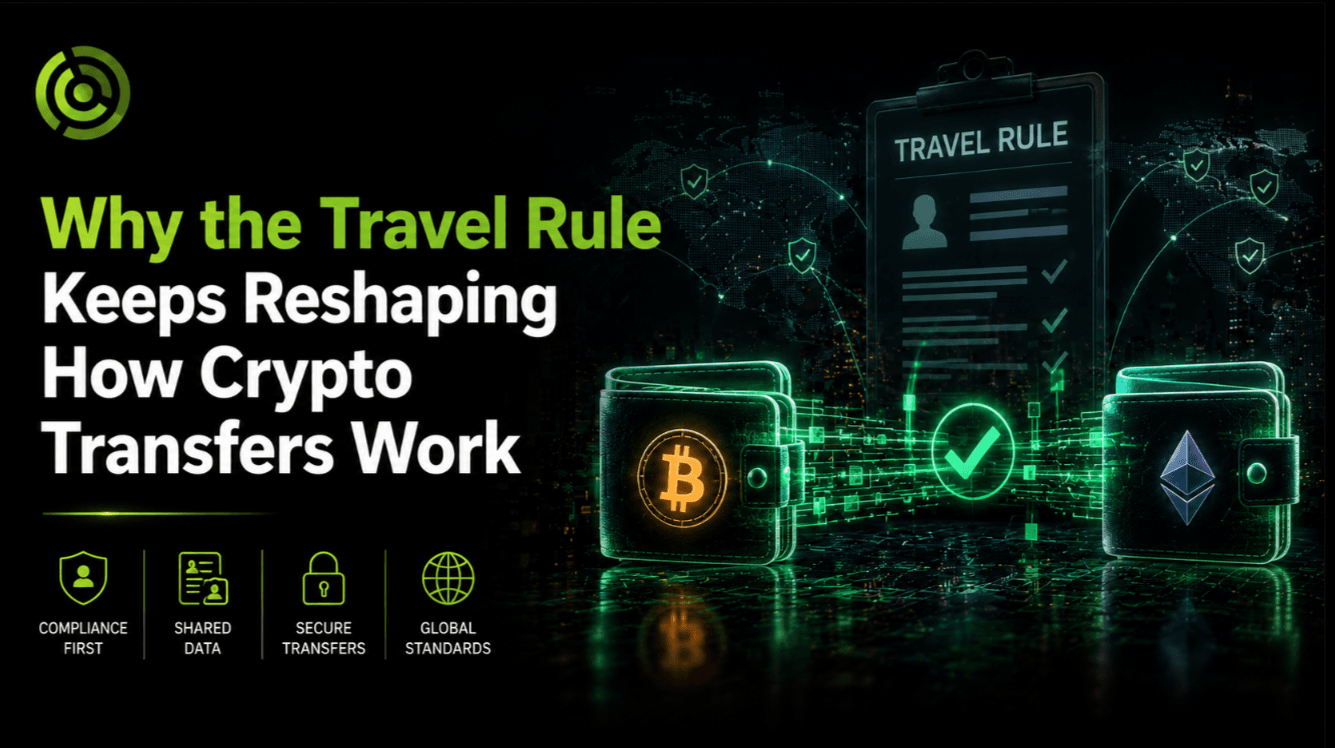
The travel rule is one of the clearest examples of traditional financial regulation being grafted onto crypto. In essence, it asks businesses that move value for customers to pass identifying information about the sender and recipient alongside a transfer above a set threshold, much as a bank attaches details to a wire. The idea is to make illicit funds harder to move anonymously through the regulated system. As the rule spreads across jurisdictions, it keeps reshaping how exchanges and custodians handle the transfers users take for granted. This is a general explainer and not legal advice; the exact obligations vary by country.
At its core, the travel rule obliges the firm sending a transfer to collect and share certain information with the firm receiving it. Typically that includes details identifying both parties, so that each regulated business has a record of who is on the other side of a transaction.
Because the requirement attaches to the businesses rather than the underlying tokens, it tends to apply regardless of which asset is moving. That is why it has become a baseline expectation for licensed exchanges in many markets.
Banks have spent decades building standardized messaging for sharing this kind of information. Crypto had no equivalent at the outset, so firms have had to adopt shared protocols to exchange data reliably and securely. Self-custody adds another wrinkle: when a transfer goes to a private wallet with no firm on the other end, there is no counterpart institution to receive the information, which forces firms to handle those cases differently.
For everyday users, the rule mostly shows up as additional checks when sending larger amounts through a regulated platform, and occasionally as questions about the destination of a withdrawal. It does not change what happens on the underlying blockchain, but it does shape what licensed firms ask of you. Treat the specifics as jurisdiction-dependent, and confirm a platform's current process directly rather than assuming it matches another country's approach.
Written by
Olivia BennettBlockchain Security ResearcherOlivia Bennett is the Blockchain Security Researcher at CoinRadar Daily, where she specializes in smart contract security, DeFi risk analysis, blockchain infrastructure, and protocol vulnerabilities. Drawing on years of hands-on cybersecurity experience, she delivers in-depth reporting that explains both the technical details and the real-world implications of security incidents across the digital asset ecosystem. Before joining CoinRadar Daily, Olivia built her career in cybersecurity, working in penetration testing, blockchain security assessments, and smart contract auditing. She participated in numerous security reviews for decentralized applications and blockchain protocols, helping identify critical vulnerabilities before they could be exploited. Her responsible disclosure work has contributed to improving the security of several major DeFi projects and protecting millions of dollars in digital assets. Olivia earned a Bachelor of Science in Computer Science from the University of Edinburgh and later completed advanced professional training in offensive security and blockchain technologies. Her combination of software security expertise and blockchain knowledge enables her to provide readers with clear, evidence-based analysis of exploits, protocol upgrades, and emerging attack vectors. At CoinRadar Daily, Olivia publishes detailed investigations into blockchain exploits, smart contract audits, cross-chain security, wallet protection, and evolving cyber threats affecting the crypto industry. She is particularly committed to translating highly technical research into practical guidance that helps investors, developers, and blockchain users better understand protocol risk and security best practices. Alongside her editorial work, Olivia contributes educational resources covering secure wallet management, decentralized finance security, and blockchain infrastructure. She also participates in industry events and technical discussions focused on strengthening Web3 security standards, supporting CoinRadar Daily's mission to provide accurate, research-driven coverage of the rapidly evolving digital asset landscape.
✓ Reviewed & edited by James Park
CoinRadar Daily Newsroom · Published June 22, 2026 · Informational, not financial advice.
Independent, rubric-scored tables covering the services this regulation coverage keeps running into.
Top rated: USDC 8.4
A stablecoin is a promise about redemption.
4rated →
Top rated: Gnosis Pay 7.8
Spend crypto at the till.
4rated →
Top rated: Kraken 8.6
Centralised venues that hold your funds while you trade.
6rated →