Best DeFi Protocols
Top rated: Uniswap Protocol 9.0
The base layer everything else is built on.
4rated →
Total value locked is the metric most cited when DeFi rises or falls, yet it can be a noisy signal. We break down what it actually captures.

By Emily Volker, Editor-in-Chief
Editorial Strategy, Investigative Journalism, Crypto Media, E-E-A-T Standards
✓ Reviewed by James Park
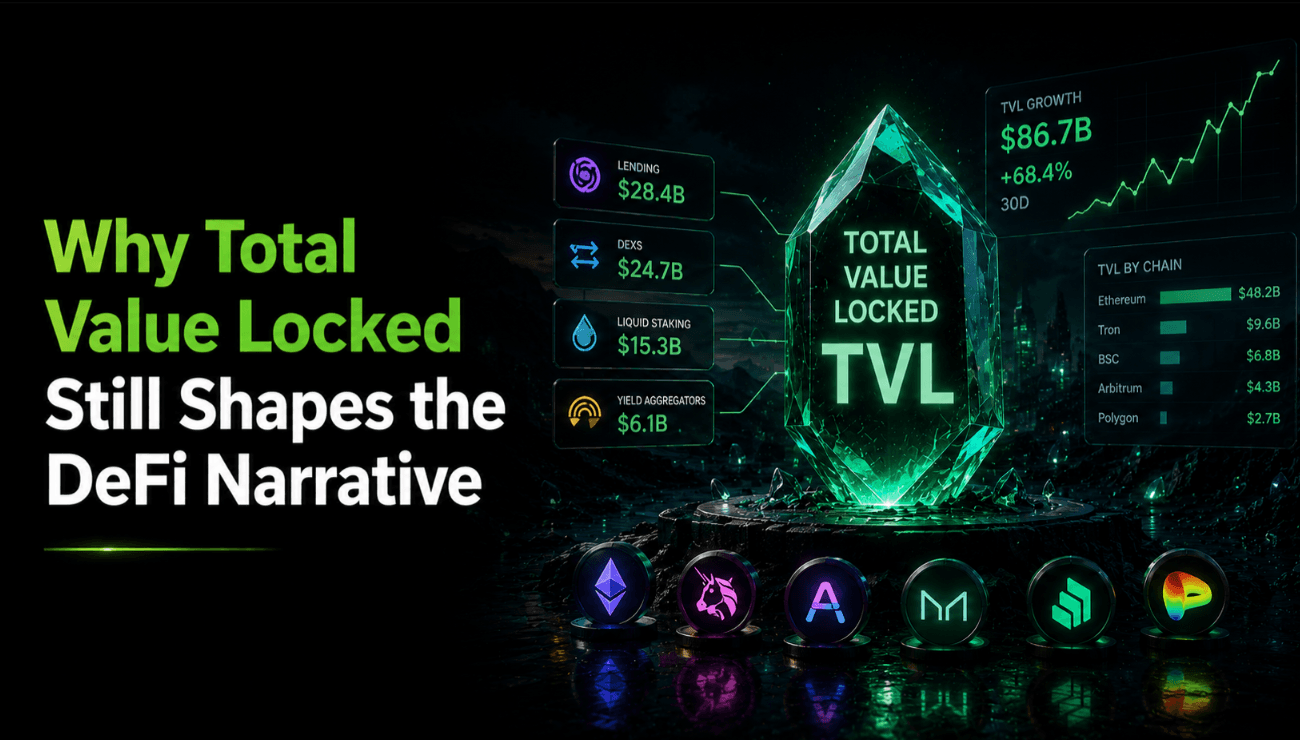
Whenever DeFi makes headlines, total value locked is usually the number doing the talking. TVL estimates the value of assets currently deposited in a protocol or across the ecosystem, and it has become shorthand for how much capital trusts decentralized finance at any moment. It is a useful gauge, but treating it as a single measure of health misses how much the figure can move for reasons that have little to do with real adoption.
At its simplest, TVL sums the assets sitting inside smart contracts: tokens supplied to lending markets, deposited into liquidity pools, or staked in various strategies. Because most of those assets are priced in dollars, the headline figure rises and falls with token prices as much as with user behavior. A sharp move in the underlying assets can swing TVL substantially even if no one deposits or withdraws a thing.
That price sensitivity is the first thing to keep in mind. When a major asset rallies, the dollar value of everything locked climbs automatically, flattering the metric. When the market falls, TVL can drop hard without any loss of confidence in the protocols themselves.
Beyond price effects, TVL can be inflated by capital that is counted more than once. In a composable ecosystem, a deposit in one protocol can be wrapped into a receipt token and redeposited elsewhere, so the same underlying value contributes to several protocols at once. Incentive programs add another layer of distortion: temporary rewards can attract capital that leaves the moment the incentives end, producing TVL that reflects subsidies rather than durable demand.
None of this makes TVL useless. It remains a reasonable starting point for gauging scale and direction, especially over longer windows. The key is to pair it with other signals: fee revenue, active users, and how sticky deposits prove to be when incentives fade. A protocol whose TVL holds steady through volatility and without heavy subsidies is telling a more convincing story than one whose chart simply tracks the broader market. Read alongside those measures, TVL becomes a helpful chapter rather than the whole book.
Written by
Emily VolkerEditor-in-ChiefEmily Volker is the Editor-in-Chief of CoinRadar Daily, where she leads a multilingual editorial team covering cryptocurrency markets, blockchain innovation, Web3, and global digital asset regulation across eight languages. With more than a decade of experience in financial and technology journalism, she has played a key role in developing high editorial standards and trusted reporting within the digital asset industry. Emily began her career as a financial journalist reporting on commodities, energy markets, and emerging technologies before discovering Bitcoin and decentralized finance in the early 2010s. She later moved to London to join one of Europe's early blockchain-focused media organizations, where she advanced into senior editorial leadership. Her experience reporting through both the rapid expansion of the 2017 ICO boom and the subsequent market correction reinforced her commitment to fact-based, research-driven journalism in an industry often influenced by speculation. She holds a Master's degree in International Journalism from City, University of London, and has completed executive studies in digital media strategy through the Reuters Institute at Oxford. Emily is a strong advocate for editorial transparency, rigorous verification, and responsible financial reporting. She also helped integrate Google's E-E-A-T principles—Experience, Expertise, Authoritativeness, and Trustworthiness—into the editorial standards followed by CoinRadar Daily. Under her leadership, CoinRadar Daily has expanded into a global cryptocurrency news platform publishing content in eight languages with a network of editors, analysts, and contributors across four continents. Emily oversees investigative reporting, editorial policy, content quality, and fact-checking processes to ensure every article meets the publication's standards for accuracy, credibility, and independence. Alongside her editorial responsibilities, Emily mentors aspiring journalists through digital media initiatives and regularly speaks at international conferences focused on journalism, fintech, blockchain technology, and digital assets, where she discusses responsible reporting, combating misinformation, and the evolving future of financial media.
✓ Reviewed & edited by James Park
CoinRadar Daily Newsroom · Published June 23, 2026 · Informational, not financial advice.
Independent, rubric-scored tables covering the services this defi coverage keeps running into.
Top rated: Uniswap Protocol 9.0
The base layer everything else is built on.
4rated →
Top rated: Uniswap 8.7
Swap venues where you never hand over your keys.
5rated →
Top rated: Aave 8.3
Borrow against your holdings, or lend them out.
4rated →