Best Liquid Staking Protocols
Top rated: Rocket Pool 8.1
Staking that hands you a tradable receipt token.
4rated →
Rather than handling all activity directly, Ethereum's base layer increasingly acts as a secure settlement anchor for the rollups built on it. The shift reframes how the network scales.

By Emily Volker, Editor-in-Chief
Editorial Strategy, Investigative Journalism, Crypto Media, E-E-A-T Standards
✓ Reviewed by James Park
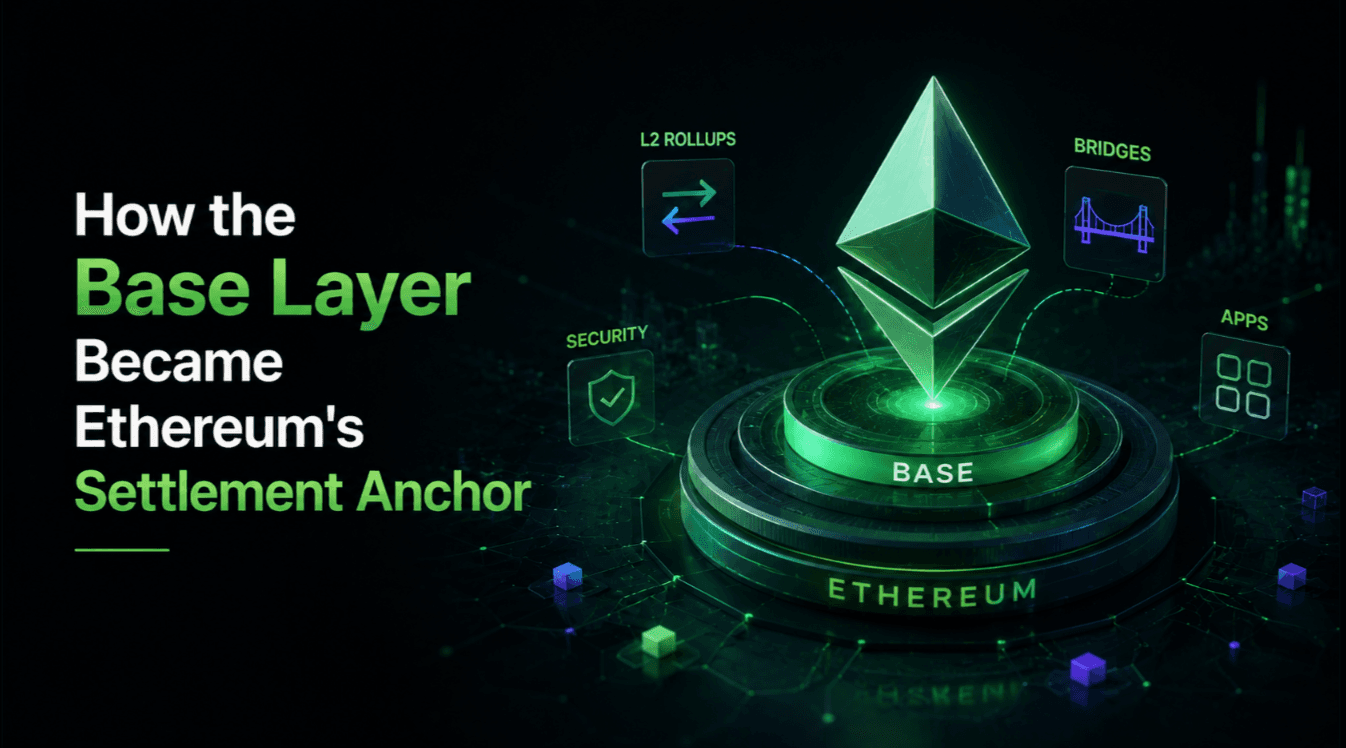
Ethereum's base layer has increasingly become a settlement anchor, meaning it secures and finalizes activity that mostly happens on rollups built above it. Instead of trying to process everything directly, the main chain focuses on what it does best, providing security and a shared source of truth, while volume moves to layers designed for scale.
Processing every transaction directly on the main chain would force all nodes to do more work, which risks pushing out smaller operators and weakening decentralization. To avoid that, Ethereum leans on rollups to handle the bulk of activity and uses its base layer to anchor the results. This keeps the core network lean while still letting the ecosystem grow.
The effect is a division of labor. Rollups supply cheap, fast capacity, and the base layer supplies the trust and finality that make that capacity meaningful.
For everyday users, this design means routine activity increasingly happens on layer-2 networks where fees are lower, while the security still traces back to Ethereum. The main chain becomes less a place you transact constantly and more a foundation the rest of the system depends on.
Treating the base layer as an anchor rather than a highway is how Ethereum scales without trading away what makes it trustworthy. — CoinRadar Daily analysis
This settlement-centric direction explains why so much development now targets the connection between the base layer and rollups rather than the base layer alone. As that relationship matures, users should see steadily cheaper activity above a core chain whose job is increasingly to be secure, neutral, and dependable.
This article is for general information only and is not financial advice. Network designs and roadmaps evolve, so confirm current details before relying on them.
Written by
Emily VolkerEditor-in-ChiefEmily Volker is the Editor-in-Chief of CoinRadar Daily, where she leads a multilingual editorial team covering cryptocurrency markets, blockchain innovation, Web3, and global digital asset regulation across eight languages. With more than a decade of experience in financial and technology journalism, she has played a key role in developing high editorial standards and trusted reporting within the digital asset industry. Emily began her career as a financial journalist reporting on commodities, energy markets, and emerging technologies before discovering Bitcoin and decentralized finance in the early 2010s. She later moved to London to join one of Europe's early blockchain-focused media organizations, where she advanced into senior editorial leadership. Her experience reporting through both the rapid expansion of the 2017 ICO boom and the subsequent market correction reinforced her commitment to fact-based, research-driven journalism in an industry often influenced by speculation. She holds a Master's degree in International Journalism from City, University of London, and has completed executive studies in digital media strategy through the Reuters Institute at Oxford. Emily is a strong advocate for editorial transparency, rigorous verification, and responsible financial reporting. She also helped integrate Google's E-E-A-T principles—Experience, Expertise, Authoritativeness, and Trustworthiness—into the editorial standards followed by CoinRadar Daily. Under her leadership, CoinRadar Daily has expanded into a global cryptocurrency news platform publishing content in eight languages with a network of editors, analysts, and contributors across four continents. Emily oversees investigative reporting, editorial policy, content quality, and fact-checking processes to ensure every article meets the publication's standards for accuracy, credibility, and independence. Alongside her editorial responsibilities, Emily mentors aspiring journalists through digital media initiatives and regularly speaks at international conferences focused on journalism, fintech, blockchain technology, and digital assets, where she discusses responsible reporting, combating misinformation, and the evolving future of financial media.
✓ Reviewed & edited by James Park
CoinRadar Daily Newsroom · Published June 20, 2026 · Informational, not financial advice.
Independent, rubric-scored tables covering the services this ethereum coverage keeps running into.
Top rated: Rocket Pool 8.1
Staking that hands you a tradable receipt token.
4rated →
Top rated: Figment 8.1
Services that stake on your behalf.
5rated →
Top rated: Uniswap Protocol 9.0
The base layer everything else is built on.
4rated →