Best Liquid Staking Protocols
Top rated: Rocket Pool 8.1
Staking that hands you a tradable receipt token.
4rated →
Smart contracts are what make Ethereum programmable, but flawed code remains one of the ecosystem's defining risks. Understanding why helps users interact with applications more safely.

By Olivia Bennett, Blockchain Security Researcher
Smart Contract Security, Audit Reports, Exploits, DeFi Hacks, White-Hat Research
✓ Reviewed by James Park
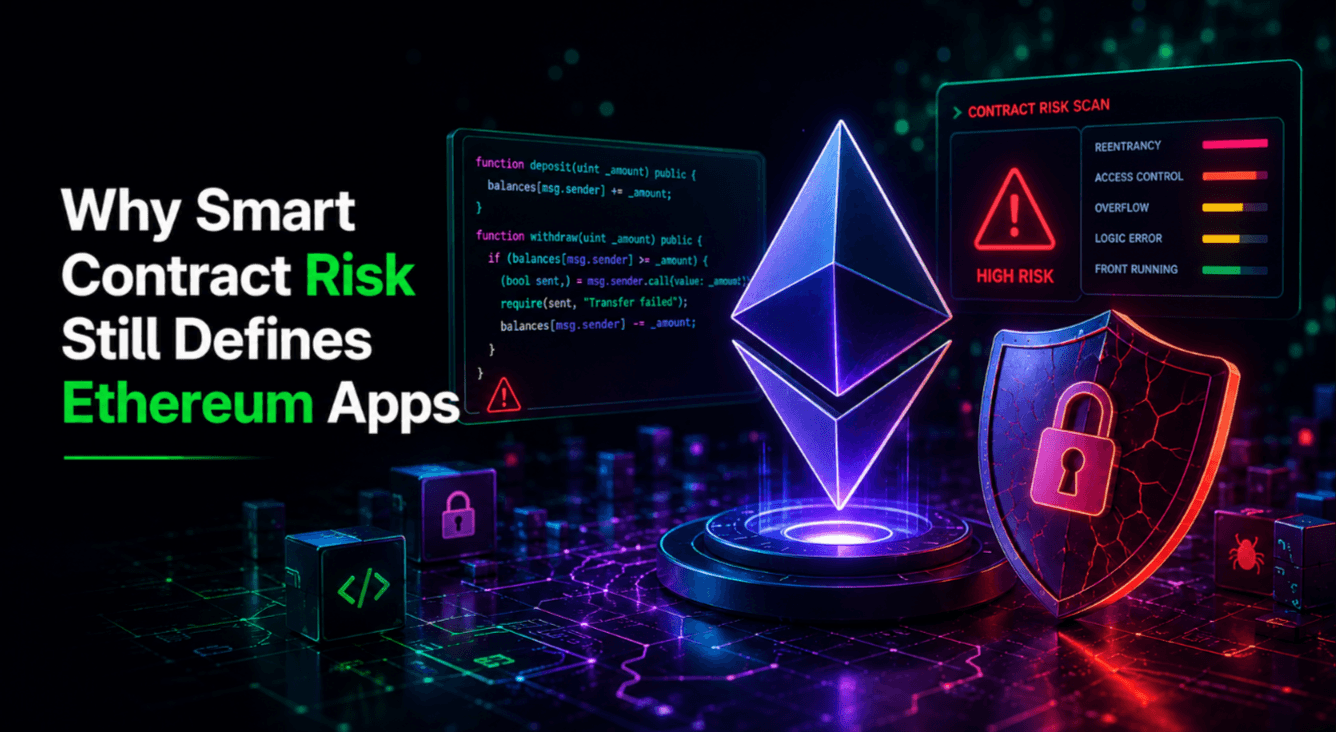
Smart contract risk still defines Ethereum applications because the same code that makes them powerful also runs exactly as written, flaws included. When a contract has a bug or a design weakness, there is often no central operator to step in and reverse the outcome, which is why this risk remains one of the most important things users should understand.
A smart contract executes automatically once its conditions are met. That predictability is the point, but it cuts both ways: if the logic is flawed, the contract will still do exactly what its code says. Because applications often build on top of one another, a problem in one contract can ripple into others that depend on it.
This is different from traditional software, where a company can quietly patch or roll back a mistake. On a public blockchain, the rules are enforced by the network, so errors can be costly and hard to undo.
Users cannot eliminate smart contract risk, but they can manage it. Favoring well-established applications, paying attention to whether code has been reviewed, and understanding exactly what they are approving all reduce the chance of an unpleasant surprise. Starting with small amounts when trying something new is a simple, effective habit.
The strength of a smart contract and its danger are the same trait: it does precisely what the code says, with no one to overrule it. — CoinRadar Daily analysis
As more value flows through Ethereum applications, the quality and security of their code grow more important. The ecosystem has responded with more rigorous review and tooling, but the underlying lesson for users stays the same: programmable money rewards caution. Treating each new contract as something to understand rather than blindly trust is the most reliable defense.
This article is for general information only and is not financial advice. Interacting with smart contracts carries risk, including loss of funds, so research applications carefully before use.
Written by
Olivia BennettBlockchain Security ResearcherOlivia Bennett is the Blockchain Security Researcher at CoinRadar Daily, where she specializes in smart contract security, DeFi risk analysis, blockchain infrastructure, and protocol vulnerabilities. Drawing on years of hands-on cybersecurity experience, she delivers in-depth reporting that explains both the technical details and the real-world implications of security incidents across the digital asset ecosystem. Before joining CoinRadar Daily, Olivia built her career in cybersecurity, working in penetration testing, blockchain security assessments, and smart contract auditing. She participated in numerous security reviews for decentralized applications and blockchain protocols, helping identify critical vulnerabilities before they could be exploited. Her responsible disclosure work has contributed to improving the security of several major DeFi projects and protecting millions of dollars in digital assets. Olivia earned a Bachelor of Science in Computer Science from the University of Edinburgh and later completed advanced professional training in offensive security and blockchain technologies. Her combination of software security expertise and blockchain knowledge enables her to provide readers with clear, evidence-based analysis of exploits, protocol upgrades, and emerging attack vectors. At CoinRadar Daily, Olivia publishes detailed investigations into blockchain exploits, smart contract audits, cross-chain security, wallet protection, and evolving cyber threats affecting the crypto industry. She is particularly committed to translating highly technical research into practical guidance that helps investors, developers, and blockchain users better understand protocol risk and security best practices. Alongside her editorial work, Olivia contributes educational resources covering secure wallet management, decentralized finance security, and blockchain infrastructure. She also participates in industry events and technical discussions focused on strengthening Web3 security standards, supporting CoinRadar Daily's mission to provide accurate, research-driven coverage of the rapidly evolving digital asset landscape.
✓ Reviewed & edited by James Park
CoinRadar Daily Newsroom · Published June 18, 2026 · Informational, not financial advice.
Independent, rubric-scored tables covering the services this ethereum coverage keeps running into.
Top rated: Rocket Pool 8.1
Staking that hands you a tradable receipt token.
4rated →
Top rated: Figment 8.1
Services that stake on your behalf.
5rated →
Top rated: Uniswap Protocol 9.0
The base layer everything else is built on.
4rated →